


Investor’s Business Daily
As we’ve noted, 2008 has been a year of records for cold and snowfall and may indeed be the coldest year of the 21st century thus far. In the U.S., the National Oceanic and Atmospheric Administration registered 63 local snowfall records and 115 lowest-ever temperatures for the month of October. Global thermometers stopped rising after 1998, and have plummeted in the last two years by more than 0.5 degrees Celsius. The 2007-2008 temperature drop was not predicted by global climate models.
But it was predictable by a decline in sunspot activity since 2000. When the sun is active, it’s not uncommon to see sunspot numbers of 100 or more in a single month. Every 11 years, activity slows, and numbers briefly drop near zero. Normally sunspots return very quickly, as a new cycle begins. But this year, the start of a new cycle, the sun has been eerily quiet. The first seven months averaged a sunspot count of only three and in August there were no sunspots at all - zero - something that has not occurred since 1913. According to the publication Daily Tech, in the past 1,000 years, three previous such events - what are called the Dalton, Maunder and Sporer Minimums - have all led to rapid cooling. One was large enough to be called the Little Ice Age (1500-1750).
The Little Ice Age has been a problem for global warmers because it serves as a reminder of how the earth warms and cools naturally over time. It had to be ignored in the calculations that produced the infamous and since-discredited hockey stick graph that showed a sharp rise in warming alleged to be caused by man. The answer to this dilemma has supposedly been found by two Stanford researchers, Richard Nevle and Dennis Bird, who announced their “findings” at the annual meeting of the American Geophysical Union in San Francisco. According to them, man not only is causing contemporary warming. He also caused the cooling that preceded it.
According to Bird and Nevle, before Columbus ruined paradise, native Americans had deforested a significant portion of the continent and converted the land to agricultural purposes. Less CO2 was then absorbed from the atmosphere, and the earth was toasty. Then a bunch of nasty old white guys arrived and depopulated the native populations through war and the diseases they brought with them. This led to the large-scale abandonment of agricultural lands. The subsequent reforestation of the continent caused temperatures to drop enough to bring on the Little Ice Age.
In a speech at Harvard last November, Harvard physicist John Holden, President-elect Obama’s choice to be his science adviser as director of the White House Office of Science and Technology, presented a “top 10” list of warming solutions. Topping the list was “limiting population,” as if man was a plague upon the earth. This is a major tenet of green dogma that bemoans the fact that the pestilence called mankind comes with cars, factories and overconsumption of fossil fuels and other resources. Read more here
By Roger Pielke Sr., Climate Science
Thanks to Andrew Forster of Local Transport Today in the UK for alerting us to the erroneous news article from the Times on December 27 2008 titled:
The war on carbon - Arguments of 2009: Can Copenhagen save the planet?
An excerpt reads: “The stakes at Copenhagen could not be much higher. Global surface temperatures have risen by a tolerable three quarters of a degree celsius over the past century, but the rate of increase is accelerating. The Kyoto Protocol has had negligible impact on greenhouse gas emissions, and projections for the mean global temperature rise in the next century range from 1.1 to 6.4 degrees. Whether fast or very fast, the Earth is heating up.
There will be continued argument about the science of climate change over the next 12 months, but not, except on the conspiratorial fringe, about the threat. Climate change is real and worsening, and there is an overwhelming likelihood that much of it is man-made.”
This is a erroneous report on the climate system! The rate of increase is NOT accelerating. There is absolutely no question that global warming has stopped for at least 4 years (using upper ocean data) ; e.g see: Pielke Sr., R.A., 2008: A broader view of the role of humans in the climate system. Physics Today, 61, Vol. 11, 54-55 and over 7 years using lower tropospheric data (MSU Lower tropospheric monthly anomalies since 2002)
Larger image here.
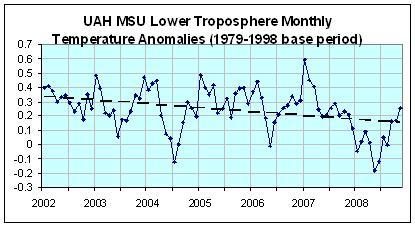
With respect to the surface temperature trends [which have a warm bias in any case, as we have documented in our peer review papers; e.g. see], a good set of analyses on this subject has been posted over the last few years at http://rankexploits.com/musings/ [you should scroll back over the last several months to view; it is an excellent comparison with model predictions]. As discussed on that website, even with the warm biased global average surface temperature trends, the models have over-predicted warming. The GISS data itself even shows recent cooling in the ocean sea surface temperatures [see their figure for Monthly-Mean Global Sea Surface Temperature; where it has cooled since 2002.
The writers of the Time article, and other journalists who write similar misinformation, damage the liklihood of responsible environmental actions as a result of their overstatement and erroneous communication to the public and policymakers of climate science. Read post here.
By Tom Nelson Blogspot
If Eilperin wasn’t a fool or wasn’t deliberately trying to mislead us, she’d put the alleged 48 cubic miles in context of the enormous size of those ice sheets.
If they really were shrinking at 48 cubic miles per year, it would take over 1,600 years for them to lose one percent of the Greenland + Antarctic estimated sum of about 7.8 million cubic miles.
She notes “In one of the report’s most worrisome findings, the agency estimates that in light of recent ice sheet melting, global sea level rise could be as much as four feet by 2100. The IPCC had projected a sea level rise of no more than 1.5 feet by that time, but satellite data over the past two years show the world’s major ice sheets are melting much more rapidly than previously thought. The Antarctic and Greenland ice sheets are now losing an average of 48 cubic miles of ice a year, equivalent to twice the amount of ice that exists in the Alps.”
ANTARCTICA
Volume of Antarctica’s Ice Cap, 1974 estimate: Antarctica’s approximately 6,000,000 cubic miles of ice.
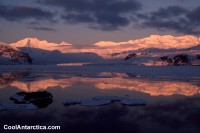
2001 estimate - CBS News: Antarctica contains about 7.2 million cubic miles of ice, about 84 percent of all the glacial ice on Earth, according to the USGS.
East Antarctic Ice Sheet Gains Mass and Slows Sea Level Rise, Study Finds: From 1992 to 2003, Curt Davis, MU professor of electrical and computer engineering, and his team of researchers observed 7.1 million kilometers of the ice sheet, using satellites to measure changes in elevation. They discovered that the ice sheet’s interior was gaining mass by about 45 billion tons per year, which was enough to slow sea level rise by .12 millimeters per year. The interior of the ice sheet is the only large terrestrial ice body that is likely gaining mass rather than losing it, Davis said.
GREENLAND
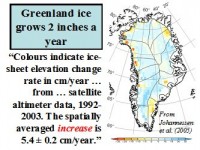
A conservative estimate of annual ice loss from Greenland is 50 cubic kilometers (12 cubic miles) per year, enough water to raise the global sea level by 0.13 millimeters a year. 1974 estimate, Volume of Greenland’s ice cap:The Greenland ice cap with its volume of 630,000 cubic miles. Estimate as of Today The Greenland Ice Sheet holds 2.95 × 10⁶ cubic kilometers (706,000 cubic miles) of ice
See larger image here
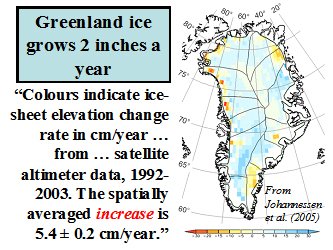
See Tom’s full blog post here. See Marc Morano’s email to Juliet Eilperin here.
By Amalendu Kundu, TNN
GANGTOK: A trip to the snow-laden Changu Lake turned into a nightmare for more than 3,500 tourists including hundreds of children on Friday. They were trapped in snowstorm conditions with the temperature dipping to minus 15 degrees at a killing altitude of 13,300 feet before the army pulled them to safety.
The majority of those trapped were from Bengal. Hundreds fell ill, shivering in the icy cold as their vehicles remained stranded near Changu and Baba Mandir for hours. Clad in just jackets and scarves, the holidayers were hardly prepared, mentally or physically, to encounter a blizzard.
The army rescued them and took them to military camps, where warm soup and loads of blankets helped revive most of them. Many had to be admitted to the army medical units for treatment.
In the morning, there was little indication of what was to come. Tourists flocked to the Changu Lake by the hundreds as they do every day. With winter setting in, there was the added attraction of seeing the lake under glittering snow-covered peaks. The tourists got more than what they had asked for.
It started with a heavy shower. The temperature plummeted sharply. The skies seemed to turn clear for a moment but suddenly, heavy snowfall started near the India-China border, 35 km from Gangtok. Roads went under a couple of feet of snow in no time. Over 450 vehicles were immediately trapped.
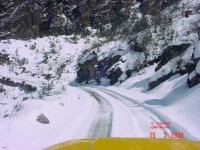
Local guides assured them that the weather would clear up, but it only got worse. More snow fell. More vehicles got stranded in the higher reaches. What compounded the torture was wind chill. With the mercury dropping to minus 10 and continuing southward, the wind picked up, cutting into exposed skin, finding its way past windscreens, locked car doors and inside jackets. (Road shown in snow in 2006 below)
The administration sent an SOS to the army that has several camps in the area. Unit 17 of the army’s elite mountain division swung into action. Aided by the Indo-Tibetan Border Police, Border Roads Organization and local police, they rescued around 1,500 tourists from 230 vehicles. Many had to be rushed for treatment while the rest were given shelter in the army camps.
Allan M R. MacRae
Following is an excerpt from an article written by Dr. Sallie Baliunas (Harvard U Astrophysicist), Dr. Tim Patterson (Carleton U Paleoclimatologist) and me in 2002. The world is now entering a ~30-year cooling phase , and the Kyoto Protocol is in disrepute. Our list of fatal flaws in Kyoto has proven to be remarkably accurate.
THE KYOTO ACCORD - POINT AND COUNTERPOINT
Excerpt:
Kyoto has many fatal flaws, any one of which should cause this treaty to be scrapped. Climate science does not support the theory of catastrophic human-made global warming - the alleged warming crisis does not exist. Kyoto focuses primarily on reducing CO2, a relatively harmless gas, and does nothing to control real air pollution like NOx, SO2, and particulates, or serious pollutants in water and soil.
Kyoto wastes enormous resources that are urgently needed to solve real environmental and social problems that exist today. For example, the money spent on Kyoto in one year would provide clean drinking water and sanitation for all the people of the developing world in perpetuity.
Kyoto will destroy hundreds of thousands of jobs and damage the Canadian economy - the U.S., Canada’s biggest trading partner, will not ratify Kyoto, and developing countries are exempt. Kyoto will actually hurt the global environment - it will cause energy-intensive industries to move to exempted developing countries that do not control even the worst forms of pollution.
Kyoto’s CO2 credit trading scheme punishes the most energy efficient countries and rewards the most wasteful. Due to the strange rules of Kyoto, Canada will pay the former Soviet Union billions of dollars per year for CO2 credits. Kyoto will be ineffective - even assuming the overstated pro-Kyoto science is correct, Kyoto will reduce projected warming insignificantly, and it would take as many as 40 such treaties to stop alleged global warming.
The ultimate agenda of pro-Kyoto advocates is to eliminate fossil fuels, but this would result in a catastrophic shortfall in global energy supply - the wasteful, inefficient energy solutions proposed by Kyoto advocates simply cannot replace fossil fuels. [end of excerpt]
This elegantly-written 2001 comment by Dr. Richard Lindzen of MIT is worth repeating:
“We are not in a position to confidently attribute past climate change to carbon dioxide or to forecast what the climate will be in the future...” “Science, in the public arena, is commonly used as a source of authority with which to bludgeon political opponents and propagandize uninformed citizens. This is what has been done with both the reports of the IPCC and the NAS. It is a reprehensible practice that corrodes our ability to make rational decisions. A fairer view of the science will show that there is still a vast amount of uncertainty - far more than advocates of Kyoto would like to acknowledge...”
Best regards to all for the Holidays
Allan M R. MacRae
Posted by JBlethen, Heliogenic Climate Change
"New research presented at the AGU today suggests that the entire Antarctic continent may have warmed significantly over the past 50 years. The study calls into question existing lines of evidence that show the region has mostly cooled over the past half-century.
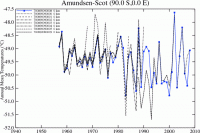
Using an iterative process to analyse the data, they found warming over the entire Antarctic continent for the period 1957-2006. Restricting their analysis to 1969 to 2000, a period for which other studies have found a net cooling trend, Steig’s study found slight cooling in east Antarctica, but net warming over west Antarctica.” “Evidence that Antarctica has warmed significantly over past 50 years”
Abstract excerpt: “We use statistical climate field reconstruction techniques to determine monthly temperature anomalies for the near-surface of the Antarctic ice sheet since 1957. Two independent data sets are used to provide estimates of the spatial covariance patterns of temperature: automatic weather stations and thermal infrared satellite observations. Quality-controlled data from occupied instrumental weather stations are used to determine the amplitude of changes in those covariance patterns through time. We use a modified principal component analysis technique (Steig et al., in review, Nature) to optimize the combination of spatial and temporal information. Verification statistics obtained from subsets of the data demonstrate the resulting reconstructions represent improvements relative to climatological mean values.”
Mann’s not the only one inventing his own “modified” PCA. Looks like Steig “got rid of” antarctic cooling the same way Mann got rid of medieval warming. Why not just look at the station data instead of “adjusting” it (graph above and linked here)? It shows a 50-year cooling trend. Read post here.
“There are three kinds of lies: lies, damned lies, and statistics.”—Disraeli
As the earth cools and their models fail miserably, alarmists are increasingly relying on statistical manipulation of real observations to pretend their theory is verifying and the world is changing as their models predict. This is a pure perversion of science.
Investor’s Business Daily
Climate Change: Sin City gets hit with almost 4 inches of snow as the white stuff even dusts Malibu, Calif. We don’t know what computer model global warmongers are using. A slot machine with three ice cubes, perhaps?
What happens in Vegas, they say, stays in Vegas. But as more evidence of the decade-long cooling trend is shoveled off the Strip, we hope that doesn’t apply to the truth about global warming. On Friday, the Las Vegas Sun reported that eight inches of snow had hit the Las Vegas Valley. The 3.6 inches that had already fallen as of late Wednesday near McCarran Airport added up to the most snow recorded for the area in December since they began keeping records 70 years ago.
The white powder even dusted Malibu as a winter storm hit parts of California. We commented recently on an Associated Press story claiming that, rather than being “evidence of some kind of cooling trend,” such events “actually illustrate how fast the world is warming.” But not everybody is convinced.
“If the issues weren’t so serious and the ramifications so profound, I would have to laugh at it,” said David Deming, a geology professor at the University of Oklahoma. “The mean global temperature, at least measured by satellite, is the same as it was in the year 1980. In the last couple of years, sea level has stopped rising, hurricane and cyclone activity in the Northern Hemisphere is at a 24-year low and sea ice globally is also the same as it was in 1980.”
Speaking of rising sea levels, is Al Gore smarter than a fourth-grader? James O’Brien, emeritus professor at Florida State University who studies climate variability and the oceans, thinks not. “When the Arctic Ocean ice melts, it never raises sea level because floating ice is floating ice, because it’s displacing water,” he points out.
“When the ice melts, sea level actually goes down. I call it a fourth-grade science experiment: Take a glass, put some ice in it, put water in it, mark level where water is. . . . After the ice melts, the sea level didn’t go up in your glass of water. It’s called the Archimedes principle.”
Global temperatures stopped rising after 1998 and have plummeted in the last two years by more than 0.5 degrees Celsius. The 2007-08 temperature drop was not predicted by global climate models. It was predictable by a decline in sunspot activity since 2000 and by a cyclical ocean-current phenomenon known as the Pacific Decadal Oscillation. On CNN’s “Lou Dobbs Tonight” recently, Jay Lehr, a senior fellow and science director at the Heartland Institute, was asked by the host what he considered the dominant influence on Earth’s climate. “Well, clearly, Lou, it is the sun,” Lehr answered, adding that “if we go back in really recorded human history; in the 13th century, we were probably seven degrees Fahrenheit warmer than we are now.”
Lehr considers global cooling to be the real threat, part of a natural pattern as we continue coming out of a period known as the Little Ice Age. “If we go back to the Revolutionary War, 300 years ago,” he said, “it was very, very cold. We’ve been warming out of that cold spell from the Revolutionary War period. And now we’re back into a cooling cycle.”
The Associated Press claims that the 10 warmest years on record have occurred since Bill Clinton’s second inaugural. But after it was discovered that NASA’s James Hansen, Gore’s chief scientific ally, had been fudging the numbers, the agency was forced to correct its data. The 10 warmest years turn out to be, in descending order: 1934, 1998, 1921, 2006, 1931, 1999, 1953, 1990, 1938 and 1939. Read more here.
If there’s a trend there, we don’t see it. So is global warming man-made and an imminent danger? As the snow falls in Vegas, don’t bet on it.
By Neil Cavuto, Fox News
You probably heard the news that it snowed in Las Vegas. Yep, Sin City becoming slush city. Hell truly has frozen over. Weird thing is, what’s happening in Vegas isn’t staying in Vegas. Cold weather and nasty storms already the norm. And it isn’t technically even winter yet. First time southern Nevada’s seen anything like this in 30 years. First time southern California’s been looking at 30 degrees this early in 20 years.
So I’m looking at all this wacky weather and asking a buddy of mine who’s an environmentalist -you see, I live fair and balanced. ask him, “What’s going on here? I thought you said I could throw out my parka for a thong?” The image immediately caused him to recoil. But he collected himself, then reminded me, “Neil, this is global warming.”
“Wait a minute,” I said. “I thought global warming meant, I don’t know, warming?” No, he assured me, this is all part of God’s great reaction to man’s not-so-great wrecking of his planet. Now I’m not the sharpest meteorological tool on the map, but even I wondered how my tree-hugging pal could have it both ways. He assured me last year snow would soon be a memory. That the oceans would be warming. More hurricanes would be coming. And glaciers would be melting.

But more snow than ever this year. The first snow Vegas has seen in 30 years. Temperatures below zero in at least 12 states in the Midwest and west, the most so early in any year. And all coming after a hurricane season that brought largely bupkis this year. “It’s all part of warming,” my friend reminded me.
You see, his is not a new forecast, just a revised one. Where you can kind of have your environmental cake and eat it too. Where the earth getting warmer is warming, and the earth getting cooler is warming. So nothing to stop Washington from big environmental spending. You see, my friend is pushing Congress for more such spending.
I wished him luck as he headed out. And suggested one other thing: Bring a coat. See post here.