

By Paul Chesser
How tremendously shallow of Florida Gov. Charlie Crist. Temperatures and public sentiment have cooled on global warming, while his political ambitions are now trained on the Senate, so what does he do? In a Schweitzer-like flip-flop, he hints that he’s having second thoughts on cap-and-trade. The Miami Herald reports:
Under mounting criticism from fellow Republicans, Crist looks ready to cancel his climate-change summit and is backing away from advocating a “cap-and-trade” energy policy.
At his well-publicized climate summit last summer, Crist pushed a number of energy plans to encourage renewable energy development and establish a cap-and-trade market that would penalize fossil-fuel use.
But Crist’s plans were shredded by the Republican Legislature and his cap-and-trade proposal has been bashed as a “tax” by his Republican U.S. Senate opponent, Marco Rubio, who has been ardently courting the GOP’s conservative wing.
“Well, it may be [a tax]. That may be accurate,” Crist, who recently signed an anti-tax pledge, said Thursday. Indeed when it served what he thought were his best political interests, Crist was gung-ho in the fight to stop global warming. He keynoted his own climate change summit in 2007 and brought in Arnold Schwarzenegger (also spoke last year), Robert F. Kennedy, Jr., and Theodore Roosevelt IV to heighten his profile on the issue. He issued executive orders, created a “Climate Action Team” and hired the advocacy group Center for Climate Strategies to steer the agenda. The alarmist media lapped it up and bestowed the love.
Now he’s trained on the Senate, as is Rubio, who is vacuuming up conservative support while Crist suffers with a tax-raising, stimulus-supporting image. Global warming is a boat anchor for Crist’s campaign now, and he’s starting to make excuses for why he might not host another climate summit, The Herald says:
Crist was even more tight-lipped about hosting another annual “Serve to Preserve Florida Summit on Global Climate Change,” which for two years attracted international media coverage and large, enthusiastic crowds to a downtown Miami hotel. Crist and California Gov. Arnold Schwarzenegger basked in the glow and vowed sweeping reforms to combat global warming.
Asked Thursday about the summit’s fate, Crist said he had not decided yet and cited the “cost” to potential sponsors. Florida Power & Light, a major sponsor of last year’s summit, gave at least $26,600 to Crist’s record-setting, $4.3 million campaign account in the past three months.
Gag me.
Read more here
Read also Paul’s post on ”The Energy Foundation’s Rubbish Research”
What a global warming alarmist beast the Energy Foundation is. For example, according to its 333-page (thanks to hundreds of grant awards to a seemingly infinite dependency class of environmentalist nonprofits) tax return for 2007 (the most recent available on Guidestar), EF has a bottomless well of funds to draw from: $68,907,029 in revenues (including $1.36 million in investment income); $53,600,903 in expenses - heck, they’re so rich, they even gave the Rockefellers money. Take that, big oil!
So how does EF get its money? They ‘splain:
Current Energy Foundation partners are: Cinco Hermanos, ClimateWorks Foundation, The Doris Duke Charitable Foundation, The Grousbeck Family Foundation, The William and Flora Hewlett Foundation, The Kresge Foundation, The McKnight Foundation, The Mertz Gilmore Foundation, The Cynthia & George Mitchell Foundation, The David and Lucile Packard Foundation, The Pisces Foundation, The Schmidt Family Foundation, The Simons Foundation, The Sea Change Foundation, and The TOSA Foundation.
The top four givers to EF for 2007 were the William and Flora Hewlett Foundation ($21,485,800), the Doris Duke Charitable Foundation ($20,727,743), the David and Lucile Packard Foundation ($7,050,000), and The TOSA Foundation ($4,250,000). Consider that when you make your next computer printer purchase.
Also note that while these groups for climate and energy research readily receive 7 to 8 figure donations from the large foundations, those organizations that are presenting information on science and energy that is not biased by the profit motive like ICECAP, CO2Science, Watts Up with That and Climate Audit are thankful for 4 to at most 5 figure annual total donations and struggle. As a 501(c)(3) public charity, ICECAP accepts corporate, foundation and individual donations to fund its educational activities. All donations are kept confidential. If you have browsed our websites or utilized our material in the past year, please consider making a financial contribution. Donate button is on the left column.
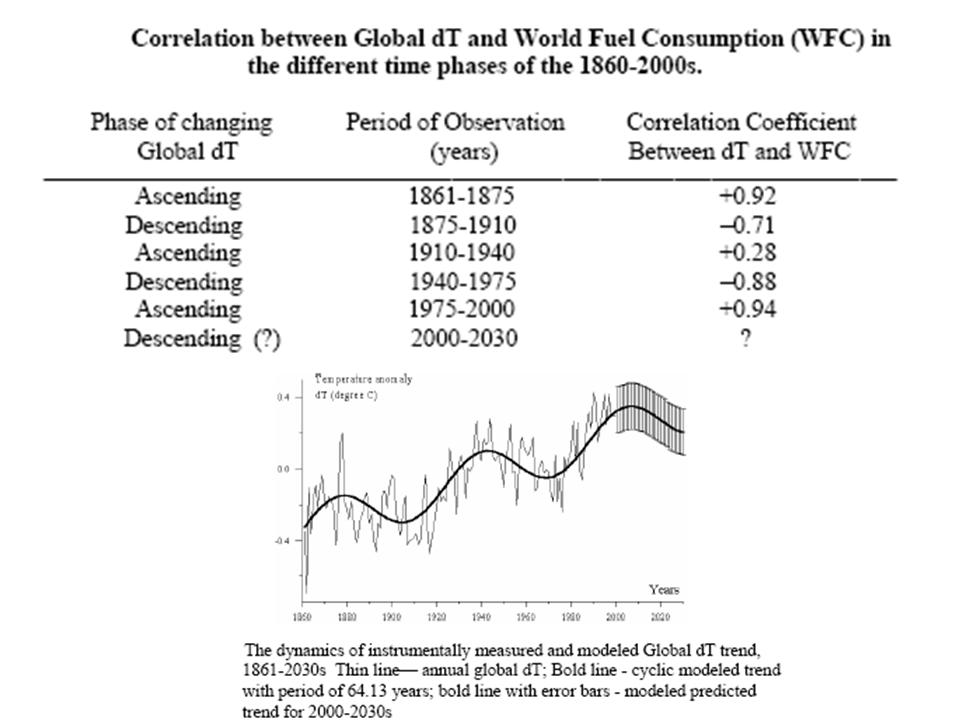
By L.B. Klyashtorin and A.A. Lyubushin (2003 paper in Energy & Environment)
Analysis of the long-term dynamics of World Fuel Consumption (WFC) and the Global Temperature anomaly (dT) for the last 140 years (1961-2000) shows that unlike the monotonously and exponentially increasing WFC, the dynamics of global dT against the background of a linear, age-long trend, undergo quasi-cyclic fluctuations with about 60 a year period. No true linear correlation has taken place between the dT and WFC dynamics in the last century.
Spectral analysis of reconstructed temperature for the last 1420 years and instrumentally measured for the last 140 years global dT shows that dominant
period for its variations for the last 1000 years lies in the 50-60 years interval. Modeling of roughly 60-years cyclic dT changes suggest that the observed rise of dT will flatten in the next 5-10 years, and that we might expect a lowering of dT by nearly 1-0.15C to the end of the 2020s.
Between 1861-1875, both WFC and dT exhibited simultaneous, well-correlated growth. During 1875-1910, the dynamics of these indices were different. WFC
continues to grow, while global dT decreases, which reflects in negative correlation between the indices. The next period, from 1910 to 1940, is of particular interest in this context. For these 30 years WFC shows virtually no increase because of the global economic crisis of 1920-30s. However, dT in the same period increased by more than 0.4C. During the subsequent 35-years (1940-1975), WFC increased by a factor of 2.5 (from 3 to 7 billion tons.). For the same period, global dT did not increase, but decreased roughly by 0.12C and negative correlation between the WFC and dT dynamics is characteristic of this time period.
Thus, on the background of monotonous increase in WFC during the last 140 years, global dT dynamics exhibited alternating 25-30-year periods of lowering or raising (with the corresponding alternation of positive or negative correlation between the WFC and dT trends). What changes in the dynamics of WFC and Global dT can we expect in the near future, between 2000-2030? Proceeding from the hypothesis of cyclic dynamics of global dT with a period of 50-60 years, we assume that the current “increasing” phase started in 1975 reached its maximum by 2000, then the gradual decrease in dT will start in the nearest few years and continue up to the 2030s.
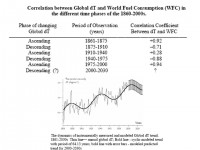
See larger image here.
Read full paper here.
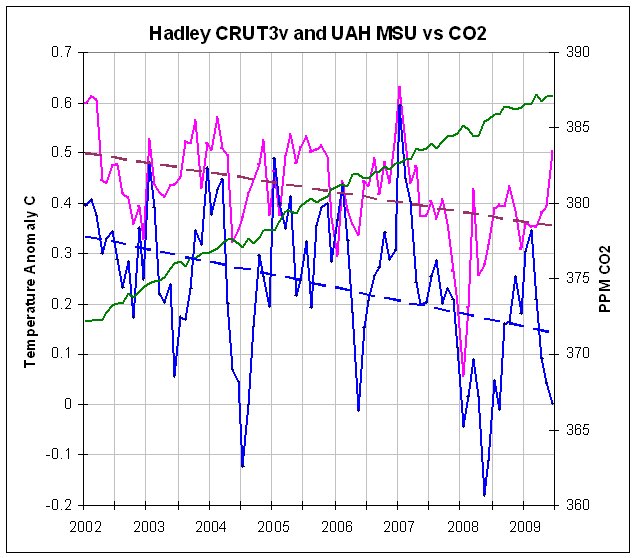
Icecap Note: Klyahtorin and Lyubushin were exactly right. See global temperature decline since 2002 even as WFC (CO2) continued to increase.
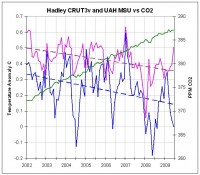
Hadley Monthly Anomalies in rose, UAH MSU in blue, CO2 monthly seasonally adjusted from ESRL. See larger image here.
EPW Blog
U.S. Senator James Inhofe (R-Okla.), Ranking Member of the Senate Environment and Public Works Committee, today commented on the economic analysis of Waxman Markey by the Energy Information Administration.
“Once again, government economic analysis of a cap and trade tax bill shows Americans will pay more at the pump, in their homes, and in many cases, with their jobs - all for virtually no affect on the climate,” Senator Inhofe said. “It’s interesting that no matter what the costs, polls continue to show Americans unwilling to pay anything to fight global warming.
“My colleagues who support cap-and-trade don’t need to listen to me. I suspect they will be hearing plenty from their constituents back home who outright reject costly cap and trade legislation. The fact is, the more Americans learn about this bill, the more they oppose it.”
Key Excerpts from the EIA Analysis:
“ACESA increases the cost of using energy, which reduces real economic output, reduces purchasing power, and lowers aggregate demand for goods and services.” “Implementing the ACESA GHG cap and trade program will affect the economy through two key mechanisms. First, the cost of using energy, particularly fossil fuels and electricity, will be increased by the requirement to submit allowances.”
“The higher delivered energy prices lead to lower real output for the economy. They reduce energy consumption, but also indirectly reduce real consumer spending for other goods and services due to lower purchasing power.”
“Ultimately, consumers will also see the impact of higher energy prices directly through final prices paid for energy-related goods and services and higher prices for other goods and services using energy as an input, and, if the cost increases cannot be passed onto consumers, labor and capital stock may be reallocated.” See release here.
Also see Press Release “Carlin Investigation Continues: Inhofe, Barrasso Send Letter to EPA On Possible Manipulation of Endangerment Finding” here.
In a letter sent today to EPA Administrator Lisa Jackson, U.S. Senator James Inhofe (R-Okla.), Ranking Member of the Senate Environment and Public Works Committee, and Senator John Barrasso (R-Wy.) questioned the process used to evaluate the scientific basis for EPA’s proposed endangerment finding for greenhouse gases under the Clean Air Act. The letter continues an ongoing investigation by Senators Inhofe and Barrasso into alleged suppression of a climate report written by Dr. Alan Carlin, a PhD economist in EPA’s Office of Policy, Economics, and Innovation.
Sen. Inhofe: “EPA’s process of determining endangerment appears to be marred by bias, and to some extent, political manipulation. I hope our investigation proves otherwise, yet it appears EPA deferred much of its own expertise and judgment to an international climate change tribunal, leaving the American people guessing as to whether the most consequential regulatory action of our time - the endangerment finding for greenhouse gases - is based on the most up-to-date scientific data and analysis.”
Sen. Barrasso: “American small business owners and workers expect transparency and good judgment from their government. The EPA should be making decisions based on science, not politics. The EPA needs to level with the American people and support the scientific data they are relying on.” In a compelling analysis, Carlin questioned, in fine detail, the science underlying the agency’s proposed endangerment finding. See letter here.
-------------------------
Aug 5, 2009: Chris Horner, of the Cooler Heads Coalition, debates and debunks alarmist Brenda Ekwurzel, a federal climate scientist, on America’s Newsroom.