


FOR IMMEDIATE RELEASE
Tuesday, September 6, 2011
Contact: Paul Chesser, Executive Director, paul.chesser@atinstitute.org
Dr. Michael Mann, lead author of the discredited “hockey stick” graph that was once hailed by the UN Intergovernmental Panel on Climate Change as the “smoking gun” of the catastrophic man-made global warming theory, has asked to intervene in American Tradition Institute’s Freedom of Information Act lawsuit that seeks certain records produced by Mann and others while he was at the University of Virginia, for the purpose of keeping them hidden from the taxpayer.
Specifically over the weekend ATI’s Environmental Law Center received service from two Pennsylvania attorneys who seek the court’s permission to argue for Dr. Mann to intervene in ATI’s case. The attorneys also filed a motion to stay production of documents still withheld by UVA, which are to be provided to ATI’s lawyers in roughly two weeks under a protective order that UVA voluntarily agreed to in May. Dr. Mann’s lawyers also desire a hearing in mid-September, in an effort to further delay UVA’s scheduled production of records under the order.
Dr. Mann’s argument, distilled, is that the court must bend the rules to allow him to block implementation of a transparency law, so as to shield his sensibilities from offense once the taxpayer - on whose dime he subsists - sees the methods he employed to advance the global warming theory and related policies. ATI’s Environmental Law Center is not sympathetic.
“Dr. Mann’s late-hour tactics offer the spectacle of someone who relies on the media’s repeats of his untrue claims of having been ‘investigated’ and ‘exonerated’ - that is, when he’s not sputtering ad hominem and conspiracy theories to change the subject,” said Christopher Horner, director of litigation for ATI’s Environmental Law Center. “Mann has tried whatever means possible to ensure he remains free of any serious scrutiny, and this just appears to be his last gasp.”
Dr. Mann’s move is therefore gratifying, and ATI will agree to his out-of-state lawyers’ motion to appear. But ATI will ask the court to uphold Virginia’s abundantly clear law, that Dr. Mann has no interest in records that are purely the property of the taxpayer.
ATI will present to the court how Dr. Mann understood, as an unambiguous and agreed-upon condition of his employment, that he had no expectation of privacy when he used UVA’s public email system. ATI therefore looks forward to seeing if, given the opportunity, UVA will defend the idea that any of its own policies be upheld in court. Since Dr. Mann has no property interest in the taxpayer-owned records sought by ATI, he has no standing and therefore should not be entered in the case. Dr. Mann wants, after the fact, for UVA to throw out policies he accepted as a condition of living off of taxpayer dollars, in order to cover up public information and to evade scrutiny.
To the extent Dr. Mann, the university, or their obstructionist backers like Union of Concerned Scientists continue to argue he has been “cleared” or “exonerated,” or that any substantive investigation has taken place, those pleadings are undermined by their persistent efforts to squelch inquiry. As a result, all the public sees is an effort to sweep Climategate revelations under the rug in order to preserve the biggest taxpayer-financed gravy train for science and academia in decades. Hence we see the Rasmussen Reports poll last month that showed a strong majority of the public believes scientists who study climate change have falsified research data in order to support their own theories and beliefs.
“Virginia’s courts do not brook conspiracy theories as the basis for intervention in run-of-the-mill Freedom of Information Act litigation,” said Dr. David Schnare, director of ATI’s Environmental Law Center. “Dr. Mann - having failed to prevail in the court of public opinion - cannot now strut into court, soap box in hand, and expect a warm welcome.”
See case documents, press releases, media coverage, commentary, broadcast interviews, etc. pertaining to ATI v. University of Virginia by clicking here: http://bit.ly/mLZLXC
For an interview with Environmental Law Center director Dr. David Schnare or director of litigation Christopher Horner, email paul.chesser@atinstitute.org or call (202)670-2680.
Follow ATI on Twitter: http://twitter.atinstitute.org
Facebook: http://facebook.atinstitute.org
By Joseph D’Aleo, CCM, AMS Fellow
Texas A&M’s Andrew Dessler has been flailing away desperately trying to save his failing global warming movement, fast tracking a paper in the GRL attempting to refute the solid Spencer Braswell paper on evidence from satellite for negative feedbacks through cloudiness. And then posting this story in the Texas Eagle claiming this hot droughty summer is definitive proof that global warming is real and actionable.
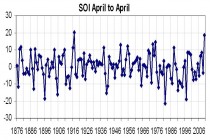
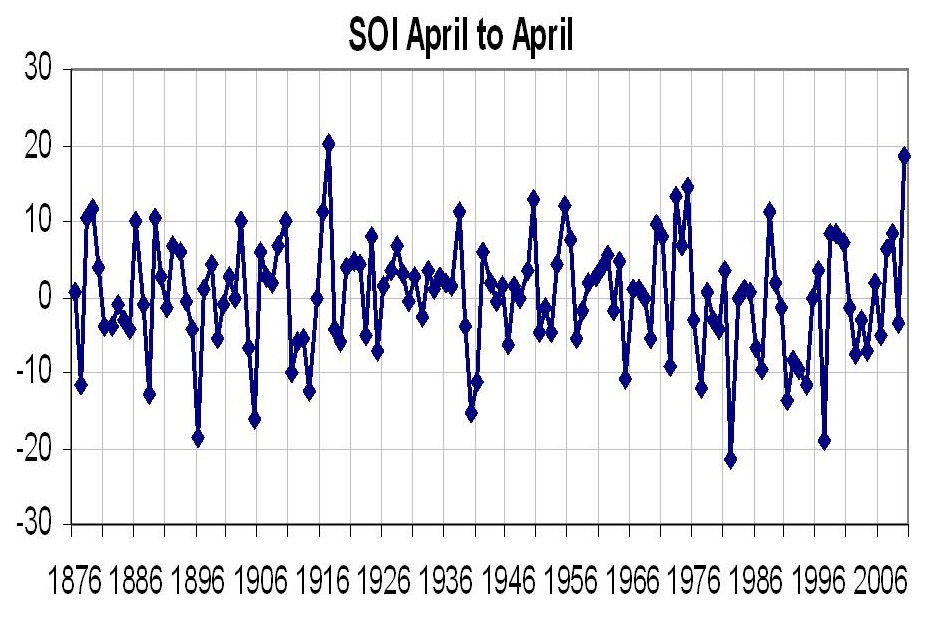
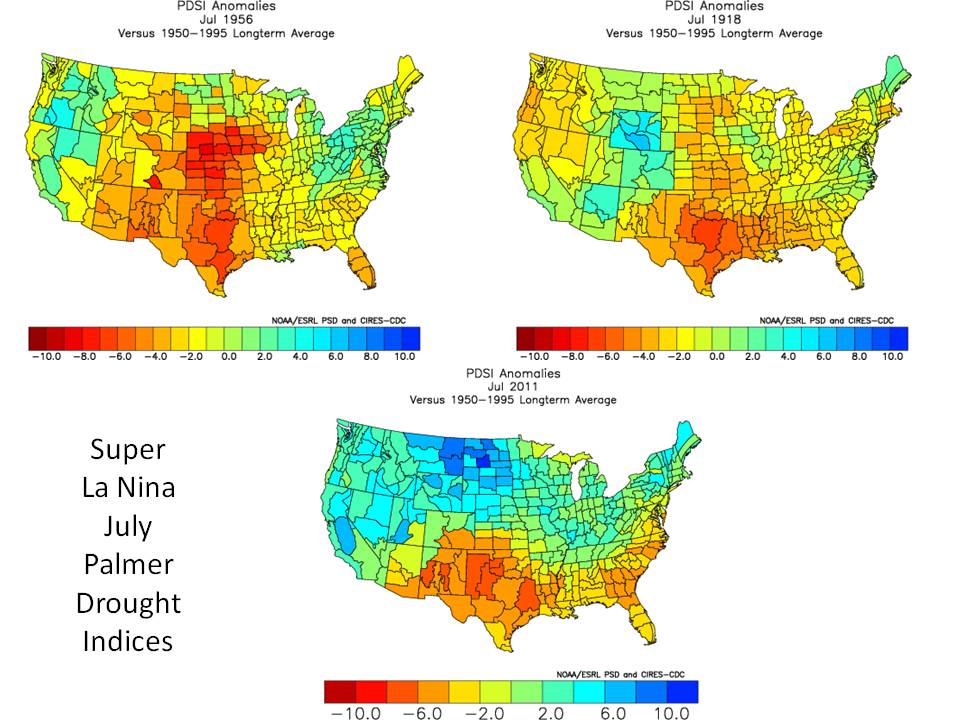
The Texas drought ranked up with the droughts of the mid 1950s and 1917/18 in Texas. All three had one thing in common. They were all super La Ninas. In terms of the traditional ENSO measure, the Southern Oscillation Index, you can see April to April values of the SOI (positive is La Nina) were only exceeded in 1917/18.
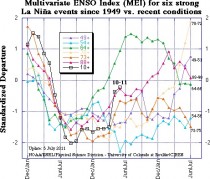
In terms of the Multivariate ENSO Index of NOAA’s Klaus Wolter, the Index was only exceeded by 1954/56 (here negative is La Nina).
Enlarged.
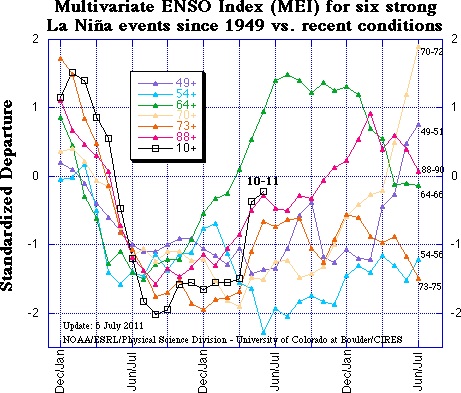
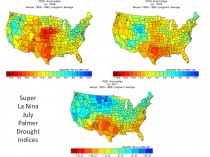
In both cases the drought lagged behind the La Nina peak in the following summer. This drought was not as far north as the 1918 and 1956 as seen by the Palmer Drought Severity index for Julys. In fact the La Nina jet stream was so strong, record rains and floods were the rule in the northern plains.
Enlarged.
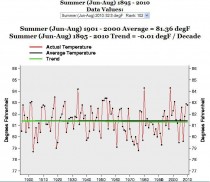
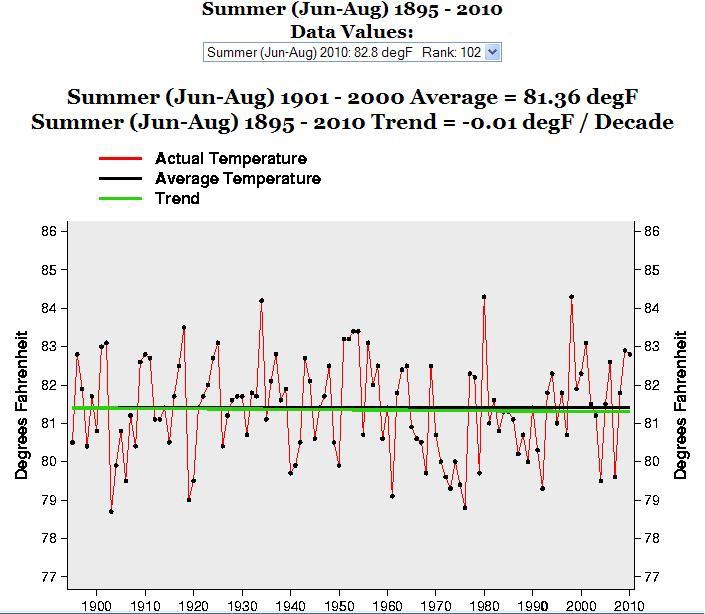
The long term temperature trends for summer in Texas show no ‘global warming’ or increased drought, no matter how many professors at how many universities in Texas opine otherwise. One brutal summer does not make the failing climate models suddenly correct. That is weather not climate.
Here are NOAA’s summer temperature trends for the state of Texas since 1895. Through last summer the trend was actually slightly negative. It may flatten when this summer’s value is added.
Enlarged.
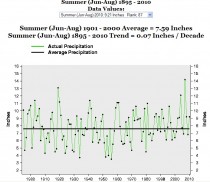
Precipitation wise, there is no evidence of increasing drought. Dry periods like the 1930s and 1950s were seen but the wettest year was 2007 and the trend up 0.7 inches per century
Enlarged.
Like in the mid 1950s, this La Nina is likely to persist and that suggests it may be dry next spring and if El Nino does not return, next summer. That still would not indicate greenhouse warming.

You see a cooling Pacific as part of solar driven global cooling should result in more La Ninas just as we saw from 1947 to 1977 when the Pacific and the earth last cooled. The warm Pacific from 1977 to 1997 led to more El Ninos for those decades. Only one significant La Nina occurred in those two decades leading some scientists to speculate a permanent El Nino was ensuing. Since the Pacific began cooling though in 1998, we have had 7 La Nina years and just 3 El Ninos. The earth is in the cooling part of the next cycle. The onset of cooling can explain ALL of the extremes of the past few years.
Weather and climate is all about natural cycles. PDF
Scientififc Alliance Newsletter
It is interesting to see how the apparently impenetrable facade of received wisdom on climate change has begun to weaken and show signs of crumbling. Many supporters of the mainstream view have become less antagonistic towards legitimate criticism and the tone of this criticism has in some cases become more moderate as alternative views are more widely reported. Could this be the start of a new phase of mature and rational debate on the issue?
Don’t hold your breath, because for every sign of proper scientific discussion, there are still plenty of dismissive or downright belligerent views expressed. Not all believers in anthropogenic global warming necessarily regard the science as settled, but there are still plenty who at least act as though they do. Take, for example, the long-awaited results from the CLOUD experiment (Cosmics Leaving Outdoor Droplets) at CERN. The press release on a paper published in Nature (CERN’s CLOUD experiment provides unprecedented insights into cloud formation) is suitably neutral, but the results have been interpreted rather differently by those with different views on AGW.
But first, we should remember what the experiment is all about. Readers are probably familiar with the hypothesis proposed by Henrik Svensmark of the Danish Space Research Centre in Copenhagen that low level cloud formation, initiated by high energy cosmic rays, is mediated by variations in the Sun’s magnetic field, for which the sunspot cycle is a proxy. More specifically, as the Sun’s magnetic field weakens, more cosmic rays penetrate the atmosphere, making more clouds, reducing the amount of sunlight reaching the surface and thus lowering temperatures. Conversely, when the Sun’s magnetic activity is higher (and when there are plenty of sunspots), the Earth is shielded to some extent from cosmic rays and temperatures tend to be higher.
Work over the last few years in Denmark had provided evidence that high energy particles (similar to cosmic rays) could induce nucleation and cloud formation, but the results of the more sophisticated CLOUD experiment were keenly awaited to see whether they could provide more definitive evidence. Broadly, the answer was yes: under very carefully controlled conditions, such as would be found as at various heights in the atmosphere, the presence of traces of sulphuric acid and ammonia did result in the formation of nuclei for cloud formation, and the addition of high energy particles increased the rate of nucleation considerably. In essence, Svensmark’s basic hypothesis has been shown to be compatible with observations.
However, this is not the whole story. Jasper Kirkby, spokesman for the experiment and lead author of the Nature paper, is quoted as saying “We’ve found that cosmic rays significantly enhance the formation of aerosol particles in the mid troposphere and above. These aerosols can eventually grow into the seeds for clouds. However, we’ve found that the vapours previously thought to account for all aerosol formation in the lower atmosphere can only account for a small fraction of the observations - even with the enhancement of cosmic rays.”
Not surprisingly, the first results do not tell the whole story and, indeed, pose additional questions. The understanding of cloud formation is still far from complete. Since clouds have an important part to play in determining ground temperatures (as anyone unfortunate enough to have spent August in north-west Europe will be only too well aware) and the IPCC modellers recognise that their models do not make a proper allowance for clouds, further experiments which might improve understanding should be welcomed by all scientists.
But initial reaction to the Nature paper has been mixed. Nigel Calder, a long term promoter of the Svensmark hypothesis, who collaborated with him to write The Chilling Stars (recommended for those who want to understand more about this issue) put out a blog posting entitled simply CERN experiment confirms cosmic ray action. However, the subtitle, The global warmists’ dam breaks, perhaps gives a better impression of his views.
Meanwhile, Gavin Schmidt, on the blog RealClimate (’Climate science from climate scientists’ posted a piece with an equally neutral title: The CERN/CLOUD results are surprisingly interesting.... But it’s not long before we come to this quote: “It is eminently predictable that the published results will be wildly misconstrued by the contrarian blogosphere as actually proving this link. However, that would be quite wrong.” He then proceeds to justify his case, in particular pointing to the lack of decline in cosmic rays over recent decades. However, this misses the point: the hypothesis suggests a more subtle effect, since only very high energy cosmic rays penetrate the atmosphere sufficiently to nucleate the low level clouds which might have a cooling influence. It is not total cosmic ray flux which is important, but the high energy part.
The BBC, often criticised by sceptics for its unquestioning acceptance of the IPCC view, report Cloud simulator tests climate models. But the tone of the report downplays any possible influence of cosmic rays. The only quotes are from Dr Kirkby and Professor Mike Lockwood from Reading University, who said “The result that will get climate change sceptics excited is that they have found that through the influence of sulphuric acid, ionisation can enhance the rate of water droplet growth. Does this mean that cosmic rays can produce cloud? No.”
Clearly, there is a lot more work to be done on this whole issue. But we should not forget that the first results of CLOUD are still at least consistent with the Svensmark hypothesis. The effect is much smaller than would be needed to have the impact he suggests, but the experiment has also so far failed to reproduce the nucleation rates necessary for cloud formation, with or without the impact of cosmic rays. Until this is done, the hypothesis certainly cannot be dismissed.
And, in contrast, we should not forget that the enhanced greenhouse effect has no direct supporting evidence, merely the apparent certainty that there is no other explanation for the pattern of temperature rise over the last century or so. Any ‘evidence’ put forward is either purely circumstantial or the output of computer models tuned to account for past changes. Since they have singularly failed to account for the temperature plateau of the last decade, confidence in them seems to be misplaced.
In these circumstances, rather than circling the wagons, it is the duty of all true scientists to maintain an open mind and not simply protect their own pet theories to the death. If only…