


Glenn Beck
Icecap Note: Having planted well over 100 trees in my lifetime, I love trees in all their seasons. But I never reacted like this to a downed tree or trees. They get recycled in my wood stove. See video here.
Dr. Roy Spencer
Download mp4 here.

By Martin Bosma, an MP for the anti-immigration party PVV
The North Pole is not melting and school children should not be ‘indoctrinated’ into thinking that it is, says Martin Bosma, an MP for the anti-immigration party PVV, in today’s Telegraaf. ‘Our schoolchildren should be learning to spell and do sums not that pathetic polar bears are drifting around on ice floes because we go on holiday by plane,’ the paper quotes him as saying.
Submitted by Frank Lansner
This is a global temperature anomaly where you compare August 2008 with 1998-2006 level using UAH MSU global data. This is a VERY good indication of global cooling.
See larger image here
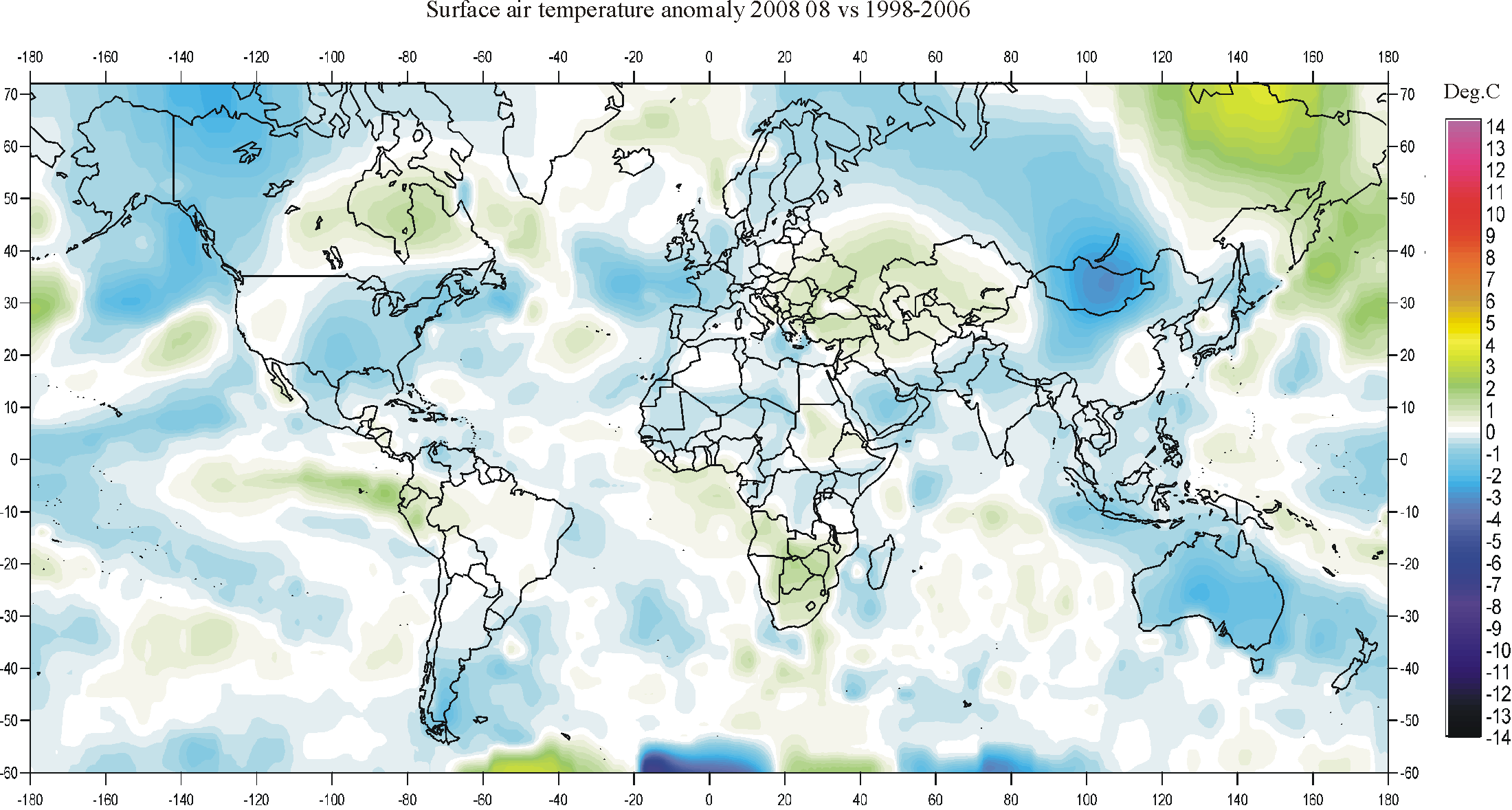
It comes from OLE HUMLUMS very nice site.
Science Online
Published Online September 11, 2008 Science DOI: 10.1126/science.1160485 Science Express Index
Northern Hemisphere Controls on Tropical Southeast African Climate During the Past 60,000 Years by Jessica E. Tierney, James E. Russell, Yongsong Huang, Jaap S. Sinninghe Damste, Ellen C. Hopmans , Andrew S. Cohen.
The processes that control climate in the tropics are poorly understood. Here, we apply compound-specific hydrogen isotopes (D) and the TEX86 temperature proxy to sediment cores from Lake Tanganyika to independently reconstruct precipitation and temperature variations during the past 60,000 years. Tanganyika temperatures follow northern hemisphere insolation, and indicate that warming in tropical Southeast Africa during the last glacial termination began to rise ~3000 years before atmospheric carbon dioxide concentrations. D data show that this region experienced abrupt changes in hydrology coeval with orbital and millennial-scale events recorded in northern hemisphere monsoonal climate records. This implies that precipitation in tropical Southeast Africa is more strongly controlled by changes in Indian Ocean sea-surface temperatures and the winter Indian monsoon than migration of the Inter-Tropical Convergence Zone.
By Cohenite on Jennifer Marohasy’s Politics and Environment Blog
The accusation of a lack of peer review (PR) by those who mount arguments against anthropogenic global warming (AGW) is at the heart of the elitism, consensus and ad hominem approach used by many supporters of AGW. It is a red herring. Science should be like the Law; transparent and universally accessible. It should not be used by specialists to dominate the general populace, or to promulgate ideological based alterations to the social and economic structure. Nor should it be used to stifle debate because, apart from anything else, the importance of science is diminished by such oppression. Because the AGW advocates have used such tactics, and been supported by a sizeable proportion of the mainstream media, the importance of blogs has grown. Their importance has also been highlighted by the degree of vitriol leveled at anti-AGW sites. Most of all the PR argument is simply wrong.
As a layman my AGW education curve has been steep. But it has been informed by a number of peer reviewed papers which have provided substantial critiques of AGW. In the interest of providing a rebuttal to the insidious PR stigma I present my ‘top 10’ papers which mount arguments against AGW, nine of them peer-reviewed. Read more and see the papers and links here.
By Joseph D’Aleo in the Old Farmer’s Almanac
Over the past century, climatic conditions have run from cool in the 1900s to warm in the ‘30s to cool in the ‘60s to warm in the ‘80s (scroll the time line above), and many of us have come to believe that mankind has been responsible for the swings. Scientists have blamed us for generating warming greenhouse gases, then polluting the air with sun-blocking particulates, and raising temperatures through urbanization, deforestation, and greenhouse gases.
There is another possible explanation for - or, at least, influence on - climate change. This involves natural factors, most notably the Sun and Earth’s oceans. We at the Almanac are among those who believe that sunspot cycles and their effects on oceans correlate with climate changes. Studying these and other factors suggests that a cold, not warm, climate may be in our future. See timeline and much more here.
By Nick Mediati and Anne B. McDonald, PC World - Eight Crazy E-Mail Hoaxes Millions Have Fallen For
E-mail alerts outlining the dangers of dihydrogen monoxide swept the Internet in the late 1990s and still pop up today. Many ask that you sign and forward a petition to ban the chemical, which contributes to global warming, is a major ingredient in acid rain, causes metals to rust more quickly, and has been found in cancerous tumors. The chemical also contributes to the greenhouse effect and to erosion of our natural landscapes. It’s even in food. Sounds pretty dangerous. You’re ready to sign right now, aren’t you?
Well, let us tell you one more thing about dihydrogen monoxide: It’s more commonly known as water. You know, the substance that every single living being relies on to survive? The origins of this item are multifold, from flyers circulated at the University of California at Santa Cruz in 1989 (so 20th century!) to a junior high school student who surveyed 50 classmates in 1997 and got 43 of them to sign his petition to ban the chemical. He then won a prize at his science fair for his project, called “How Gullible Are We?” Several Web pages touting the chemical’s dangers are still live. Don’t feel too bad if you’ve ever fallen victim to this hoax; even a government official in New Zealand too the bait. See MP Tries to Ban Water.
See Penn and Teller in this video accomplish the same.