




October 21, 2016
The once professional societies continued their slide into unprecedented advocacy in recent years as they boarded the politically-driven grant gravy train and recruited to their memberships a whole generation of eco fanatics indoctrinated in our failing schools at all levels. Their advocacy with congress is not at all scientific. They claim ‘consensus’ in their letter. The late great Michael Crichton, author of State of Fear on this topic, said “Historically, the claim of consensus is the first refuge of scoundrels; it is a way to avoid debate by claiming the matter is already settled.” “Let’s be clear: the work of science has nothing whatever to do with consensus. Consensus is the business of politics. In science, consensus is irrelevant. What is relevant is reproducible results. The greatest scientists in history are great precisely because they broke with the consensus.” (Galileo, Newton, Einstein, etc). He concluded: “There is no such thing as consensus science. If it’s consensus, it isn’t science. If it’s science, it isn’t consensus. Period.”
The following letter has been written by a lawyer that was part of the science and legal team responding to the EPA’s regulatory assault in amici briefs to the SCOTUS and DC circuit (circus) courts and the former, long-time top economist and analyst for the EPA. The letter responds to the 31 ‘former’ scientific societies that have degraded into advocacy, special interest (keep the money coming) and lobbyist groups. It was sent personally to each of the 31 signatories of the June 28, 2016 Consensus Scientific View of Climate Change letter to the congress. The refer to the research report which has been thoroughly reviewed by 11 highly credentialed reviewers. The 3 authors of the report have given full support to the letter.
Dear ------:
This letter is written with respect to the June 28 Letter, subscribed by your organization and some thirty other U.S.-based scientific societies. I attach a copy of that June 28 Letter for your reference. Besides this letter to you, we are addressing letters similar to this one to each of those other societies.
On September 21, 2016 a major new Research Report was published on the ICECAP website and at other locations. The Research Report was undertaken by its authors because they were unable to find anywhere in the literature of climate change a mathematically rigorous validation of a statistically significant, quantitative relationship between rising atmospheric greenhouse gas concentrations and surface as well as tropospheric temperatures.
The Research Report provides the methodology and findings of a definitive study designed to validate or invalidate the principal scientific hypotheses underlying the EPA’s December 2009 Endangerment Finding with respect to so-called “greenhouse gases,” including the hypothesis that rising greenhouse gas concentrations are likely to be associated with harmful or dangerous increases in surface temperatures. The results of the Research Report apply equally well to the Physical Science reports issued by the UN Intergovernmental Panel on Climate Change over the last few decades. In accordance with the scientific method, the Research Report used the best available temperature data from multiple sources, each of them structurally independent from the others, for the validation/invalidation exercise. The data used in the Research Report are fully available via links in the Report itself, and came from sources including satellites, weather balloons, ocean buoys, and also surface thermometer records.
The principal conclusions of the Research Report are as follows:
* “These analysis results would appear to leave very, very little doubt but that EPA’s claim of a Tropical Hot Spot (THS), caused by rising atmospheric CO2 levels, simply does not exist in the real world.”
* “Once EPA’s THS assumption is invalidated, then EPA’s climate models that rely upon the THS assumption are also invalid.
* “[T]his analysis failed to find that the steadily rising Atmospheric CO2 Concentrations have had a statistically significant impact on any of the 13 critically important temperature time series data analyzed.”
* “[T]hese results clearly demonstrate - 13 times in fact - that once just the ENSO [El Nino/La Nina] impacts on temperature data are accounted for, there is no “record setting” warming to be concerned about. In fact, there is no ENSO-Adjusted Warming at all.”
The June 28 Letter to which you subscribed contains statements strongly implying that there had previously been some sort of empirical validation of a quantitative causal relationship between increasing atmospheric greenhouse gas concentrations and increasing global average surface temperatures. For example, you state: “Observations throughout the world make it clear that climate change is occurring, and rigorous scientific research concludes that the greenhouse gases emitted by human activities are the primary driver.” Later in the June 28 Letter, you state: “There is strong evidence that ongoing climate change is having broad negative impacts on society, including the global economy, natural resources, and human health.”
However, as noted above, the authors of the Research Report have been unable to find in any scientific study a rigorous empirical validation of a statistically significant quantitative relationship between rising greenhouse gas concentrations and tropical, contiguous U.S. or global temperatures. Indeed we can find no paper that actually provides mathematically rigorous empirical proof that the effect of increasing atmospheric greenhouse gas concentrations on world temperatures is different from zero with statistical significance.
As you might realize, we are concerned that prestigious scientific societies, including your own, have subscribed to a letter to Members of Congress purporting to convey scientific propositions as having been definitively established, when in fact there has never been a mathematically rigorous empirical validation of the propositions stated, and indeed there now appears to be a definitive scientific invalidation of those propositions.
Obviously, the June 28 Letter preceded the September 21 Research Report. We therefore ask you to reconsider your June 28 Letter in light of the Research Report. Alternatively, could you kindly:
* Refer us to the research study or studies that, in a mathematically proper and rigorous fashion, empirically validate a quantitative relationship between rising atmospheric greenhouse gas concentrations and global temperatures as reflected in all thirteen major data sets as used in the Research Report. Such a study must be very clear as to the analysis process and data utilized and must be able to be replicated.
* Refer us to the research study or studies that definitively empirically validate the so-called Tropical Hot Spot that is a critical underpinning of the “lines of evidence” on which EPA says it relies for its Endangerment Finding. (The term “Tropical Hot Spot” refers to the hypothesized warming pattern whereby increasing greenhouse gas concentrations cause the tropical mid-troposphere to warm more rapidly than the lower troposphere, which in turn warms more rapidly than the surface.)
* Refer us to the research study or studies that definitively empirically demonstrates that there is statistically significant warming to account for in the global troposphere after controlling for ENSO [El Nino/La Nina] effects.
In closing, we wish to remind you of the well-known quote from noted physicist Richard Feynman:
“It doesn’t matter how beautiful your theory is, it doesn’t matter how smart you are. If it doesn’t agree with experiment, it’s wrong.”
As a leader of a major scientific society, you of course realize that Feynman’s aphorism captures the essence of the scientific method that underlies the entire project of science, including all of the work of your organization and its members. If you as a scientific society are going to use your authority to advocate for a government policy agenda, the American people are entitled to know the specific empirical work that validates your scientific hypothesis that greenhouse gases are warming the planet. Also, if there is apparently definitive empirical research, such as the Research Report, that would seem to invalidate the principal hypotheses that underlie your policy advocacy, the American people are entitled to your definitive refutation of that work before you continue your policy advocacy.
In short, if you have mathematically rigorous empirical validation of the hypotheses that underlie your advocacy, kindly provide it. If you do not, kindly say so.
Very truly yours,
Francis Menton
Law Office of Francis Menton
85 Broad Street, 18th Floor
New York, New York 10004
fmenton@manhattancontrarian.com
Alan Carlin
Webmaster: carlineconomics.co
carlineconomics@gmail.com
Mr. Menton is a lawyer in New York. He has represented numerous scientists, among them the authors and many of the reviewers of the Research Report cited in this letter, in making submissions as amici curiae to courts including the D.C. Circuit and the U.S. Supreme Court on issues related to energy and climate matters. Mr. Menton has a JD from Harvard Law School and a BA in Mathematics and Economics from Yale.
Dr. Carlin is a retired senior analyst and manager at the US Environmental Protection Agency, Washington, DC, 1971-2010; previously he was an economist at the RAND Corporation, Santa Monica, CA. He is the author of Environmentalism Gone Mad, Stairway Press, and the author or coauthor of about 40 other professional publications including many on climate science and economics. He has a PhD in economics from MIT and a BS in physics from Caltech.
See Alan’s post on this letter to the societies here.
Climate change ranked dead last in a recent survey of 16 issues Americans care about.
================
See Nicolas’s Debunking Leonardo DiCaprio’s Climate Change Documentary

By Nicholas Loris
To the dismay of some pundits, celebrities, and environmental activists, three presidential debates produced zero questions on global warming. Simply wishing an issue to be a priority won’t make it one.
Americans and people around the world are apathetic to taking action on climate change. And for good reason. Chicken Littles have incorrectly predicted doomsday scenarios and, even in the event of climate catastrophe, costly policies offer a nonsolution.
Both domestic and international polls demonstrate how little individuals want to take action on global warming and even more important, how little they’re willing to pay for it.
Take, for instance, the United Nations’ “My World” survey that asked individuals to choose six issues that “are most important for you and your family.” Nearly 10 million people have responded, and out of a list of 16 issues, “action taken on climate change” ranked dead last. Education, health care, and better job opportunities came in as the top three.
Even climate polling data spun as encouraging isn’t all that impressive. A March Gallup poll reports that concerns over climate change are at an eight-year high. But that headline alone doesn’t provide the full context.
While the percent of Americans who worry about global warming a great or fair deal is up to 64 percent (compared to 55 percent from a year ago, but still lower than the 66 percent reported in 2008), the percentage of Americans who perceive global warming as a serious threat is the lowest (57 percent) since Gallup asked the question in 1998.
Another allegedly encouraging poll comes from a recent survey conducted by the Energy Policy Institute at the University of Chicago and the AP-NORC Center. The New York Times heralded the results as “Americans Appear Willing to Pay for a Carbon Tax Policy.”
But just how much are Americans willing to pay? A measly buck a month. Fifty-seven percent of respondents were willing to pay an additional dollar per month on their electricity bill to combat climate change. Forty-two percent weren’t even willing to pay that much. For proponents of an aggressive carbon tax, that’s not very encouraging.
At $20 a month, the public is more than 2-to-1 against paying to combat climate change, which is more telling that there’s no real appetite for this. Importantly, the poll fails to include how much abated warming Americans would receive from paying an additional $1, $20, or $50 per month. In every scenario, the answer is next to nothing.
Even if the U.S. cut 100 percent of its carbon dioxide emissions (which would cost Americans a lot more than $50 per month), it would not make any meaningful impact on projected warming.
Using the same estimated climate impact from a doubling of carbon dioxide emissions that the Intergovernmental Panel on Climate Change assumes in its modeling (which is arguably higher than reality), the world would only be 0.137 degrees Celsius cooler by 2100 if the U.S. shut down its entire economy.
The entire industrialized world could cut carbon dioxide emissions by 100 percent and the result would be a whopping 0.278 degrees Celsius cooler by the turn of the century. Let’s see how our grandchildren feel about that sacrifice.
Polling data alone certainly isn’t a reason to ignore an issue. But the reality that we’re not headed toward catastrophic warming and that costly policies that ripple through the economy won’t mitigate global temperatures most certainly are.
Research Report Executive Summary
Background
On December 15, 2009, EPA issued its Green House Gas (GHG) Endangerment Finding, which has driven very significant and costly regulations beginning with CO2. Focusing primarily on the time period since 1950, EPA’s Endangerment Finding predicated on Three Lines of Evidence, claims that Higher CO2 Emissions have led to dangerously Higher Global Average Surface Temperatures.
Relevance of this Research
The assumption of the existence of a “Tropical Hot Spot (THS)” is critical to all Three Lines of Evidence in EPA’s GHG/CO2 Endangerment Finding.
Stated simply, first, the THS is claimed to be a fingerprint or signature of atmospheric and Global Average Surface Temperatures (GAST) warming caused by increasing GHG/CO2 concentrations[1]. The proper test for the existence of the THS in the real world is very simple. Are the slopes of the three temperature trend lines (upper & lower troposphere and surface) all positive, statistically significant and do they have the proper top down rank order?
Second, higher atmospheric CO2 and other GHGs concentrations are claimed to have been the primary cause of the claimed record setting GAST over the past 50 plus years.
Third, the THS assumption is imbedded in all of the climate models that EPA still relies upon in its policy analysis supporting, for example, its Clean Power Plan - recently put on hold by a Supreme Court Stay. These climate models are also critical to EPA’s Social Cost of Carbon estimates used to justify a multitude of regulations across many U.S. Government agencies.
Objectives of the Research
The objective of this research was to determine whether or not a straightforward application of the proper mathematical methods would support EPA’s basic claim that CO2 is a pollutant. Stated simply, their claim is that GAST is primarily a function of four explanatory variables: Atmospheric CO2 Levels, Solar Activity, Volcanic Activity, and a coupled ocean-atmosphere phenomenon called the El Nino-Southern Oscillation (ENSO.)
The first objective of this research was to determine, based on the very considerable relevant and credible tropical temperature data evidence, whether or not the assumed THS actually exists in the real world.
The second related objective was to determine whether, adjusting ONLY for ENSO impacts, anything at all unusual with the Earth’s temperatures seemed to be occurring in the Tropics, Contiguous U.S. or Globally. It is a well-known meteorological fact that, other things equal, El Ninos lead to a global scale warming and La Ninas a global scale cooling, whose magnitudes are related to their ENSO strengths.
The third objective was to determine whether the rising atmospheric CO2 concentrations alone can be shown to have had a statistically significant impact on the trend slopes of often -publically-quoted temperature data.
It should be noted that in carrying out this research project, every effort was made to minimize complaints that this analysis was performed on so-called “cherry picked temperature data”. To avoid even the appearance of such activity, the authors divided up responsibilities, where Dr. Christy was tasked to provide temperature data sets that he felt were most appropriate and credible for testing the THS as well as the two other EPA Endangerment Finding hypotheses. All told, thirteen temperature time series (9 Tropics, 1 Contiguous U.S. and 3 Global) were analyzed in this research. The econometric analysis was done by Jim Wallace & Associates, LLC, and when completed, cross checked by the two other authors as well as seven reviewers.
Findings of the Research
These analysis results would appear to leave very, very little doubt but that EPA’s claim of a Tropical Hot Spot (THS), caused by rising atmospheric CO2 levels, simply does not exist in the real world. Also critically important, even on an all-other-things-equal basis, this analysis failed to find that the steadily rising Atmospheric CO2 Concentrations have had a statistically significant impact on any of the 13 critically important temperature time series data analyzed.
Thus, the analysis results invalidate each of the Three Lines of Evidence in its CO2 Endangerment Finding. Once EPA’s THS assumption is invalidated, it is obvious why the climate models they claim can be relied upon, are also invalid. And, these results clearly demonstrate - 13 times in fact - that once just the ENSO impacts on temperature data are accounted for, there is no “record setting” warming to be concerned about. In fact, there is no ENSO-Adjusted Warming at all. These natural ENSO impacts are shown in this research to involve both changes in solar activity and the well-known 1977 Pacific Climate Shift.
Moreover, on an all-other-things-equal basis, the research strongly implies that there is no statistically valid proof that past increases in Atmospheric CO2 Concentrations have caused the officially reported rising, even claimed record setting temperatures.
Finally, regarding the credibility of these research findings, the temperature data measurements that were analyzed were taken by many different entities using balloons, satellites, buoys and various land based techniques. Needless to say, if regardless of data source, the results are the same, the analysis findings should be considered highly credible.
PDF of this Executive Summary here.
See full abridged 68 page report here. The authors and reviewers all highly recommend that you read the PREFACE which explains the methodology and will help you better understand the detailed temperature analyses.
-----------------
Study Authors & Reviewers
Authors
Dr. James P. Wallace III
Jim Wallace & Associates, LLC
50 Years Mathematical Modelling Team Management
Ph.D., Economics, Minor in Engineering, Brown University
M.S., Mechanical Engineering, Brown University
B.S., Aeronautical Engineering, Brown University
Dr. John R. Christy
Distinguished Professor of Atmospheric Science, Alabama State Climatologist and Director of the Earth Science System Science Center at the University of Alabama in Huntsville.
Lead Author, Contributing Author and Reviewer of United Nations IPCC assessments.
Awarded NASA’s Medal for Exceptional Scientific Achievement.
Elected a Fellow of the American Meteorological Society in 2002
Joseph S. D’Aleo
Certified Consulting Meteorologist
Elected AMS Fellow
BS, MS Meteorology University of Wisconsin
ABD NYU Air Resources, Honorary Doctorate VSC
45 years operational and research meteorology
---------
Reviewers
Dr. Alan Carlin
Retired Senior Analyst and manager, US Environmental Protection Agency, Washington, DC.
Author, Environmentalism Gone Mad, Stairway Press, 2015.
Ph.D., Economics, Massachusetts Institute of Technology, Cambridge, MA.
BS, Physics, California Institute of Technology, Pasadena, CA.
Dr. Harold H. Doiron
Retired VP-Engineering Analysis and Test Division, InDyne, Inc.
Ex-NASA JSC, Aerospace Consultant
B.S. Physics, University of Louisiana - Lafayette
M.S., Ph.D., Mechanical Engineering, University of Houston
Dr. Theodore R. Eck
Ph.D., Economics, Michigan State University
M.A, Economics, University of Michigan
Fulbright Professor of International Economics
Former Chief Economist of Amoco Corp. and Exxon Venezuela
Advisory Board of the Gas Technology Institute and Energy Intelligence Group
Dr. Craig D. Idso
Chairman, Center for the Study of Carbon Dioxide and Global Change
Ph.D., Geography, Arizona State University
M.S., Agronomy, University of Nebraska, Lincoln
B.S., Geography, Arizona State University
Dr. Richard A. Keen
Instructor Emeritus of Atmospheric and Oceanic Sciences, University of Colorado
Ph.D., Geography/Climatology, University of Colorado
M.S., Astro-Geophysics, University of Colorado
B.A., Astronomy, Northwestern University
Dr. Anthony R. Lupo
IPCC Expert Reviewer
Professor, Atmospheric Science, University of Missouri
Ph.D., Atmospheric Science, Purdue University
M.S., Atmospheric Science, Purdue University
Dr. Thomas P. Sheahen
Ph.D., Physics, M.I.T.
B.S., Physics, M.I.T.
Dr. George T. Wolff
Former Chair EPA’s Clean Air Scientific Advisory Committee
Ph.D., Environmental Sciences, Rutgers University
M.S., Meteorology, New York University
B.S., Chemical Engineering, New Jersey Institute of Technology
----------
Research Report Endorsement
The authors of this research are very much interested in knowing the names and credentials of individuals who would like to add their names to the list of scientists whose names already appear in the report under the following statement:
“The Undersigned Agree with the Conclusions of this Report.”
After reading and thinking about this research report, if you would like to have your name added to such a list, please send your name and credentials in a fashion similar to those listed in the report.
Please send this information to the following dedicated email address: frostdoc@aol.com
[1] See U.S. Climate Change Science Program, Synthesis and Assessment Product 1.1, Temperature Trends in the Lower Atmosphere - Understanding and Reconciling Differences, Chapter 1, p. 18-19, PDF
The individuals asking to their names added that have very substantial relevant credentials are listed below:
Dr. Alan Carlin
Retired Senior Analyst and manager, US Environmental Protection Agency, Washington, DC.
Author, Environmentalism Gone Mad, Stairway Press, 2015.
Ph.D., Economics, Massachusetts Institute of Technology, Cambridge, MA.
BS, Physics, California Institute of Technology, Pasadena, CA.
David Bennett Laing, Earth systems scientist
Asst. Prof. of Geology, Eastern New Mexico University and University of Maine system, retired
Author, “The Earth System,” 1991. Wm C Brown, 590 pp.
University of Arizona, Tree-Ring Laboratory, 3 yrs, ABD
Harvard University, MA; Dartmouth College, BA
Dr. Ruth F. Weiner
Adjunct Professor of Nuclear Engineering, University of Michigan
Member, USNRC Advisory Committee on Nuclear Waste
Member EPA National Air Pollution Control Techniques Advisory
Ph. D (chemistry) The Johns Hopkins University
B.S., M.S. (physics) University of Illinois
By Anthony Watts, WattsUpWith That

Democratic presidential nominee former Secretary of State Hillary Clinton and former Vice President Al Gore campaign together at the Miami Dade College on Tuesday in Miami. (Photo by Joe Raedle/Getty Images)
Hillary Clinton later made the statement on Twitter:
Our next president will either step up our efforts to address climate change or drag us backward and put our whole future at risk.
We’ve always had destructive hurricanes, but Hurricane Matthew was likely more destructive because of climate change.
Followed by Al Gore saying:
“from a tropical storm to a Category 5 hurricane in just 36 hours, that’s extremely unusual”
.IMHO, HillaryClinton is the right choice in this election if we care about solving the climate crisis
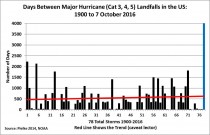
What crisis? The worst hurricane ever to hit the USA was The Great Galveston Hurricane in 1900, which killed up to 6000 people, long before CO2 ever became an issue.
Today, we have an 11 year hurricane drought of Cat3 or greater failing to make landfall on the USA. The previous drought record was 8 years set in the 1860s!
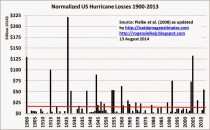
We have hurricane damage losses which are down:
We have hurricane and tropical storm frequency which is flat to slightly down.
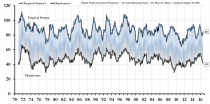
Figure from Dr. Ryan Maue: Last 4-decades of Global Tropical Storm and Hurricane frequency - 12-month running sums. The top time series is the number of TCs that reach at least tropical storm strength (maximum lifetime wind speed exceeds 34-knots). The bottom time series is the number of hurricane strength (64-knots+) TCs.
And Tornado deaths are down too
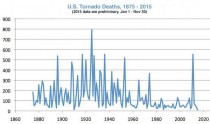
Pardon my french, but WHAT CLIMATE CRISIS as they view it in weather terms? Their pitch of a load of bollocks!
-------
Lets also remember in the words of Christopher Booker:
Al Gore in his Oscar-winning film An Inconvenient Truth went much further, talking of 20 feet, and showing computer graphics of cities such as Shanghai and San Francisco half under water.
But if there is one scientist who knows more about sea levels than anyone else in the world it is the Swedish geologist and physicist Nils-Axel Morner, formerly chairman of the INQUA International Commission on Sea Level Change. And the uncompromising verdict of Dr Morner, who for 35 years has been using every known scientific method to study sea levels all over the globe, is that all this talk about the sea rising is nothing but a colossal scare story.
Indeed instead of the dramatic use of a lift to show the 20 foot rise, Gore could have instead used the Manhattan Yellow pages to demonstrate the rise coming. Recall also in the UK, a court ruled if Al Gore’s science fiction horror movie was shown in the schools, the teacher would have to read the 9 major errors (just the tip of the iceberg). Gore and Clinton make a perfect pair.


See Patrick Micheals USATODAY post Today’s Weather is Hardly Unusual! here.
Perspective on Matthew in the Rear-View Mirror Now
Joseph D’Aleo, CCM
Matthew first became a storm on September 28 east of the islands in the Atlantic. It moved into the Caribbean where it intensified to a major hurricane. After sparing Jamaica, Matthew turned north pounding eastern Cuba and Haiti. Haiti was hardest hit with 145 mph winds and torrential flooding rains that resulted in an estimated 1000 deaths.
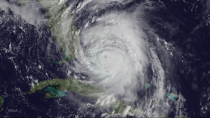
Haiti is the poorest country in the Americas with a population of 10 million. Matthew is the latest devastating event to affect Haiti with rainfall of 15 to 20 inches and as much as 40 inches in the mountains and a storm surge on the south coast of up to 10 feet.
Haiti is especially vulnerable to hurricane disasters given its location, topography and poverty. In 1963, Hurricane Flora struck the coast of Haiti causing a 12-foot storm surge that killed an estimated 7,000. In 2004, heavy rains sparked flooding that killed more than 1,000. Just four months later, Hurricane Jeanne struck the northern coast causing flooding that killed around 3000. In 1994, Hurricane Gordon caused in 1,790 deaths from mudslides and flooding. In 2008, three hurricanes and a tropical storm targeted Haiti in less than four weeks in August and September causing 800 deaths and devastating crops.
Matthew after leaving Haiti rolled through the Bahamas and then teased the Florida east coast. The storm weakened as it neared Florida to a Category 2 storm and tracked just off the east coast, sparing the population from the worst possible outcome. The storm’s eyewall passed over Cape Canaveral with a report of a wind gust to 107 mph. The strongest official station wind gust in Florida was 68 mph at Daytona Beach. However, tropical storm force winds, heavy rains and the storm surge caused property damage, lengthy power outages and what has been described as extensive beach erosion.
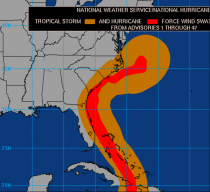
Matthew’s rains increased as it moved north dumping 12 to over 18 inches of rainfall from Savannah, Georgia and Hilton Head Island to Charleston in South Carolina. 96 mph wind gusts were reported near Tybee Island, Georgia and 88 mph at Hilton Head Island Airport. Matthew made landfall as a Category 1 near McClellanville, South Carolina Saturday and soon after was downgraded but still rains fell in North Carolina to the Tidewater area in Virginia, recently flooded by rains from Julia.
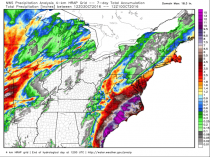
Matthew hooked up on a cold front that was dropping through the northeast and brought some much needed rainfall (about 0.6 inches here in southern New Hampshire) and near the coast, locally damaging winds. The peak wind was 58 mph in Aquinnah, Massachusetts.
Though the storm was a major hurricane out at sea in the Caribbean, when it eventually made landfall on the mainland, it was a category 1 storm. This continues the record of almost 11 years (short now by about a week) without a major hurricane landfall on the mainland. The last major hurricane was Hurricane Wilma in late October 2005. The old record of 8 years was set in the 1860s.
MIT’s Dr. Kerry Emanuel called Hurricane Matthew a ‘run-of-the-mill’ hurricane. Indeed in the history of the hurricane giants, it was not extraordinary though like with most hurricanes affecting the islands and mainland in any way, there was certainly angst, pain and suffering. That is and always was a part of our weather and climate. Here is a compilation of 30 peer reviewed studies show no connection between climate change and hurricanes.