


By Chris White
A climate scientist infamous for incorrectly claiming he once won the Nobel Prize is criticizing a museum for not being faithful to the truth and facts because of its association with a billionaire climate skeptic.
A so-called climate denier does not deserve a leadership position at the American Museum of Natural History, according to Penn State University professor Michael Mann. He was referring to Rebekah Mercer, a wealthy conservative who sits on the museum’s board of trustees.
‘A natural-history museum must be accurate, faithful to the facts and trusted by the public,” Mann wrote Monday in an editorial for The News York Times. He urged the museum to distance itself from Mercer, a supporter of President Donald Trump and donator to conservative causes.
Mann has consistently been called out for falsely claiming to have co-won the Nobel Prize in 2007 with the Intergovernmental Panel on Climate Change and former Vice President Al Gore.
The prize was awarded to Gore that year for his “efforts to build up and disseminate greater knowledge about man-made climate change, and to lay the foundations for the measures that are needed to counteract such change,” according to the panel.
Mann claimed in his lawsuit in 2012 against conservative pundit Mark Steyn and National Review that he was a Nobel Laureate, but the Nobel committee has consistently rebuked this claim. Mann went on to slam the museum and Mercer for not adhering to the truth and scientific standards.
“For years, many scientists were hesitant to come out of their labs and speak up for fear that truth-telling would result in personal attacks or threaten their professional credibility,” said Mann, who gained fame for his “hockey stick” graph showing global temperature rise - Gore eventually used the academic’s graphs in his documentary, “Inconvenient Truth.”
Mann and a handful of scientists used a super PAC to get their colleagues to align against Trump during the presidential election over the president’s willingness to “embrace of conspiracy theories, anti-science attitudes, and disregard for experts.”
The group, Not Who We Are PAC, wasn’t heavily involved during the election, compared to the tens of millions spent by other super PACs. The group has only spent $23,000 on ads targeting Trump, according to federal filings.
\
Mann dismissed the idea that the push against Mercer is a politically partisan issue. He later suggested the museum move to use the Mercer family’s donations “to develop exhibitions and programs that educate the pubic about the climate-denial machine that illuminate its history of using propaganda to obstruct pro-climate action and the document how we’ve arrived at this current crisis point for the planet.”
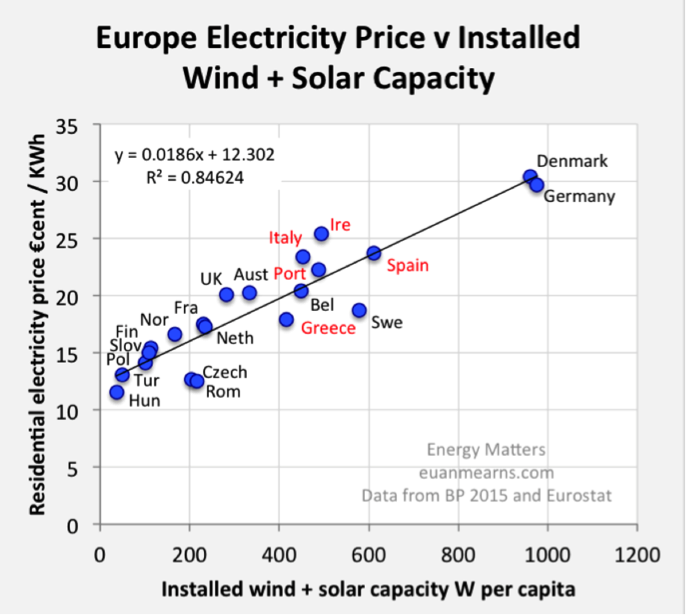
November 21, 2017/ Francis Menton
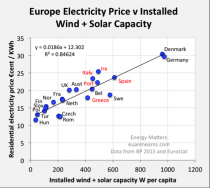
Germany—that’s the place where there really is a 100% consensus on the need for immediate action to solve the supposed “climate crisis.” It’s the land of the “Energiewende”—the forced transition to the use of intermittent renewables like wind and solar to generate electricity. It’s the place where—as I noted in this post back in September -- no major political party has dissented on the need to act on the “climate” issue. It’s the place that has happily driven its usage of renewables to generate electricity up to about 30% of the supply, and therefore its cost of residential electricity up to more than triple the average U.S. price. It’s a place where anyone questioning the so-called “science” underlying the warming scare can expect to be greeted with derision and scorn. And yet, somehow reality still seems to be intruding.
Over the weekend, the talks among political parties in Germany to form a coalition government collapsed. As of now, nobody seems to know what is going to happen next. And—even though there is little overt dissent on the virtue of reducing carbon emissions—it seems like the ever-more-evident costs of this “climate” program are starting to drive events.
Just to set the table, let me remind readers about the state of the political playing field on this issue in Germany and the rest of Europe and other major countries. A good background article is this one from Dana Nuccitelli in the Guardian from October 2015, “The Republican Party Stands Alone in Climate Denial.” The article summarizes some work from Norwegian political scientist Sondre Batstrand, analyzing the positions on this issue of all conservative political parties from countries including the USA, UK, Norway, Sweden, Spain, Canada, New Zealand, Australia, and Germany. The conclusion:
[Batstrand] found that the US Republican Party stands alone in its rejection of the need to tackle climate change and efforts to become the party of climate supervillains.
That’s not the only example of over-the-top rhetoric in the piece. For example, Nuccitelli quotes Jonathan Chait of New York Magazine on the position of then-candidate Jeb Bush on this issue:
In any other democracy in the world, a Jeb Bush would be an isolated loon, operating outside the major parties, perhaps carrying on at conferences with fellow cranks, but having no prospects of seeing his vision carried out in government.
In Germany, a political party needs to get 5% of the vote in an election to get any seats in the Bundestag. As an indication of how correct Batstrand was, in the previous (2013) election, the only party that could remotely be considered a climate dissenter, AfD, got only 4.7% and no seats. Another party, FDP—a free market classic liberal party and not really climate dissenters, but legitimately concerned about the costs of “climate” policies—got 4.8% and also no seats.
In the recent elections in September, those two parties suddenly got, between them, 23.3% of the vote and 24.6% of the seats. And suddenly Angela Merkel needs one or both of them to form a coalition government. Oh, and she also needs the Green Party. How is that playing out? An impasse! Benny Peiser of the Global Warming Policy Foundation reports this morning:
Most remarkable: Germany’s failed and increasingly unpopular climate policies are at the core of the crisis. It also signals the collapse of Germany’s decade-old climate consensus. While the Green Party demanded the immediate shut-down of 10-20 of Germany’s 180 coal power plants, the Liberal Party (FDP) stood by its manifesto promise of a radical reform of the Energiewende, advocating the end to subsidies for renewable energy.
Experts at the Federal Ministry of Economics had warned participants at the exploratory coalition talks that Germany will miss its legally binding 2020 climate targets by a mile and that trying to achieve its 2030 goals would risk the economic prosperity of the country. The Ministry also warned that any attempt to force a radical reduction of CO2 emissions :by 2020 would only be possible by partial de-industrialisation of Germany.”
Climate business as usual is no longer an option for the Liberals [aka FDP]. The party fears that a fast exit from coal-fired power generation, as demanded by the Greens, would result in severe social, economic and political problems. A continuation of radical climate policies would affect Germany’s main coal regions, not least in Eastern Germany where the right-wing protest party Alternative fur Deutschland (AfD) had gained significant support in the federal elections in September.
So, if you were to go around the streets of the major cities of Germany and take an opinion survey, you will find very close to one hundred percent agreement on the need to ‘take action’ on climate change immediately. But what? Does this mean that we will be putting thousands of coal miners out of a job, and more thousands of utility workers at coal plants out of a job, and driving the cost of electricity from three times the U.S. average to five times or maybe ten, and making our electric grid not work right any more, and by the way also “partially de-industrializing” Germany? Wait, you didn’t tell us about those things!
I’m actually hoping that Chancellor Merkel does a deal with the Greens and maybe the S
DP, and continues down her road of green folly. The real world needs some concrete examples of actual disaster to teach us a lesson in reality.
-----------
On cue: The Green Empress has no clothes
By Viv Forbes
During December 2017, Germany’s millions of solar panels received just 10 hours of sunshine, and when solar energy did filter through the clouds, most of the panels were covered in snow. Even committed Green Disciples with a huge Tesla battery in their garage soon found that their battery was flat and that there was no solar energy to recharge it.
The lights, heaters, trains, TVs, and phones ran on German coal power, French nuclear power, Russian gas, and Scandinavian hydro, plus unpredictable surges of electricity from those few wind turbines that were not iced up, locked down in a gale, or becalmed.
Germany has long supported two incompatible ideas: engineering excellence and green totalitarianism. Angela Merkel’s support of climate alarmism while preaching energy efficiency continues this discordant tradition.
But King Winter has exposed the weak underbelly of Germany’s energy policy. Empress Merkel now faces a hostile political climate with no clothes.
The green energy retreat has started in the green energy movement’s own heartland.
Further Reading:
Germany gets 10 hours of Sunshine for December 2017:
http://notrickszone.com/2018/01/03/dark-days-for-german-solar-power-country-saw-only-10-hours-of-sun-in-all-of-december/#sthash.JBk2C8XQ.dpbs
Germany’s climate change hypocrisy:
http://dailysignal.com/2018/01/11/germany-becomes-new-poster-child-climate-change-hypocrisy/
Wind Turbines produce Zero Global Energy:
https://www.spectator.co.uk/2017/05/wind-turbines-are-neither-clean-nor-green-and-they-provide-zero-global-energy/
Mugged by Reality - German Climate Consensus Collapsing:
http://mailchi.mp/thegwpf.org/germanys-climate-consensus-is-collapsing?e=e1638e04a2
During December 2017, Germany’s millions of solar panels received just 10 hours of sunshine, and when solar energy did filter through the clouds, most of the panels were covered in snow. Even committed Green Disciples with a huge Tesla battery in their garage soon found that their battery was flat and that there was no solar energy to recharge it.
The lights, heaters, trains, TVs, and phones ran on German coal power, French nuclear power, Russian gas, and Scandinavian hydro, plus unpredictable surges of electricity from those few wind turbines that were not iced up, locked down in a gale, or becalmed.
Germany has long supported two incompatible ideas: engineering excellence and green totalitarianism. Angela Merkel’s support of climate alarmism while preaching energy efficiency continues this discordant tradition.
But King Winter has exposed the weak underbelly of Germany’s energy policy. Empress Merkel now faces a hostile political climate with no clothes.
The green energy retreat has started in the green energy movement’s own heartland.
Further Reading:
Germany gets 10 hours of Sunshine for December 2017:
Germany’s climate change hypocrisy:
Wind Turbines produce Zero Global Energy:
Mugged by Reality - German Climate Consensus Collapsing:
Read more.
Dr. Roy Spencer
Weather.com published an article noting that the two Cat 4 hurricane strikes this year (Harvey and Irma) is a new record. Here’s a nice graphic they used showing both storms at landfall.
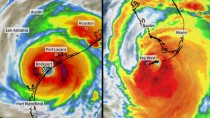
Left: Hurricane Harvey makes landfall near Rockport, Texas, on Aug. 25, 2017 | Right: Hurricane Irma makes its first landfall at Cudjoe Key, Florida, on Sept. 10, 2017 (graphic: Weather.com).
But the statistics of rare events (like hurricanes) are not very well behaved. Let’s look at this new record, and compared it to the 11+year period of no major hurricane strikes that ended when Harvey struck Texas.
The Probability of Two Cat 4 Strikes in One Year
By my count, we have had 24 Cat 4 or Cat 5 landfalls in the U.S. between 1851 and 2016. This gives a probability (prior to Harvey and Irma) of one Cat4+ strike every 7 years. It also leads to an average return period of two Cat4+ strikes of about 50 years (maybe one of you statisticians out there can correct me if I’m wrong).
So, since the average return period is once every 50 years, we were overdue for two Cat4+ strikes in the same year over the entire 166 period of record. (Again, for rare events, the statistics aren’t very well behaved.)
The Probability of the 11-Year “Drought” in Major Landfalling Hurricane
In 2015, a NASA study was published which calculated how unlikely the (then) 9-year stretch with no major hurricane landfalls was. They came up with a 177 year return period for such an event.
I used that statistic to estimate what eventually happened, which was 11 years with no major hurricane strikes.
I get a return period of 560 years!
Now, which seems more unusual and potentially due to climate change: something that should happen only once every 50 years, or every 560 years?
Maybe global warming causes fewer landfalling major hurricanes.
By James Delingpole
Spoiler alert: Gore’s scaremongering ‘facts’ are all inconveniently untrue.
Spencer, a principal research scientist at the University of Alabama in Huntsville, begins his book An Inconvenient Deception kindly, by noting that he much prefers the new movie to its 2006 Oscar-winning prequel An Inconvenient Truth.
It was much less of a PowerPoint presentation and more of a human interest story. It follows Gore over the years as he tries to convince fellow politicians, foreign heads of state, and the public that the climate crisis is real. While some have considered Gore’s role in the movie to be too self-indulgent, I thought it showed some humanity in someone many people over the years have considered too “stiff”.
But there the praise ends. When Spencer saw the movie, he was one of only three viewers in a 750-seat theater - and one of these people walked out half way through. This local reaction is borne out by the movie’s dismal reception at the box office. No one is going to see Al Gore’s terrible new movie. And - scientifically speaking, at least - they’re really not missing much.
Here are some of Al Gore’s dubious claims rebutted.
Greenland Melting
Gore is shown visiting cryospheric expert Konrad Steffen. “Surface melting is shown with dramatic aerial video. Rivers of meltwater form and plunge down into huge holes in the ice sheet called “moulins"."
But: “What isn’t mentioned is that this happens every summer, naturally.”
In fact this is a good example of Gore’s favorite cheat: show dramatic footage of a natural event - eg ice melting rapidly - and then leave the viewer to infer that this is another disastrous and unprecedented consequence of man-made climate change. It spares him the risk of telling flat out lies which might get fact-checked later. The viewer’s imagination does all Gore’s dirty work…
Meanwhile, in the real world, remember, Greenland recently recorded its coldest temperature ever measured in July for the Northern Hemisphere.
Flooding in Miami
Gore wants you to believe that this is caused by climate change. After all, in his previous movie he predicted sea level rises of 20 feet.
Sadly in the real world sea level has continued to rise at the same rate as for the last 150 years - about an inch per decade (Icecap note: more like 4 inches/century if you use stations where the land is not rising or sinking). Miami has always been beset by tidal flooding - so called “king tides”. But the other big problem is that its land has been sinking at a rate of around an inch per decade (3mm a year). Neither this, nor the sea level rise, has anything to do with climate change.
Storm Damage
Gore claims storms are getting more powerful.
Not true:
Roger Pielke, Jr. has done a lot of research in this area. As population increases, there are simply more things to break when a storm comes through. There have been no observed long-term increases in storm intensity from a meteorological point of view over the period of interest, that is, since the Industrial Revolution began. And even if there was an increase, there would be no way to attribute those changes to human activities.
Flooding of the 9/11 Memorial from Hurricane Sandy
Gore claims he predicted this in An Inconvenient Truth. No he didn’t: He only mentioned general sea level rise from melting of the Greenland ice sheet, not large surges from exceptional storms like Sandy, which have always been a risk for coastal residents. This is a clear case where Gore is deceiving you.
In fact the rate of sea level rise has not increased in New York: Sea level at Battery Park at the southern tip of Manhattan has been monitored since the 1850s, and has been rising naturally since that time at an average rate of 1.1 inch per decade, with no sign of acceleration.
Earthrise: The Big Blue Marble
Gore repeatedly invokes this famous image of the earth from space - one of the most viewed photos in the world - taken by Apollo astronaut and geologist Harrison (Jack) Schmitt on the Apollo 17 mission to the moon on December 7, 1972.
Here’s the irony:
Jack Schmitt, who I know and have worked with, is (like me) a skeptic of the supposed dangers of CO2 emissions and of the claim that climate change is entirely human-caused. He has been active in the fight to correct the record on climate change and the supposed dangers of carbon dioxide.
Solar Power, Solar City, and Elon Musk
Renewables salesman Gore is big on the idea that solar will save the world from fossil-fuel-induced warming. But there’s a fundamental problem with solar (and wind): It takes huge fields of solar collectors to collect much electricity from sunlight, clouds greatly reduce it, and 365 days a year it goes away at night. Fossil fuels are highly concentrated forms of energy, while solar and wind are relatively weak and diffuse. They are also expensive and only appear competitive if you ignore the vast taxpayer subsidies propping them up.
So, the claim that solar is in any way cheaper than fossil fuels is simply not true. Maybe someday it will be, but not any time soon. Without the government forcing citizens to pay more for solar through subsidies, the solar industry would have very little to sell other than for remote specialty applications where electricity is needed and there are no power lines to provide it.
The current success of Elon Musk, Tesla, Solar City, and solar energy installations in general is due to government subsidies. These are your tax dollars that the solar industry has convinced government to give to the solar energy effort. Investors, in turn, also cash in on the subsidies - while they last. The claim by Gore and others that the solar industry is employing vast numbers of people is not what you want if the product they provide is too expensive, or not in demand. As an extreme example of why the number of workers isn’t a good measure of economic value, we could put 100% of our labor force to work digging holes in the ground and filling them up again, but what would that do for our prosperity?
Verdict: Al Gore’s movie is an epic fail.
But we could kind of have predicted that, couldn’t we?
by Sam Rolley
A little more than a decade after his initial inconvenient truths failed to come to fruition, former Vice President Al Gore released a sequel to the “documentary” largely responsible for creating the cult of global warming. But in spite of Inconvenient Truth 2, “Truth to Power,” the only hot air many Americans sense is that coming from the climate obsessed left.
In fact, the past week offers a couple of alternative views for people who believe denizens of coastal cities ought to all be breathing through snorkels by now.
In a lengthy interview with a Los Angeles news outlet last week, Weather Channel founder John Coleman succinctly explained what the cult of global warming is all about: money and power.
Coleman made the statement as he decried San Diego Mayor Kevin Faulconer’s Climate Action Plan, an economically unsustainable effort to punish residents and businesses for global warming no one has proven exists or, for that matter, is a product of the progress of man.
“I think he saw money and power, and I don’t know what else he thought of it… I can’t believe he really [felt he] was going to save the city from some terrible fate,’ Coleman said, adding the whole global warming farce “just turns my stomach.”
The 82-year-old Weather Channel founder then offered this assessment of global warming alarmist projections: “San Diego’s not going to go underwater. Period… Not in my lifetime or yours or our kids’ lifetime. When the Earth ends in 4 1/2 billion years, it probably still won’t have flooded.”
He added: “The damn tsunami warning route signs that they put up all over the city [are] about as silly as anything I’ve ever saw in my life. The chance of a significant tsunami hitting Southern California is about as great as a flying saucer landing tonight at Lindbergh Field. It’s just sheer nonsense.”
Coleman is no stranger to battling global warming propaganda. On his personal blog, he’s made a mission of overturning claims made via bad climate science - using his background knowledge of basic weather patterns and mass media manipulation to make some pretty solid points. It’s worth a read.
“I’m just a dumb old skeptic - a denier as they call me - who ought to be jailed or put to death,” he told MyNewsLA. “I understand how they feel. But you know something? I know I’m right. So I don’t care.”
Coleman, of course, isn’t alone.
Another powerful argument against global warming conventional wisdom hit the web this week courtesy of alternative medicine expert Dr. Mark Sircus.
“Every prediction Gore has made has been wrong” he wrote, noting that the only organizations saying otherwise are those approved by the government and promoted by the press.
For Gore acolytes, read that as the power that needs to hear some truth.
Like Coleman, Sircus pointed out the big problem with being a skeptic: Anyone who dares dispute the establishment is quickly cut down and ridiculed.
He wrote: “Trump is just about the only politician in the world with the courage to stand up to all the lies about climate change. I would stop publishing so many essays on climate change if the press would let up on their global warming fraud but when I see their bold face lies an indignation arises in my belly. Even Trump dare not say a word more about climate change because they, the owners of all the mass media, would drown him, which they do anyway every day.”
Throughout the rest of his essay, Sircus noted multiple examples of actual recent climate events that should raise big questions about the theory that the planet is headed for its hottest days.
Based on the evidence he gathered, the doctor said he belies the opposite is true because of a phenomenon which has no relationship to how man behaves on planet earth.
He wrote: “Solar cycles typically last 11 years and during that time, the north and south magnetic poles flip. It looks a lot like a heartbeat when graphed out. We are currently in Cycle 24.
“The solar scientists say that the latest model shows the Sun’s magnetic waves will become offset in Cycle 25, which peaks in 2022. Then, in Cycle 26, solar activity will fall by 60 per cent.”
Bottom line: Either global warming is a terrifying reality that should concern us all to the point of making major lifestyle changes; or it’s an effort in social engineering to encourage the masses to accept more government restriction and regulation without question.
Based on millionaire Gore’s greenhouse gas heavy lifestyle, I’m going with the latter.
By Julie Kelly
You’d think the 97 percent of scientists who supposedly all agree about climate change would eagerly line up to vanquish climate deniers - but apparently not.
Way, way back in April 2017, scientists around the world participated in the ‘March for Science’ as a show of force and unity against an allegedly anti-science Trump administration. Their motto was “science not silence”: many wrote that mantra on pieces of duct tape and stuck it across their mouths.
March for Science organizers claimed that “the best way to ensure science will influence policy is to encourage people to appreciate and engage with science. That can only happen through education, communication, and ties of mutual respect between scientists and their communities - the paths of communication must go both ways.”
But that was so three months ago.
Many scientists are now rejecting an open debate on anthropogenic global warming. EPA administrator Scott Pruitt appears ready to move forward with a “red-team, blue-team” exercise, where two groups of scientists publicly challenge each other’s evidence on manmade climate change. The idea was floated during a Congressional hearing last spring and outlined in a Wall Street Journal op-ed by Steve Koonin, former undersecretary of energy in the Obama administration. Koonin said the public is unaware of the intense debate in climate science and how “consensus statements necessarily conceal judgment calls and debates and so feed the “settled,” “hoax” and “don’t know” memes that plague the political dialogue around climate change.”
It would work this way: A red team of scientists critiques a key climate assessment. The blue team responds. The back-and-forth continues until all the evidence is aired and refuted, followed by public hearings and an action plan based on the findings. It happens entirely out in the open. Koonin said this approach is used in high-consequence situations and “very different and more rigorous than traditional peer review, which is usually confidential and always adjudicated, rather than public and moderated.” (Climate scientist Judith Curry has a good primer on this concept here.)
Pruitt is prepared to pull the trigger on this idea, according to an article in E&E News last week. In an interview with Breitbart News on June 5, Pruitt touted the red-team, blue-team initiative, saying that “the American people need to have that type of honest open discussion, and it’s something we hope to provide as part of our leadership.”
Instead Of Dialoguing, Climate Scientists Preach
Now you would think the scientific establishment would embrace an opportunity to present their case to a wary, if disinterested, public. You would think the 97 percent of scientists who supposedly all agree human activity is causing climate change would eagerly line up to vanquish climate deniers, especially those in the Trump administration. You would think the same folks who fear a science-averse President Trump would be relieved his administration is encouraging a rigorous, forensic inquiry into the most consequential scientific issue of our time that has wide-ranging economic, social, and political ramifications around the world.
You would think.
But instead, many scientists and activists are expressing outrage at this logical suggestion, even advising colleagues not to participate. In a June 21 Washington Post op-ed, three top climate scientists repudiated the red-team concept, offended by the slightest suggestion that climate science needs fixing. Naomi Oreskes, Benjamin Santer, and Kerry Emanuel wrote that “calls for special teams of investigators are not about honest scientific debate. They are dangerous attempts to elevate the status of minority opinions, and to undercut the legitimacy, objectivity and transparency of existing climate science.”
In a July 1 post full of irony, leading climate scientist Ken Caldeira blasts the climate contest: “We don’t want red team/blue team because science doesn’t line up monolithically for or against scientific positions.” What? Never mind the 97 percent consensus claim that’s been shoved down our throats for the past decade. (Caldeira also wrote just a few months ago that “the evidence for human-induced global warming is now so strong that no sensible person can deny a human role in these temperature increases. We can argue about what we should or should not do ... but the argument is over.")
Caldeira then smugly questions why “politicians who have never engaged in any scientific inquiry in their lives believe themselves to be the experts who should tell scientists how to conduct their business?” (Shall we then ask why scientists who have never engaged in any legislative or political endeavor in their lives believe themselves to be the experts who should tell lawmakers how to conduct their business?)
Climate Scientists Fear Losing Power, Nothing Else
Then there is the interminably-petulant and prosaic Michael Mann, who routinely dishes out the “denier” name to anyone who crosses him, and recently compared himself to a Holocaust survivor. Mann told ThinkProgress that the red-team concept is “un-American” and a ruse to “run a pro-fossil fuel industry disinformation campaign aimed at confusing the public and policymakers over what is potentially the greatest threat we face as a civilization.”
Aha! Right there is the key objection to the entire exercise: the risk to their political power. These activists know that climate change long ago stopped being about science. It is a liberal, big-government agenda wrapped up in a green cloak of superiority and virtue. For the past decade, the pro-climate crusaders have ruled policymaking, from international organizations to federal agencies down to your local park district. The Trump administration poses the first threat to their dominance, and instead of being up to the task of defending it - in public, with evidence and not platitudes, facing scientists they have smeared for not being part of the ‘consensus’ - they want to walk away.
That’s why I hope Pruitt proceeds with it. Let the blue team have an empty bench that will show American exactly what they think of ‘science’ - and them.
Julie Kelly is a National Review Online contributor and food policy writer from Orland Park, Illinois. She’s also been published in the Wall Street Journal, Chicago Tribune, Forbes, and The Hill.
By Pierre Gosselin
We have all heard about the record-breaking ice mass balance and cold temperature reading of -33C recently set in Greenland - the Arctic island that is supposedly the canary in the climate coal mine.
It turns out that things up there are colder than we may be led to believe and that the alleged warming there is fiction.
Hat-tip: Gerti
Struggling to explain
The Swiss online Baseler Zeitung (BAZ) here reports: “In Greenland July this year has been the coldest ever. That has left climate catastrophists struggling to explain it.”
Citing the Danish Meteorological Institute, the BAZ comments that the -33C reading earlier this month was “the coldest July temperature ever recorded in the northern hemisphere”, smashing the previous record of 30.7C.
Expanding ice mass, media ignores
The BAZ adds that also the “ice cover has grown strongly over almost all of Greenland”.
But this has been ignored, as the Switzerland-based daily also bravely writes that “most journalists and media leaders are active or passive members of the green-socialist Climate Church and the new religion of the post-Christian western world” and acknowledge only things that fit their world narrative. This likely explains why there’s been no word about the record cold in Greenland. Why? The BAZ comments:
It casts the central prophesy of a continuous and ultimately lethal global warming, for which we are ourselves to blame, into question.”
Greenland has been cooling
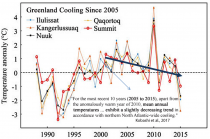
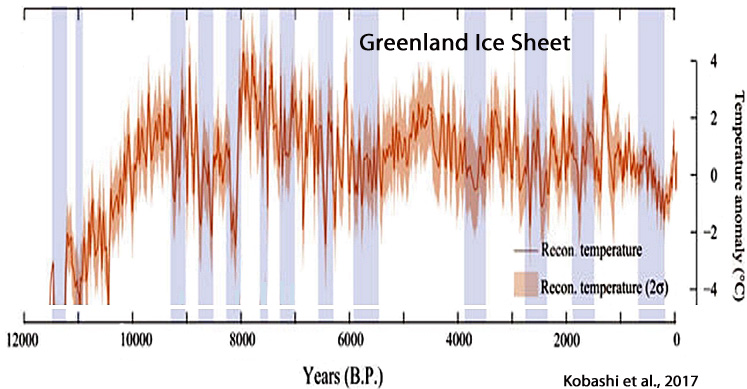
Recently NTZ reported here that Greenland in fact has been cooling over the past decade, as three recent studies alarmingly show us. According to one published in May of this year by a team of researchers led by Takuro Kobashi of the University of Bern, mean annual temperatures at the summit of Greenland have been showing “a slightly decreasing trend in accordance with northern North Atlantic-wide cooling”. See chart below.
Enlarged
Greenland’s temperatures headed in the wrong direction, defying climate model projections. Underlying chart source: Kobashi et al., 2017.
Warm optimum near an end?
The team by Kobashi also show that the Greenland Summit temperature have not risen in 90 years, and that Greenland was far warmer earlier in the Holocene:
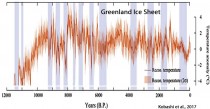
Greenland temperatures were much warmer over past 10,000 years than they are today.
One has to wonder if the current optimum may be nearing an end. History shows that the earth’s surface temperature is in fact highly unstable and that most optimums don’t last much beyond 10,000 years. We need to ask ourselves what could be done to avert the catastrophe that a new ice age would bring with it. The overall trend does not bode well.
---------
See this post on Greenland Ice by Tony Heller on the “Year Wittout an Arctic Summer”.
Joseph D’Aleo, CCM, AMS Fellow
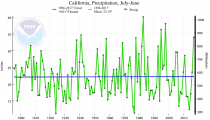
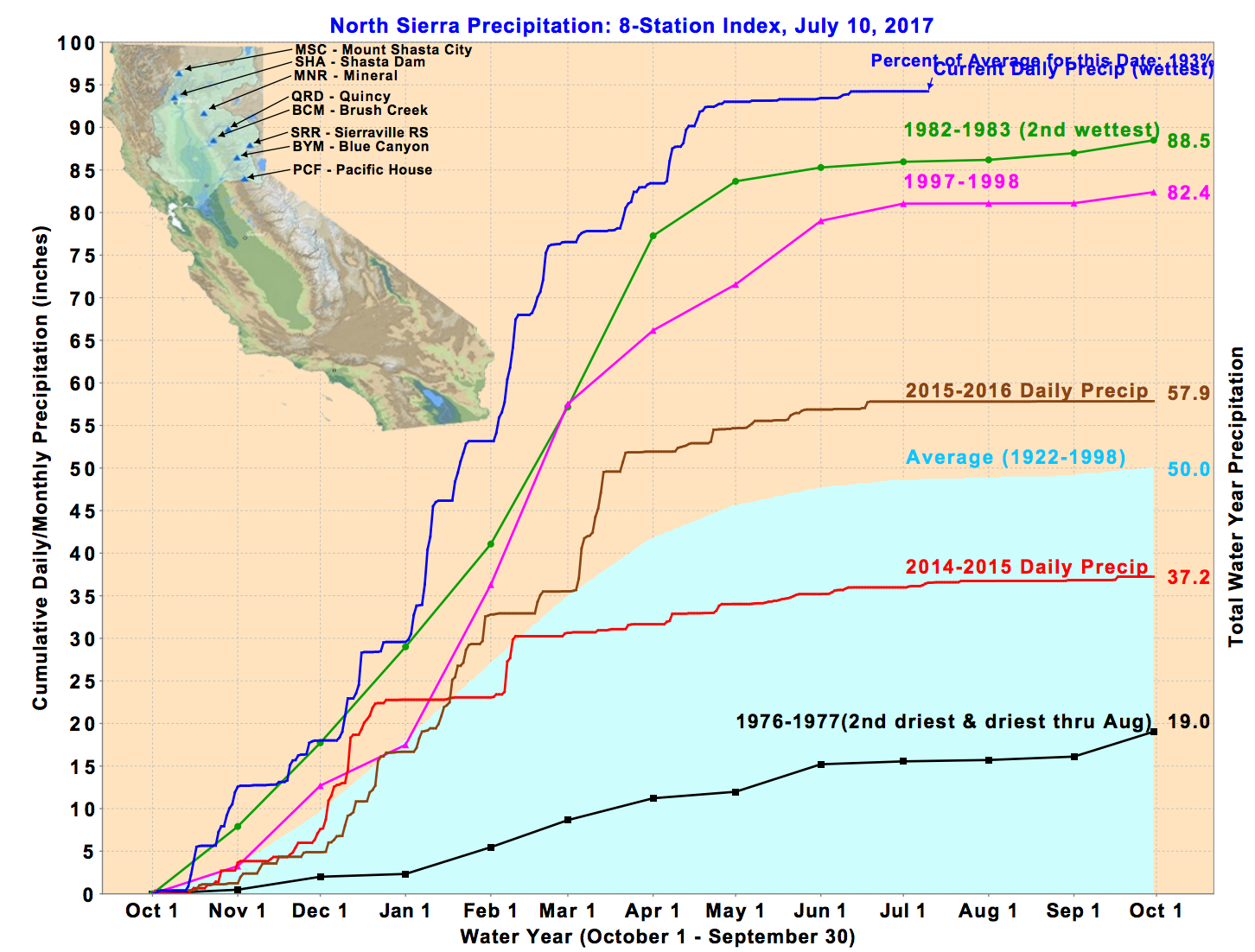
California precipitation is tied to the state of the Pacific Ocean (both ENSO where the El Ninos which are usually wet and La Ninas which are usually dry and the longer term Pacific Decadal Oscillation which influences the strength and frequency of El Nino and La Nina). It is highly variable but the long-term trend is a meaningless +0.01"/decade or +0.1” per century. That however does not stop climate scientists trolling for dollars or media environmental reporters from making it into a scare story.
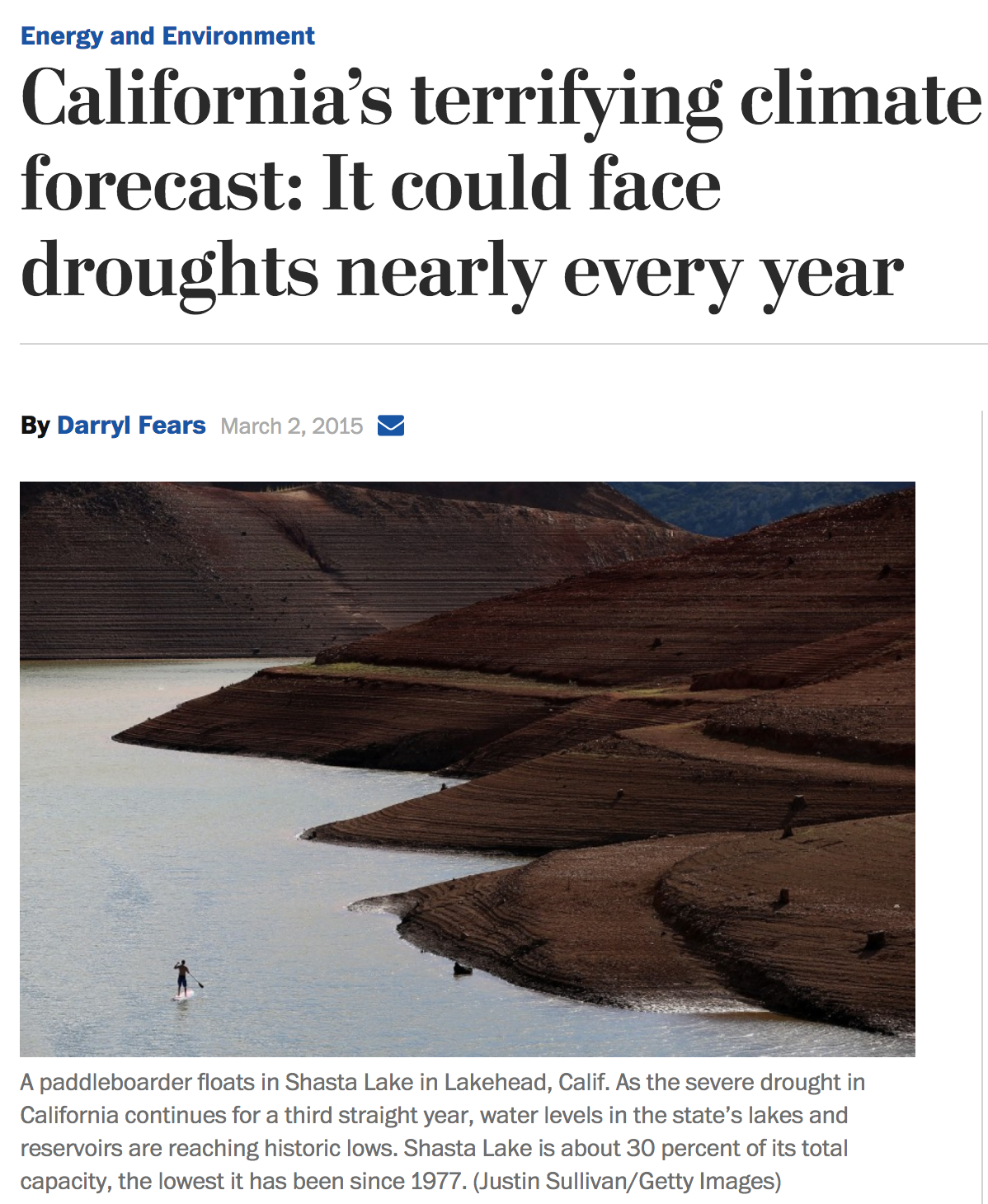
Back just over a year ago in 2015 at the end of the two year drought, in the Washington Post, Darryl Fears had these headlines with many universities predicting future heat and drought and raising the possibility that is had already started!
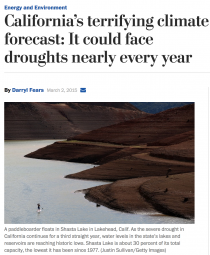
The reporter actually did a lot of research into university research. Little did he know it all is nonsense.
-----
But then came the 2016/17 wet season which in places had the all-time record precipitation and snowfall (over 200% of normal).
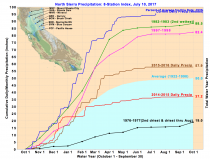
And the result:
Climate scientists predict wet future for California
“What I am arguing is El Nino-like years are going to become more the norm in California,” said researcher Robert Allen.
UPI By Brooks Hays | July 6, 2017 at 3:50 PM
Heavy rain coupled with severe erosion caused the winter 2017 damaging of the Oroville Dam in northern California. New climate models run by scientists at the University of California, Riverside project that the northern part of California could experience increased rainfall through 2100.
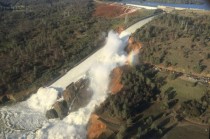
Heavy rain coupled with severe erosion caused the winter 2017 damaging of the Oroville Dam in northern California. New climate models run by scientists at the University of California, Riverside project that the northern part of California could experience increased rainfall through 2100. File Photo by EPA/California Department of Water Resources
July 6 (UPI)—Climate scientists now expect California to experience more rain in the coming decades, contrary to the predictions of previous climate models.
Most scientists agree that California, like most places, will get warmer through the end of the century. And until now, most agreed California would get drier. New research out of the University of California, Riverside, however, suggests otherwise.
The new models predict the state will enjoy a 12 percent increase in precipitation totals through 2100.
Both central and northern California will get wetter, according to the models, while Southern California will experience slightly less precipitation through the end of the century. Most of the increase in precipitation will be during the winter months.
“Most previous research emphasized uncertainty with regards to future precipitation levels in California, but the overall thought was California would become drier with continued climate change,” Robert Allen, an associate professor at UC Riverside, said in a news release. “We found the opposite, which is quite surprising.”
Weather variability makes it difficult to project how climate change will affect rain and snow totals. Predicting future precipitation totals in California is further complicated by the fact that the northern half of the state is expected to get wetter while the southern half is predicted to get drier.
But predictive climate and weather models are growing more sophisticated, allowing scientists to quiet the noise of yearly variability and focus on longterm patterns.
The new research—detailed in the journal Nature Communications—suggest increasing surface temperatures in the tropical eastern Pacific Ocean, lying to the 2,500 miles east, will encourage a local trade wind delivering a larger number of storm systems to the California coast.
“Essentially, this mechanism is similar to what we in California expect during an El Nino year,” Allen said. “Ultimately, what I am arguing is El Nino-like years are going to become more the norm in California.”
In other words, California’s future is likely to look more like the past two years, during which the state enjoyed record rainfall totals.
-----------
This is a little like Texas where the drought of 2011-2013 was supposed to be the start of a permadrought...but then came the flooding. Note the multi-year (7) more serious drought in the 1950s - both a reflection of the 60 year multidecadal ocean cycle?
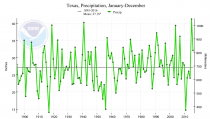


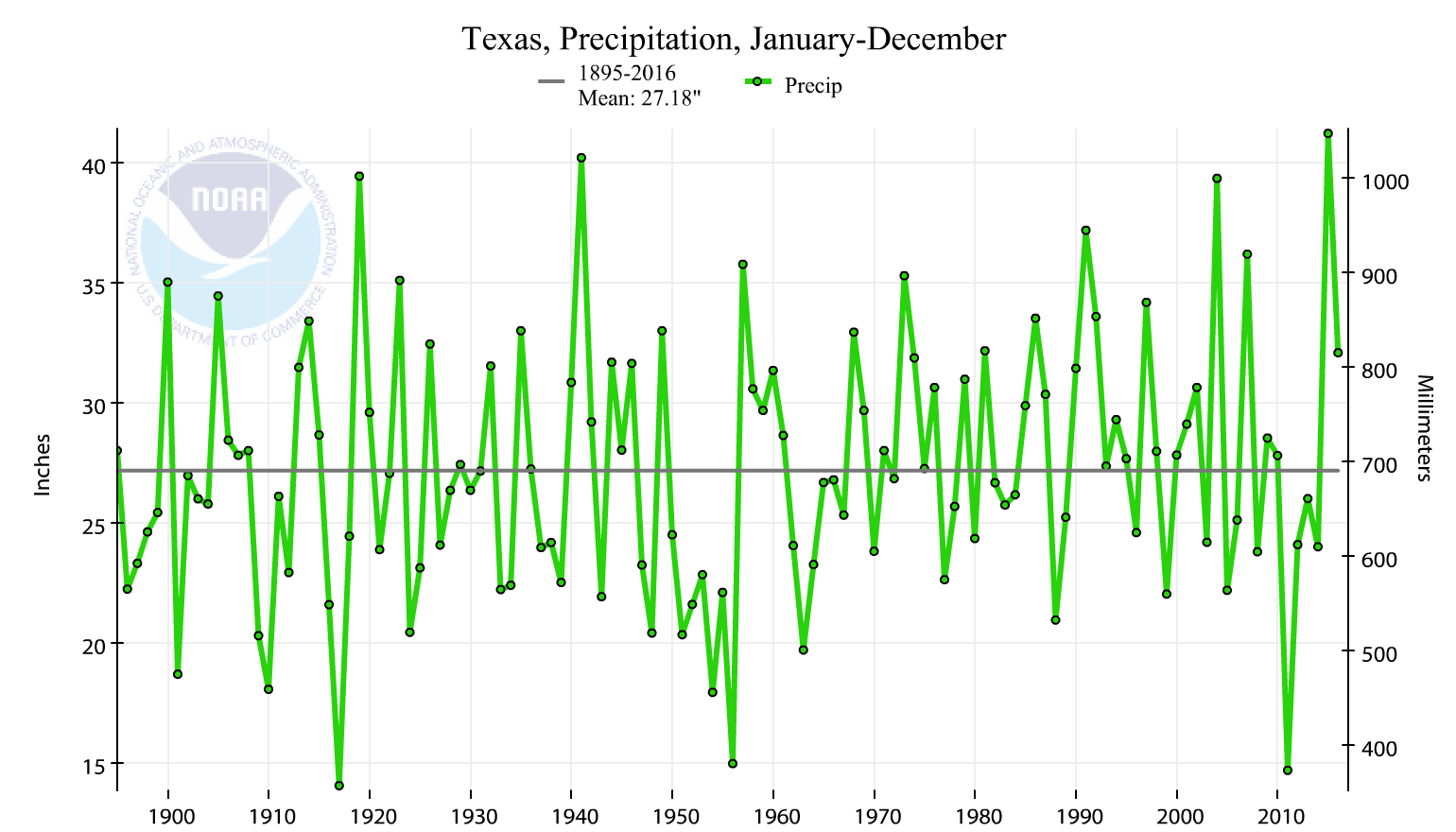
The long term trend was flat at the time of the drought early this decade, now it slightly up since 1895.