




By S. David Sultzer American Thinker
Trump’s EPA has started the process to rescind the EPA’s authority to regulate CO2 and other alleged greenhouse gasses. It would remake our nation and shake a Western civilization already being pummeled by green madness. These regulations, both here and abroad, have been stalking horses for socialism and vehicles for fraud. graft, and funding left-wing actors on a scale unseen in human history.
On the international stage, the move to declare CO2 a pollutant and man its evil cause agent began in the 1970s with the first communist billionaire in the west, Maurice Strong. In 1988, Strong was instrumental in creating the United Nations Intergovernmental Panel on Climate Change (UN IPCC), an organization that had as its primary purpose proving that “human activities” were increasing CO2 and to plan reparations for poor nations caused by western polluters.
Until 2007, the US resisted the claim that CO2 was a pollutant that could be regulated to adjust the world’s climate. That year, five activist Supreme Court Justices donned white lab coats of climate scientists in Massachusetts v. EPA to hold that the Clean Air Act was written so broadly that it gave the EPA, created simply to clean up pollution, almost unlimited authority to regulate carbon dioxide, an essential, albeit minute, part of our atmosphere.
This judicial overreach mattered because even a super-majority of congressional Democrats had rejected a law that would have authorized the EPA to regulate CO2. Armed with this Supreme Court ruling, Obama’s EPA acted unilaterally in 2009 to declare CO2 a pollutant it could regulate. How’s that for spitting in the face of Art. 1, Section 1 of the Constitution, which holds that the power to legislate is vested solely in Congress?
Today, according to those steeped in the canard of global warming, we sit at the edge of climate catastrophe. The climate is warming at an unprecedented rate. Sea levels will rise to inundate the lands. Floods and hurricanes are increasing in number and severity.
Perhaps worst of all, the evil little troll, Greta Thunberg, is mad at us
That’s the narrative: We are in a climate crisis and humanity itself is in danger. The WEF tells us that the cost of failing to respond to climate change will bankrupt the world. The only solutions are to adopt socialism and transfer the wealth of the US to the UN, where it can be redistributed as a form of green reparations.
Except...all of that is hot garbage.
Climate science is little more than modern Lysenkoism. It has been subject to decades of gatekeeping in universities, grant-making entities, the UN, and science journals, all working together to suppress any challenges to “the anthropogenic climate change consensus.” All too often, “climate modeling has transformed from a scientific tool into a mechanism for manufacturing hysteria.”
The climate models used to forecast doom in the coming decades are a canard. They have uniformly and grossly overstated the actual warming trends.
The temperature records have been reworked repeatedly over the past decades to create a warming trend far in excess of the raw historic data, and which data is, itself, questionable.
Many climate studies rely on questionable peer review as ostensible proof of their reliability rather than reproducing the studies.
Notably, there has been no increase in the number or severity of weather-related disasters for decades. The actual trendline, according to Roger Pielke, Jr., is completely flat.
[T]he completely false notion that global weather and climate disasters have increased and will continue to increase is commonly reported in the legacy media, buoyed by the promotion of false information by organizations that include the United Nations. In 2020 the U.N. claimed falsely of a “staggering rise in climate-related disasters over the last twenty years.”
Yet despite all of the above - much of it known for well over a decade - the climate change juggernaut has ignored it all and rolled on. The twin benefits to those pushing this canard are increased government power and access to almost limitless wealth.
By Joseph DAleo, CCM Co-Chief Meteorologist Weatherbell Analytics, LLC
Climate alarmists have consistently said we could look forward to more frequent and stronger hurricanes, thanks to climate change. Our climate is always changing but the changes are driven by natural cycles. Ocean temperature events like El Nino and La Nina and longer-term cycles like the Pacific Decadal Oscillation (PDO) and Atlantic Multidecadal Oscillation (AMO) determine where hurricanes are most likely to occur and how strong and damaging they may become.
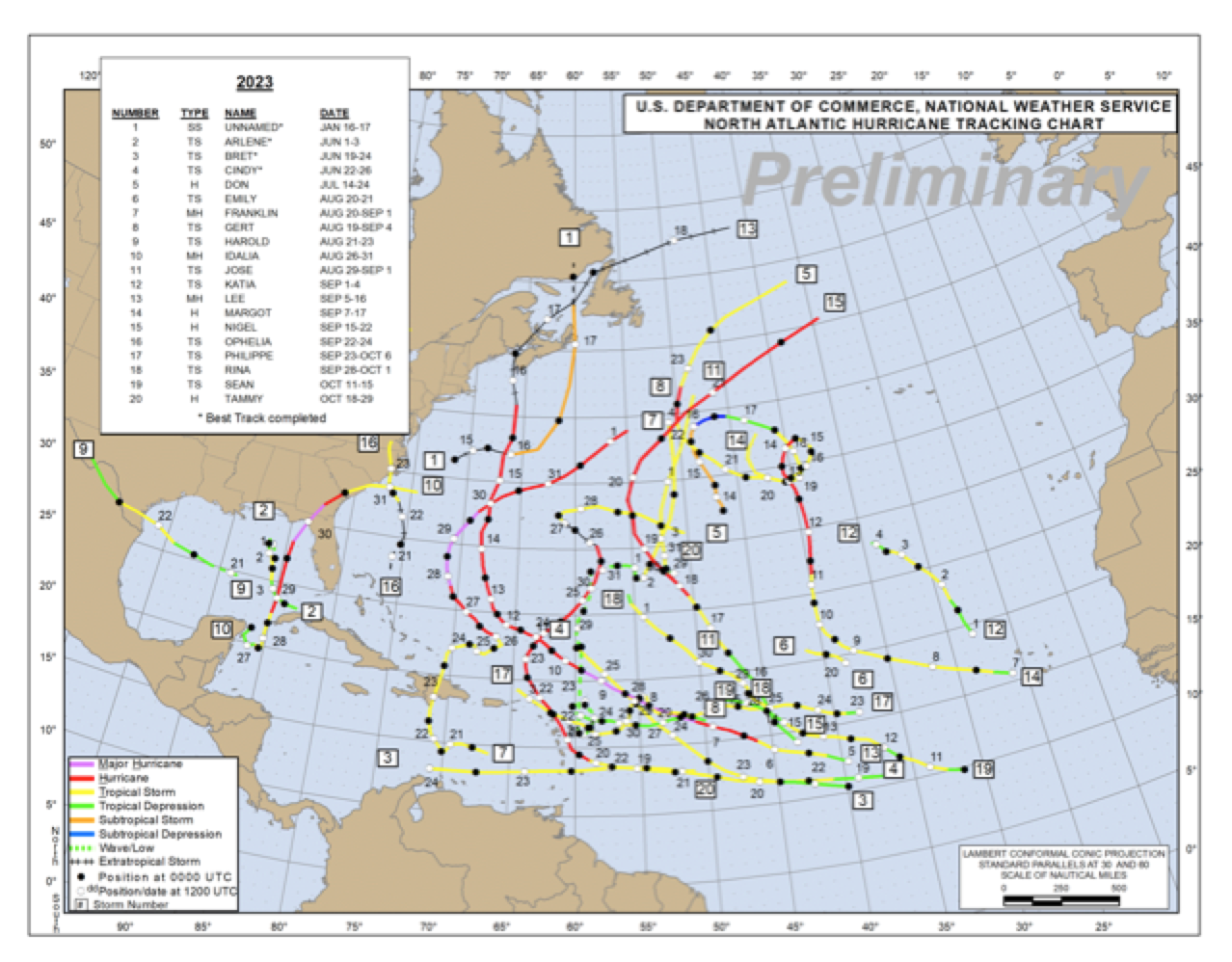
In 2023, in the Pacific, a strong El Nino developed in the eastern Pacific after a 3 year stubborn La Nina, favoring more and stronger storms in the Pacific. Meanwhile, a record warm tropical and subtropical Atlantic created a conducive environment for the continuation of overall above-normal Atlantic hurricane seasons. However, the El Nino played a role in keeping all but one Atlantic storm (Idalia) out at sea.
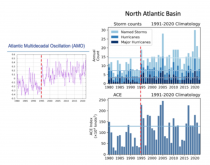
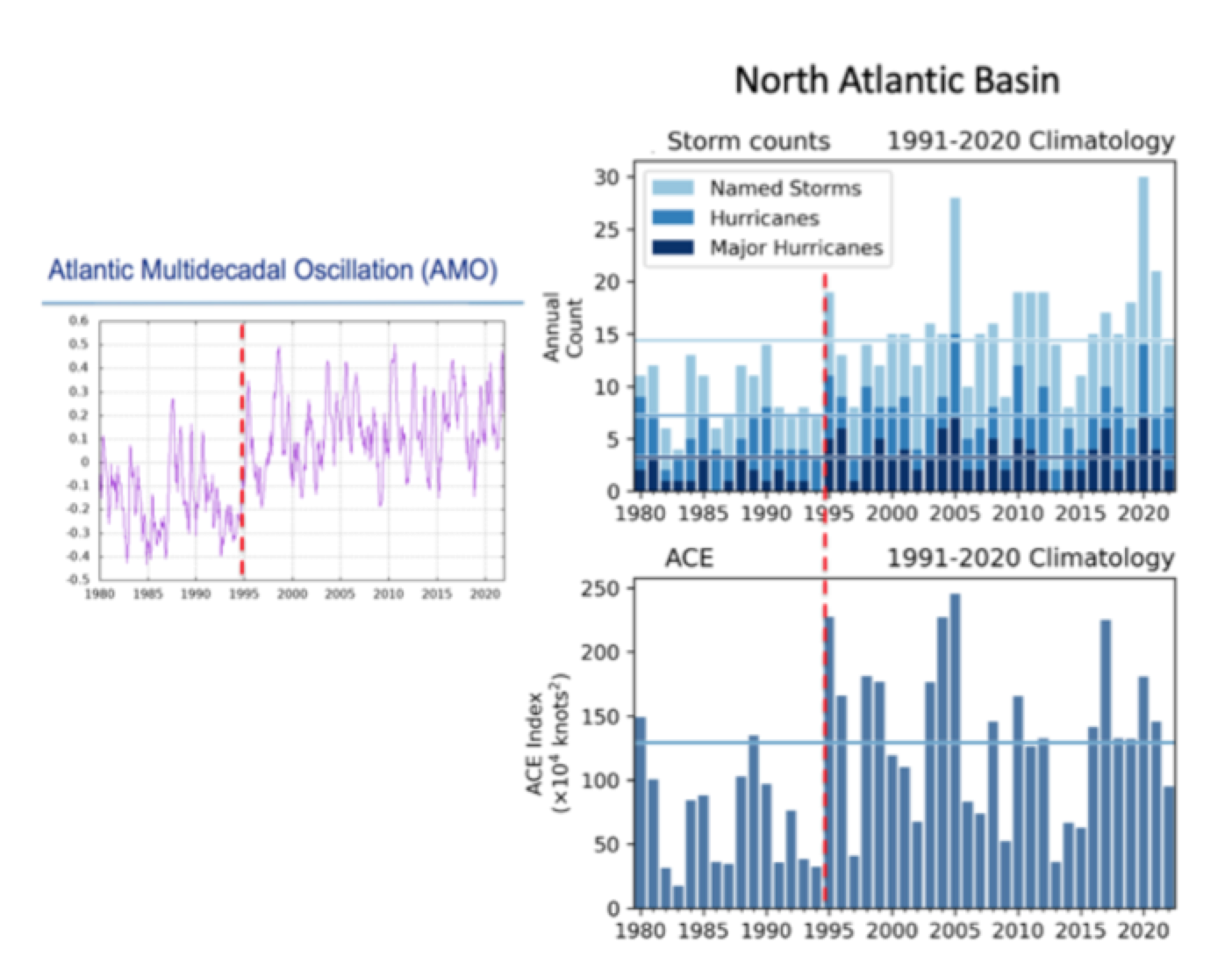
A great example of the roles of the oceans has been observed the last half century. When the Atlantic was cold in the 1960s to early 1990s (negative AMO or Atlantic Multidecadal Oscillation) Atlantic storms were much less frequent and landfalls mostly limited to the Gulf Coast. When the Atlantic swung into its multi-decadal warm mode in the late 1990s, the activity in the Atlantic more than doubled on average.
Enlarged
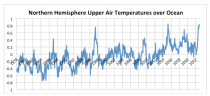
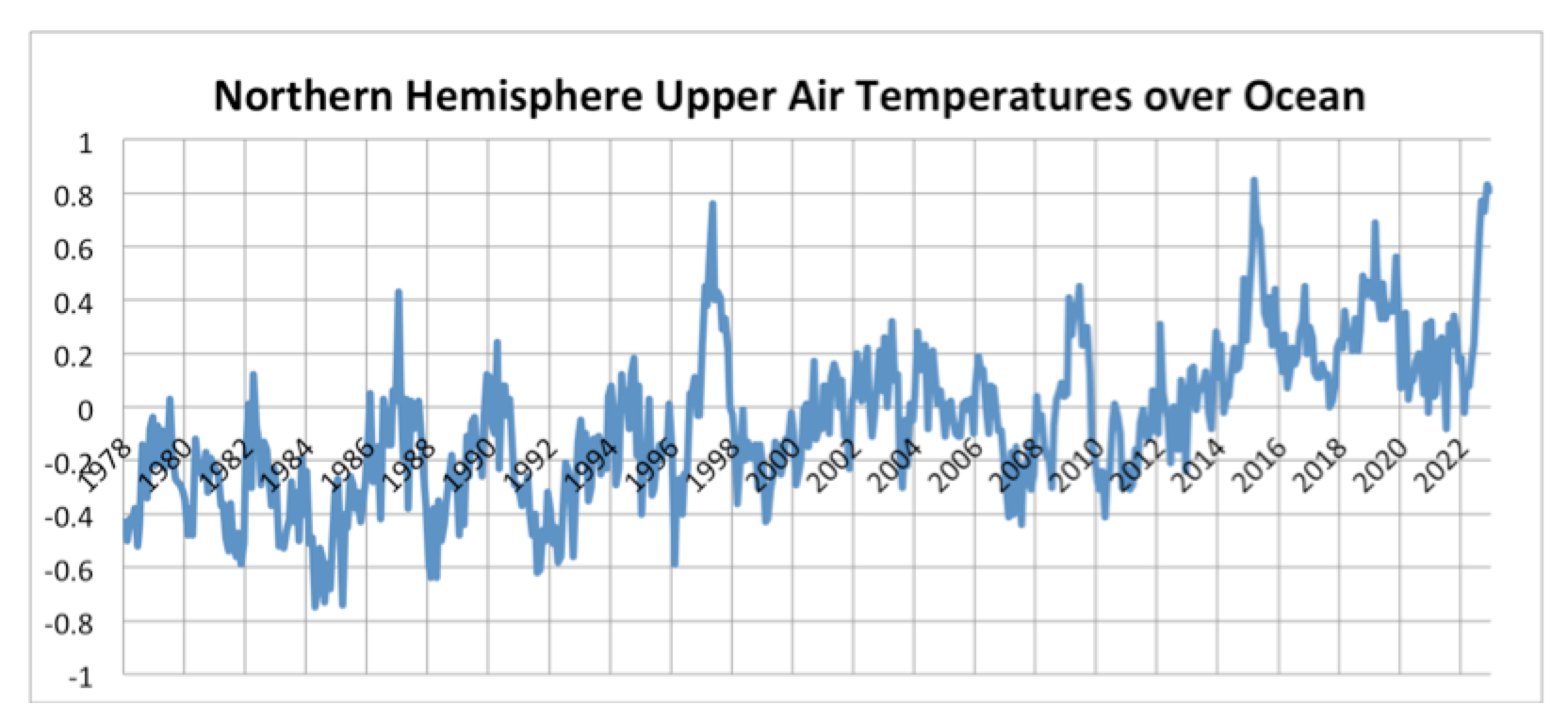
The Atlantic temperatures spiked in 2023 as the planet readjusted after 3 years of La Nina. Some scientists believe that Hunga Tonga-Hunga Ha’apai erupted in January 2022, shot 146 metric megatons of water into the stratosphere potentially contributing to atmospheric warming according to a new study published in Nature Climate Change.
THE PACIFIC OCEAN CYCLE - EL NINOS VS LA NINAS
Activity tends to be higher in the Atlantic Basin when the Atlantic is warm and when La Ninas and the negative (cold) Pacific Decadal Oscillation (PDO) are in place in the tropical Pacific. The cold eastern Pacific waters in La Ninas reduce hurricane development in that region but do not affect Atlantic activity.
When El Ninos and the warmer Pacific Decadal Oscillation (PDO) are present, hurricanes become more likely there but the east Pacific storms produces shear in the upper atmosphere in the Atlantic that disrupts developing storms.
Gray 1984 found that of the 54 major hurricanes striking the U.S. coast between 1900 and 1983, only 4 occurred in 16 El Nino years in contrast to 50 making landfall during the 68 non El Nino years. This is a rate of 0.25 major hurricanes during El Nino and 0.74 per year in non-El Nino years, almost a 3 to 1 ratio. Tartaglione etal in 2002 showed there was a 71% greater chance of an impact on the east coast in La Nina years
When a three-year La Nina faded this spring and summer, expectations were that the warm water would generate super storms in the Pacific Basin.
Indeed Hurricane Hillary on late August became the first tropical cyclone to make landfall in California in over eight decades. Death Valley, known for being the hottest place on earth, received a year’s worth of rain in 24 hours, had its wettest day in history. Otis followed in late October intensifying a full five categories, from a tropical storm to a Category 5 hurricane - the highest level - in less than 24 hours before landfall on Mexico.
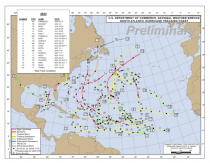
For the Atlantic, record warm ocean temperatures August to October resulted in 20 named storms, 4th highest for the U.S. but thanks to El Nino, only Hurricane Idalia made landfall with max winds of 110 kt the strongest hurricane to make landfall in the Big Bend region of Florida since 1896.
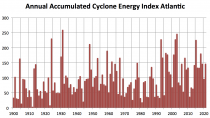
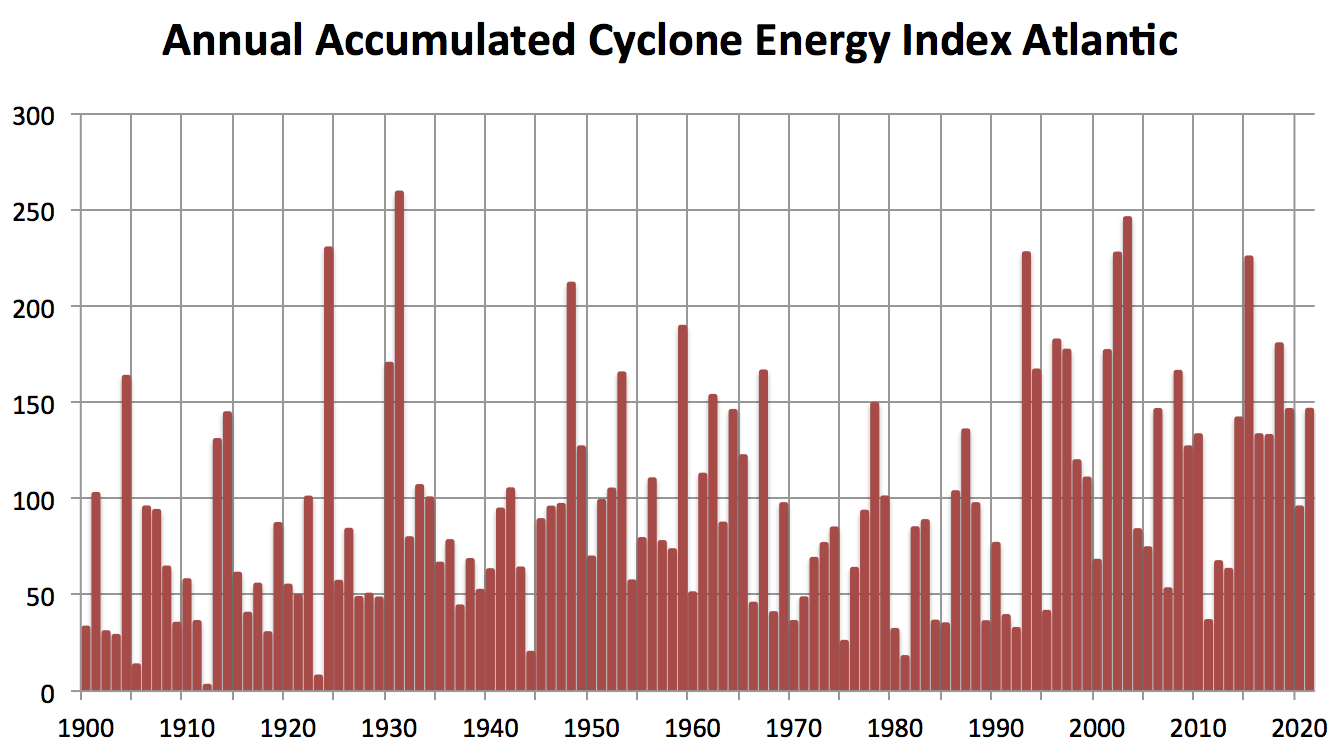
The Accumulated Cyclone Energy Index, the best measure of the seasons activity shows the active period starting in the middle 1990s with the Atlantic AMO in it’s warm mode.
The late season was characterized by sinking motion and no storm development in the Caribbean during September, often a busy time of year. Without tropical activity, drought conditions prevailed in the western Gulf States.
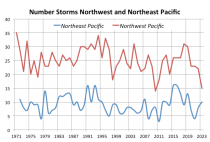
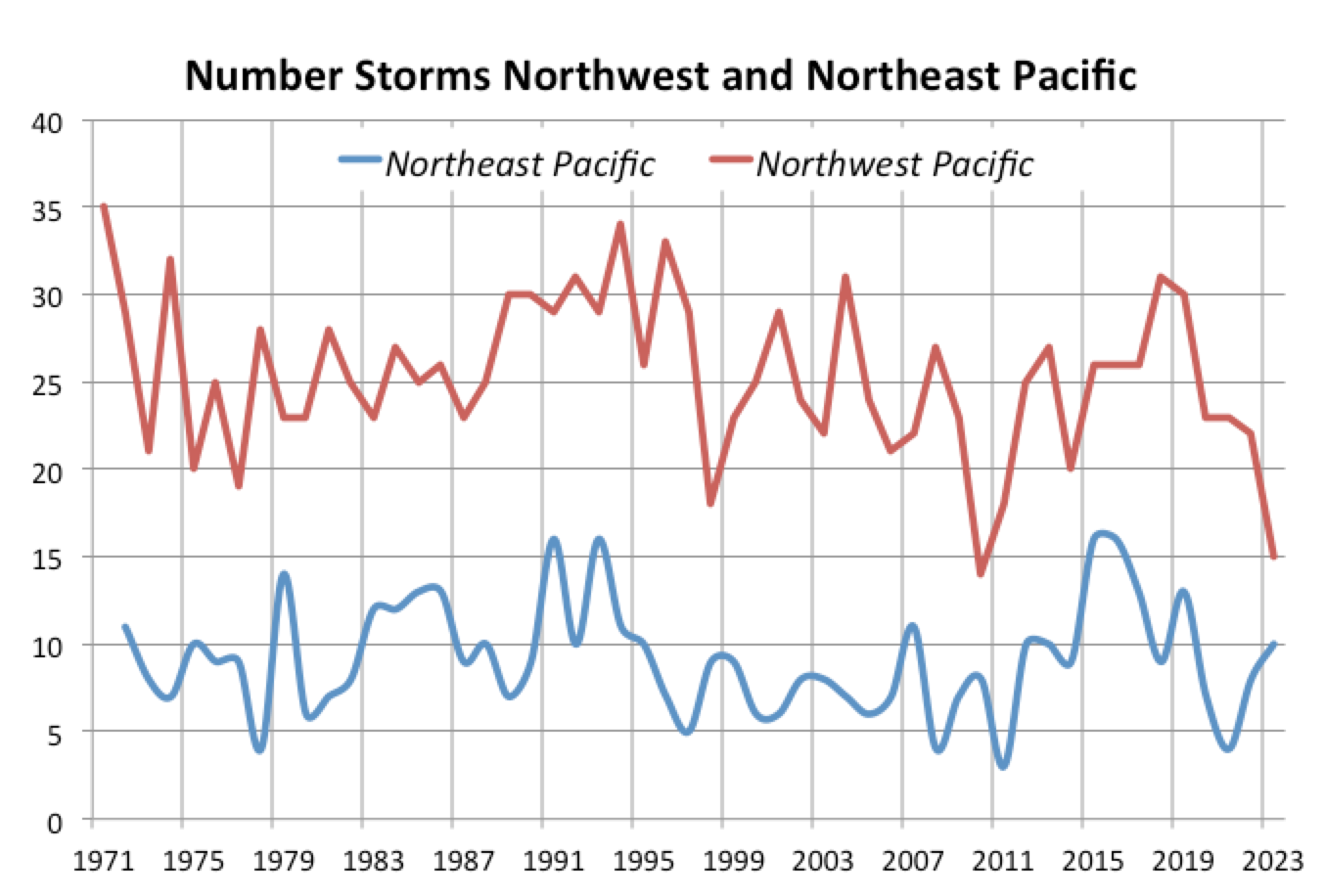
The El Nino was biased to the eastern Pacific during the early to mid tropical season, which kept the overall numbers down in the western Pacific region.
Enlarged
It should be noted that the 2023 season was characterized by unusual rapid intensification of some of the storms that impacted land as well as unusual landfall locations. Dr. Phil Klotzbach, one of the many star students of the late great Dr. Bill Gray continues his fine work at CSU. See his excellent detailed review of this unusual season here.
See more detail on hurricane seasons here
by ROY W. SPENCER September 7, 2022, 11:48 PM
UPDATE:
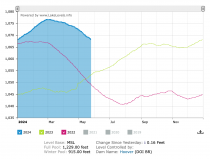
Record snows in California brought water levels back to near normal. That continues into 2024.
-----------
The media is promoting disinformation on the cause of the reservoir’s record-low level.
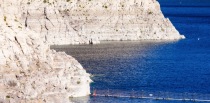
Lake Mead (Michael Vi/Shutterstock)
The water level in Lake Mead is reaching record lows and the popular narrative maintains that drought brought on by human-caused climate change is to blame. But the government’s own data from the Bureau of Reclamation shows this is not true.
Imagine a large city has been built in the middle of the Sahara Desert. Since no precipitation falls there, a large man-made reservoir is created with water piped in from a thousand miles away. The desert city grows over time, but the water supply does not. Over the years, the desert city must ration water as the reservoir is drained due to overuse. In this hypothetical situation, would it be rational to blame the water shortage on drought and global warming? No.
Yet, this is the situation we have with Lake Mead.
As can be seen in the Bureau of Reclamation’s official estimate of the yearly natural water flows into Lake Mead, there has been no long-term trend in water flow into the reservoir.
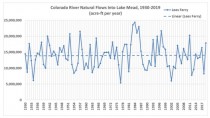
Yearly natural water flows into Lake Mead at Lees Ferry, Nevada, since 1930. The measured flows have been corrected for upstream diversions created over time to provide a best estimate of whether climate change has caused drought-induced reductions in water supply to Lake Mead. Details of those corrections are described here. Data source here.
Most of the water supplying the Colorado River at this location comes from snowmelt in the upper Colorado River watershed. The April snowpack in that region also shows no trend.
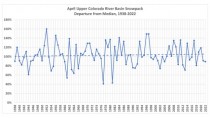
Upper Colorado River watershed snowpack as estimated each April from 1938 to 2022. Department of Agriculture data source here.
So, why is Lake Mead losing so much water? The answer is overuse. The Colorado River Basin Water Supply and Demand Study, published in 2012, showed that water demand from Lake Mead increased rapidly over the decades but remained less than water supply until around 2000, after which usage exceeded the available water supply in most years. This is what can be expected when we build cities in the desert (e.g. Las Vegas) and grow crops on arid land where there is insufficient natural precipitation.
That virtually every news story we read blames the water crisis on climate change or drought leads to widespread disinformation on the causes of falling water levels in Lake Mead. This then leads to expensive and misguided solutions to the problem. For example, on July 22, Forbes published an article titled “Why Is Lake Mead Shrinking? Climate Change Is a Major Reason.” Also in July, NASA published ”Lake Mead Keeps Dropping,” in which the agency stated the reservoir “provides a stark illustration of climate change.”
In fact, climate change does not even predict reductions in precipitation in the region that feeds water to Lake Mead.
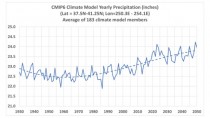
CMIP6 climate model projections of yearly precipitation over the upper Colorado River watershed. Climate model data archived here.
Rational approaches to climate change, to the extent it exists, must be informed by accurate data. This is why Dr. John Christy and I created and continue to maintain and update a satellite-based global temperature dataset at the University of Alabama in Huntsville. That global dataset shows less global warming than scattered surface-based thermometers, which are prone to increasing spurious heat sources over time.
But in the case of Lake Mead, the datasets (such as those in the three graphs above) are not even in question. The problem is that lazy and biased reporting - even in some scientific reports - has led to the widespread misperception that climate change is responsible for Lake Mead losing water. It’s not.
Lake Mead is being drained. It’s not climate change.
Roy W. Spencer is a Ph.D. meteorologist and climate researcher at the University of Alabama in Huntsville, and was formerly an award-winning NASA Senior Scientist for Climate Studies.
by Vijay Jayaraj
Amidst the clamor surrounding the intensive use of coal in China and India, one may not realize that these nations have some of the world’s largest renewable energy installations.
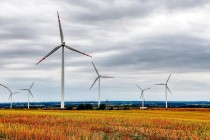
In fact, I hail from the Indian state of Tamil Nadu which is often compared to Scandinavia for its large number of wind farms. Accounting for 25 percent of the country’s wind capacity, the state has the largest share of such generating assets in a nation of 1.3 billion people.
Yet even Tamil Nadu relies heavily on coal to meet its electricity demands, with power emergencies and blackouts being the order of the day anytime there are shortages of fuel. It is much the same across the country, where 70 percent of the electricity comes from coal.
The much-touted wind farms are of little help in such emergencies. Yes, they generate electricity, but it is highly insignificant, only 4.6 billion units compared to coal’s 92 billion units. Despite wind accounting for 10 percent of total installed capacity in the country’s power sector, its total contribution to generation is less than three percent. Wind farms simply cannot produce on-demand electricity, and certainly not in the amount needed by large cities.
“Yet again, power cuts have become the norm in Tamil Nadu; there is already a huge impact on people’s lives,” said the former chief minister of the state.
Last month, Tamil Nadu’s chief minister pleaded for more coal as supply was critically low: “The Chief Minister M K Stalin wrote to Prime Minister Narendra Modi, demanding his intervention to ensure the supply of 72,000 (million tonnes) of coal per day.”
Even a small hiccup in the supply of coal results in widespread blackouts across an entire state. This reveals that the wind capacity of the state is an exaggerated asset that cannot deliver when power is needed. The wind farms work well only during optimum wind months, which means they are useless for more than half of the year.
The officials in charge of delivering power to people are aware of this pathetic situation and, hence, continue to invest in fossil fuel energy sources, especially coal.
The state recently approved the construction of an additional 2,640 megawatts of capacity at a 1,600-megawatt coal-fired plant despite opposition from various quarters. A total of 607 hectares were acquired for the installation of stages 2 and 3 at the Super Critical Thermal Power Project at Udangudi. The plant will look to import 30 percent of its coal from Indonesia, South Africa, Australia, and China.
Further, the federal government of India has now decided “to tackle the power crisis by invoking Section 11 of the Electricity Act, mandating all imported coal-based projects to generate power at full capacity.”
Instead of curtailing coal plants, as climate doomsayers demand, India is increasing its coal dependency. With a forecast of severe shortage in the coming months, the federal government is stepping in to import more coal and avoid more blackouts. “Coal India would import coal for blending on a government-to-government basis and supply ... to thermal power plants of state generators and independent power producers,” the federal Power Ministry said in a May 28 letter.
The federal government has asked coastal plants to import as much coal as possible and promised to provide loans to do so. Electricity demand from coal plants is so high that the state of Tamil Nadu and a few others have allowed plants to increase prices.
Vijay Jayaraj is a Research Associate at the CO2 Coalition, Arlington, Va., and holds a Master’s degree in environmental sciences from the University of East Anglia, England. He resides in Bengaluru, India.
First published here at Human Events on June 6, 2022.
Francis Menton
Over time, I have had many posts on the scientific method, most recently in January 2021 here. You posit a falsifiable hypothesis. Then you collect and examine the evidence. If the evidence contradicts your hypothesis you must abandon it and move on. Really, that’s the whole thing.
Then there is woke “science,” most visible these days in the arenas of response to the Covid-19 virus and of climate change. Here the principles are a little different. In woke “science” there is no falsifiable hypothesis. In place of that, we have the official orthodox consensus view. The official orthodox consensus view has been arrived at by all the smartest people, because it just seems like it must be right. The official orthodox consensus view must not be contradicted, particularly by the little people like you. Based on the official orthodox consensus view, those in power can take away all your freedom (Covid) and/or transform the entire economy (climate). After all, it’s the “science.”
But what if evidence seems to contradict the official orthodox consensus view? I’m sorry, but as I said the official orthodox consensus view must not be contradicted. Today’s news brings a couple of extreme examples of that, one on the virus front, and the other relating to climate. Both of these are from Europe, so you may not have seen them.
On the virus front, we consider the case of Germany. For some reason, Germany has been relatively lightly hit by the virus, at least so far. According to the latest from Worldometers, Germany has had 940 deaths per million population to date. This compares, for example to 2,593 deaths per million in Czechia (worst of all countries), 1,864 in the UK, and 1,732 in the U.S. But starting in about mid-March, Germany has seen a renewed “surge” of cases. Why? Some might say that the virus is just going to get you sooner or later. But on March 23 German Chancellor Angela Merkel announced a new three-week “lockdown” of the strictest variety, which included the forced closing of most stores from April 1 to 5. And with that three-week period about to expire, the website No Tricks Zone (German speakers) reports today that even further extensions are under consideration:
The German government is looking to impose even stricter lockdown measures. Liberty has been suspended indefinitely in Europe.
The problem here is that if the proposition that lockdowns work were a falsifiable hypothesis, it would have been falsified by now. The most striking data come from here in the U.S., where strict lockdown states like New York (2642 deaths per million as of today), New Jersey (2800), Illinois (1878) and Michigan (1759) continue to get shown up by wide open places like Florida (1584) and Texas (1705). Try to find any actual data for the efficacy of lockdowns, and you can’t. That is, except for their efficacy in generating an unemployment rate of 13% in New York City versus 4.8% in Florida.
But Germany, like the blue U.S. states, operates by the alternative principles of woke “science.” After all, data or no data, all the smartest people know that lockdowns must work. No Tricks Zone reports today on a news conference that took place on Friday (April 9) in Germany. An independent journalist named Boris Reitschuster got a chance to pose a question to Oliver Ewald, a spokesman for the German Ministry of Health. Here is the question (translation from NTZ):
Herr Ewald, [a journalist] at the WZ wrote in a report that the German government has no proof of the effectiveness of lockdowns. So my question is: what scientific studies do you have? Thank you.”
And here is the initial response, plus some further back and forth:
Ewald: Herr Reitschuster, you know that as a fundamental rule, we do not assess comments from journalists, and so here I will stick to that.”
Reitschuster: There’s a misunderstanding, Herr Ewald, I only brought up a quote and then followed it up with a stand-alone question, and this question has nothing to do with the quote. I’ll gladly repeat the question once again; what scientific study...”
Ewald: When you read one sentence from this comment here and request an assessment without, so to speak, providing further context or basis, I can’t say anything on that.”
Reitschuster: Completely without the sentence, for the third time, what scientific study does the German government have? Thank you.”
Ewald: I’ve said what I have to say say on that!”
NTZ comments: “We all know there is no study that supports lockdowns, and so spokesman Ewald is clearly trapped.” However, you should expect the lockdown to continue in Germany.
Over to the subject of climate change. As you may have read, last week brought record-breaking cold to much of Europe which, given that we are well into April, caused substantial damage to crops in their early stages of Spring growth. Actually, it’s likely that you didn’t read about that at all. That’s because the U.S. mainstream media mostly only report on record warmth, not record cold. As an example, I can’t find any mention of the subject of Europe’s cold snap in the New York Times (although I do find an article in the Washington Post).
But, particularly given the extensive crop damage, let alone the readership personally experiencing the bitter cold temperatures, the European press can’t avoid reporting on the subject. Doesn’t this extreme cold kind of undermine the official orthodox consensus view that the climate is rapidly getting warmer?
Here is the story from France’s Le Figaro, April 9 (my translation):
A bout of severe frost struck numerous crops this week in France. Temperatures plummeted, in some places, below 0 degrees C (32 F) at a speed never seen since 1947 for the month of April.
Quick, somebody needs to explain how that is consistent with “global warming.” Le Figaro calls in one Thierry Castel, identified as a “climatology researcher.” Here’s his explanation:
This is well linked [to global warming]. The differences in temperatures between the polar zones and the mid-latitudes are decreasing. That process modulates the undulations of the jet stream (the fast winds over the North Atlantic that play a big role in atmospheric circulation). Because of that, we are faced with the descent of cold Arctic air, and the more important northward movement of warm air.
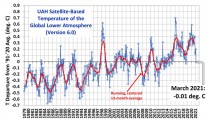
Sure, Thierry. Meanwhile, the UAH guys report another substantial drop in world atmospheric temperature in March 2021. The global temperature anomaly for the month is -0.01 deg C (as against the 30 year average of 1991-2020). That brings us back down to about the same temperature we had back in 1988. Needless to say, Le Figaro was way too polite to confront M. Castel with this information.
Here is the latest UAH chart of global temperatures, going back to 1979:
By Steve Goreham
By Steve Goreham
Originally published in Washington Examiner.
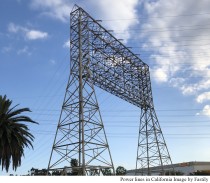
More than a million Californians suffered power blackouts last Friday evening. When high temperatures caused customer demand to exceed the power available, California electrical utilities used rotating outages to force a reduction in demand. The California grid is the worst in the nation, with green energy policies pursued by the state likely furthering reduced grid reliability.
At 6:30 pm on Friday, Pacific Gas and Electric, California’s biggest utility, began shutting off power in rolling outages to force a reduction in demand. Southern California Edison also denied power to homes, beginning just before 7 pm. Shutoffs impacted a rotating group of up to two million customers until 11 pm.
The California Independent System Operator (CAISO) declared a Stage 3 Electrical Emergency, the first Stage 3 emergency since 2001. Spot power electricity prices soared to over $1,000 per megawatt-hour, more than 10 times the usual price.
In 2018, 19 percent of California’s electricity came from roof-top and utility-scale solar installations, the highest percentage in the nation. But by 6:30 pm each day, that solar output approaches zero. The state lacks enough reliable electricity generation capacity to run the air conditioners during hot summer evenings.
California has the least reliable electrical power system in the US. It isn’t even close. According to data by Eaton Corporation, the state leads the US in power outages every year, with more than double the outages of any other state over the last decade.
_thumb.jpg)
The causes of power outages can be divided into four major groups, which in order of importance are weather or downed trees, faulty equipment or human errors, unknowns, and vehicle accidents. California suffered the largest number of outages in each category in each year for 2014 through 2017.
For more than a decade, California has been closing coal and nuclear power plants. Recently, the state also began closing natural gas-fired plants as part of a continuing effort to fight global warming.
In 2006, Senate Bill 1368 established California’s Emissions Performance Standard, an effort to reduce state greenhouse gas emissions from power plants. Since 2007, 11 in-state, coal-fired plants have been closed as a result, with an additional 3 converted to biomass fuel. California also slashed imports of electricity generated from coal plants. The Argus Cogen plant in Trona is the last remaining coal plant.
California nuclear plants, though not emitters of greenhouse gases, are also being phased out. The second and third units of the San Onofre nuclear generating plant near Los Angeles ceased operation in 2013. The Diablo Canyon plant, the last nuclear plant in California, is scheduled for closure in 2025.
Driven by state efforts to reduce greenhouse gas emissions, gas-fired plants are also being shuttered. Natural gas generating capacity has fallen by more than 10 percent since 2013, with additional reductions planned.
Following the blackouts last Friday night, blackouts resumed at 6:30 pm on Saturday. Power officials blamed the loss of 1,000 megawatts of wind power when the wind subsided and the unexpected shutdown of a 470-megawatt power plant. It’s clear that the state does not have enough reliable baseload power as backup for intermittent wind and solar energy.
The problem of California’s poor electric reliability will likely get worse. On September 10, 2018, then Governor Jerry Brown signed Senate Bill 100, committing California to obtain 100 percent of its electricity from “clean energy sources” by 2045. Replacement of coal, nuclear, and natural gas generators with wind and solar will continue erode grid reliability.
As part of global warming efforts, officials want all citizens to switch their natural gas stoves and furnaces to electric models. More than 30 California cities have enacted bans on gas appliances, including the major cities of San Francisco and San Jose. Almost 10 percent of the state population now lives in an area covered by restrictions against gas appliances in new residential construction.
California also wants residents to transition from gasoline- and diesel-powered cars and trucks to plug-in electric models. So, when those blackouts occur in the future, not only will your lights and air conditioners fail, but you won’t be able to cook your food or drive your car either.
California sacrificed reliable electrical power on the altar of the fight against global warming. There is no evidence that state efforts will have the slightest effect on global temperatures, but they will be great for candle and flashlight sales.
Steve Goreham is a speaker on the environment, business, and public policy and author of the book Outside the Green Box: Rethinking Sustainable Development.
By Frank Lassee
Climate alarmist are telling you a false story line
It’s really about spending huge sums of taxpayer money on a non-existent problem and vastly expanding government control over our lives
Greenland’s name wasn’t just a clever marketing ploy by the Icelandic Vikings to get suckers to move there
There is so much good news because of our gently warming world that you gotta wear shades - more food and less poverty
Be aware of the climate alarmist Trojan Horse
--------
On Tuesday evening, I appeared on the PBS program Chicago Tonight, with Alderman Matt Martin for a discussion about Chicago’s so-called “climate emergency.”
During the segment, we debated the merits of his resolution, “Declaring a Climate Emergency and Emergency Mobilization Effort to Restore a Safe Climate.” As you may know, several cities throughout America have passed similar measures, which are more about virtue-signaling than pragmatic solutions.
In essence, these misguided resolutions are all about spending huge sums of money on a non-existent problem and vastly expanding government control to boot. Just think about a city saving the earth. Oh, the hubris! Coincidence? I think not. These resolutions - including the Green New Deal - are not intended to avoid a climate cataclysm. They are really about increasing the power of politicians, so they can exert maximum control over our lives while reaching even deeper into our wallets and purses.
It isn’t about the climate, because we are not, nor have been, on the brink of a climate apocalypse. The manufacturing of the “climate crisis” is a stealth maneuver to increase the size and scope of government under the guise of global warming - don’t ever forget it.
In reality, we are threatened more by the Climate Delusion than we are by a worldwide climate catastrophe. In fact, over the past 170 years, our world (thankfully) is warming at a very gentle rate. This is natural, as all planets tend to undergo periodic cycles of warming and cooling. I don’t think it is a coincidence that without the presence of mankind, Mars is also experiencing a gentle warming cycle.
This warming/cooling phenomenon has been occurring for millennia, well before humans discovered and put petroleum to use for our benefit. For instance, there once was a time when humans actually walked from Asia to North America - not because they could walk on water, but because ocean levels were much lower, exposing a land bridge between present-day Russia and Alaska. Believe it or not, our planet has experienced several cooling and warming periods.
Greenland is called Greenland because from 900 to 1300, humans could actually grow crops in the then-warmer soil and climate of Greenland - it wasn’t just a clever marketing ploy by the Icelandic Vikings to get suckers to move there. This Medieval Warm Period was preceded by the cold and dark Middle Ages. Which was preceded by the Roman Warm Period from 700 BC to the time of Christ.
The Romans wore togas and shorts for a reason, it was warm way back then. When it is warm, it is better for plants, animals, and people. CO2 is plant food, worldwide crop harvests are up, up, up. Fortunately, we are in the midst of a natural warm and wet period, which is a good thing. In fact, more people die from exposure to cold than heat every year. I could go on and on, with mountains of facts, but I digress.
I know you are fed a steady diet of lies by the radical, legacy media. Unfortunately, like Alderman Martin, they are telling you a false story line. Taking this into account, I understand if you are skeptical in regards to The Heartland Institute’s perspective of climate realism. We at Heartland have done a deep dive into this topic and offer you a truthful, fact-based, realist perspective.
Martin’s resolution claims “WHEREAS, the death and destruction already wrought by current average global warming of 1 degree C [this is America for goodness sake, why isn’t this expressed in Fahrenheit?] demonstrates that the Earth is already too hot for safety and justice, [whatever that means] as attested by increased and intensifying wildfires, floods and rising seas, diseases, droughts and extreme weather.”
This alarmist rhetoric is quite alarming, and should immediately trigger your skeptical side. This type of doom and gloom propaganda is precisely why I call those who have joined the climate change movement (to some it has become a religion) climate alarmists, aka the green extreme. This is a classic case of the Chicken Little folk tale in action. Even worse, it is a world-wide false alarm, the sky is not falling and it isn’t burning up either.
At present, the world is experiencing less hurricanes that are less severe than in the past.
There are also less tornadoes in the United State than in many times in the past.
Australia, the desert continent, is getting wetter.
NOAA temperature data points to no heat increase in the U.S. over the past two (actually even 9) decades.
The oceans have risen 4 inches a century for the past 170 years, and are holding steady.
I have witnessed Lake Michigan at very high and very low levels. In my life, global warming and now climate change were blamed for both the highs and the lows. Wow, you can’t make this stuff up.
For decades, climate alarmists, like children (and Chicken Little) have simply made stuff up. And their highly unqualified predictions have been proven false time and time again. Over and over, they parrot the same dire projections and yet they carry on as if nothing has happened as these predictions fail to materialize, again and again and again.
Here is a primer on their poor predictions. Polar bears are going to die! There are more than ever. We will all be dead in a few years! We are not. Everyone will starve! Meanwhile, more people are well-fed and global poverty is at its lowest rate ever!
Being from Wisconsin, I ask: why would Wisconsinites not welcome a North Carolina-like climate? Why would people who live in northern Alberta, Canada not welcome Wisconsin-esque weather? Land values are up in northern Alberta, because the land is able to be used for more productive purposes. Put another way, humans can grow more crops when it is warm. There is so much good news because of our gently warming world - not in spite of it. We are being fed a steady diet of lies by the prophets of doom for the benefit of themselves and their wealthy well-connected friends; not for the benefit of ordinary, hard-working Americans - like you.
Be aware!
Sincerely,
Frank Lassee
---------
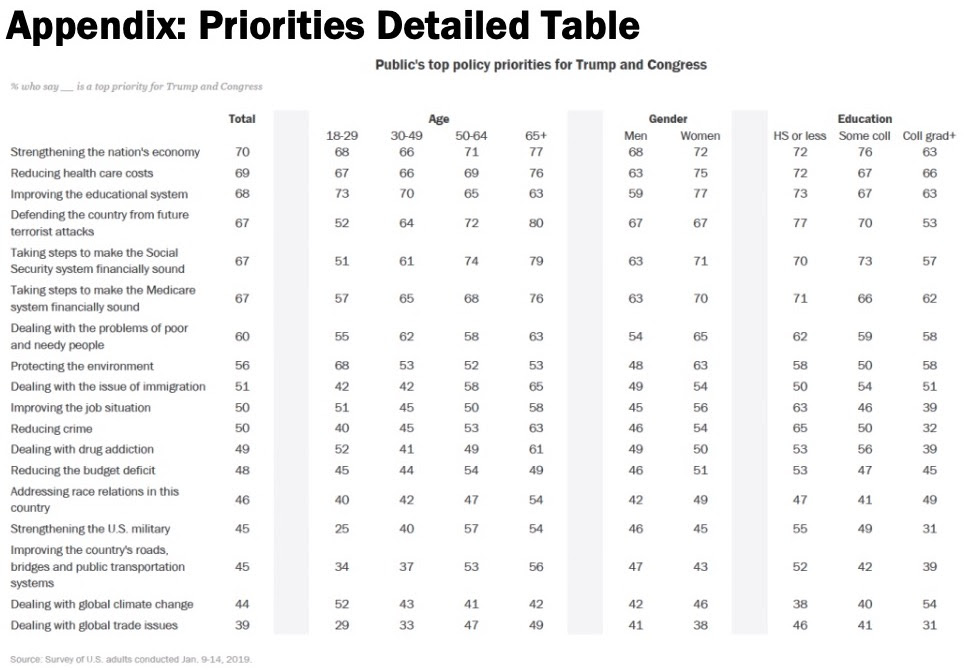
Surveys show the public largely does not prioritize climate change policies.

--------
Also see A CLIMATE AND ENERGY PRIMER FOR POLITICIANS AND MEDIA by contributing author Allan MacRae and has helped make Alberta the shining star of Canadian energy over the decades. There too the politicians and media and the public have been programmed by false claims and green energy frauds and are willing to toss the low cost clean fossil fuel energy legacy out and replace it with unreliable and expensive green energy. Greens expect population to adapt its consumption to the available supply and simply come to accept rationing and power interruptions, of the sort that are unfortunately still common in underdeveloped countries. They insist that is the necessary price for averting the phoney climate apocalypse.
--------------
Peer-reviewed study reveals majority of scientists are skeptical of ‘global warming crisis’
By Thomas Lifson in American Thinker
Without the claimed “scientific consensus” on global warming or climate change, the Green New Deal becomes just another progressive con game, but with the highest stakes ever.
Writing in Forbes, James Taylor shows that the supposed 97% “scientific consensus” on global warming is false:
Don’t look now, but maybe a scientific consensus exists concerning global warming after all. Only 36 percent of geoscientists and engineers believe that humans are creating a global warming crisis, according to a survey reported in the peer-reviewed Organization Studies. By contrast, a strong majority of the 1,077 respondents believe that nature is the primary cause of recent global warming and/or that future global warming will not be a very serious problem.
The survey results show geoscientists (also known as earth scientists) and engineers hold similar views as meteorologists. Two recent surveys of meteorologists (summarized here and here) revealed similar skepticism of alarmist global warming claims.
According to the newly published survey of geoscientists and engineers, merely 36 percent of respondents fit the “Comply with Kyoto” model. The scientists in this group “express the strong belief that climate change is happening, that it is not a normal cycle of nature, and humans are the main or central cause.’
The authors of the survey report, however, note that the overwhelming majority of scientists fall within four other models, each of which is skeptical of alarmist global warming claims.
The genesis of the 97% figure was always questionable, but now, with an actual peer-reviewed study, it is time for the junk heap.
Shhhh! Nobody tell Ocasio-Cortez:
Trump: When I’m on the debate stage with one of these maniacs, I mean, how do you get to Europe? We haven’t figured that one out, we don’t use airplanes anymore. You saw what I’m doing in California, right, they have a fast track, the fast train goes from San Francisco to Los Angeles.”
The authors of the survey report, however, note that the overwhelming majority of scientists fall within four other models, each of which is skeptical of alarmist global warming claims.
The genesis of the 97% figure was always questionable, but now, with an actual peer-reviewed study, it is time for the junk heap.
By Casey Plunkett
See how Facebook is doing fake Fact-Checking on papers that are not published on cabal controlled journals here.
Academics and scientists are yet again issuing “consensus” statements on climate change. In 2017, we were warned by 16,000 scientists across 184 countries that “human beings and the natural world are on a collision course.” This past week, BioScience, an academic, peer-reviewed journal from Oxford University Press, found 11,224 scientists, from 153 countries, who signed off on the latest climate change drivel. Citing a “moral obligation to clearly warn humanity of any catastrophic threat and to “tell it like it is,” they’ve published the paper “World Scientists’ Warning of a Climate Emergency.” In dystopian tone, they’ve issued a demand for Earth’s population to “be stabilized - and, ideally, gradually reduced - within a framework that ensures social integrity.”
With the disclaimer that I’m just a layman who resides in “flyover country,” who are these “11,000 Scientists,” and do they even have credibility to weigh in on this matter? Scientists, with few exceptions, are subject matter experts in specific fields - their expertise isn’t inherently relevant and extensible across varying fields of science. For example, a physicist won’t teach a graduate-level course in biology, a podiatrist won’t perform open heart surgery, and a botanist has minimal insight on quantum computing. How many of these 11,000 scientists possess germane degrees in meteorology, climatology, or atmospheric science? Lo and behold, BioScience actually published a list of these scientific signatories in the attached link - so I looked.
In keyword searches across 324 pages of signing signatories, spanning 11,224 scientists, I found 240 (2%) individuals with professions that can be construed as bona fide meteorologists, climatologists, or atmospheric scientists. As a frame of reference, the Department of Labor reports that there are 10,000 atmospheric scientists in the U.S. Conversely, this list contains plenty of “experts” who have zero credibility on the topic of climate change, coming from fields such as infectious diseases, paleontology, ecology, zoology, epidemiology and nutrition, insect ecology, anthropology, computer science, OB-GYN, and linguistics. Bluntly, and no offense intended, I could not care less what a French professor or a zookeeper thinks about climate change - let alone allow him to tell me how to live my life.
This raises the question: “Why did so few meteorologists, climatologists, and atmospheric scientists sign off on this latest paper?” Perhaps they know that this is faux science? The climate is a complex dynamic that science don’t fully understand, let alone predict. Nonetheless, radical, statist elements of society continue to advocate economy-destroying actions - taking lemmings over the cliff with them.
At family gatherings in the upcoming holiday season, when annoying in-laws cite “scientific consensus” on man’s effects on climate change, expose their ignorance and the irrelevance of these doomsday papers with an analogy. Advise them to seek out the consensus opinion of a group of chemists, linguists, and data scientists if they believe they tore a rotator cuff or have concerns with an asymmetrical mole they’ve discovered.