




See this powerful piece on how the evil forces of George Soros, Jeffrey Sachs and the UN have rope the socialist Pope Francis into their One World Government/Population Control Agenda.
FICTION:
UN chief says natural disasters have quadrupled since 1970

UNITED NATIONS: Secretary-General Antonio Guterres says the number of natural disasters has nearly quadrupled since 1970 and the United States has experienced the most disasters since 1995 followed by China and India.
The UN chief told reporters Tuesday that in recent days the world has seen the “dramatic aggravation” of climate change with “unprecedented events” caused by flooding from Texas to Bangladesh, India, Nepal and Sierra Leone.
He said that last year 24.2 million people were displaced by sudden disasters - “three times as many as by conflict and violence.” Guterres said before the current floods, preliminary reports said 2,087 people died this year from natural disasters. He said scientists say “extreme weather is precisely what their models predict will be the new normal of a warming world.”
------------
FACT
Extreme Weather Expert: ‘World is presently in an era of unusually low weather disasters’
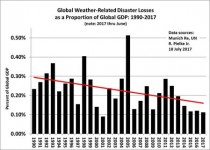
Professor Roger Pielke Jr. of the University of Colorado Boulder: “The world is presently in an era of unusually low weather disasters. This holds for the weather phenomena that have historically caused the most damage: tropical cyclones, floods, tornadoes and drought. Given how weather events have become politicized in debates over climate change, some find this hard to believe...The US has seen a decrease of about 20% in both hurricane frequency and intensity at landfall since 1900...Data on floods, drought and tornadoes are similar in that they show little to no indication of becoming more severe or frequent...Thus, it is fair to conclude that the costs of disasters worldwide is depressed because, as the global economy has grown, disaster costs have not grown at the same rate. Thus, disaster costs as a proportion of GDP have decreased. One important reason for this is a lack of increase in the weather events that cause disasters, most notably, tropical cyclones worldwide and especially hurricanes in the United States.”
Chris White
Australian scientists at the Bureau of Meteorology (BOM) ordered a review of temperature recording instruments after the government agency was caught tampering with temperature logs in several locations.
Agency officials admit that the problem with instruments recording low temperatures likely happened in several locations throughout Australia, but they refuse to admit to manipulating temperature readings. The BOM located missing logs in Goulburn and the Snow Mountains, both of which are in New South Wales.
Meteorologist Lance Pidgeon watched the 13 degrees Fahrenheit Goulburn recording from July 2 disappear from the bureau’s website. The temperature readings fluctuated briefly and then disappeared from the government’s website.
“The temperature dropped to minus 10 (13 degrees Fahrenheit), stayed there for some time and then it changed to minus 10.4 (14 degrees Fahrenheit) and then it disappeared,” Pidgeon said, adding that he notified scientist Jennifer Marohasy about the problem, who then brought the readings to the attention of the bureau.
The bureau would later restore the original 13 degrees Fahrenheit reading after a brief question and answer session with Marohasy.
“The bureau’s quality control system, designed to filter out spurious low or high values was set at minus 10 minimum for Goulburn which is why the record automatically adjusted,” a bureau spokeswoman told reporters Monday. BOM added that there are limits placed on how low temperatures could go in some very cold areas of the country.
Bureaus Chief Executive Andrew Johnson told Australian Environment Minister Josh Frydenberg that the failure to record the low temperatures at Goulburn in early July was due to faulty equipment. A similar failure wiped out a reading of 13 degrees Fahrenheit at Thredbo Top on July 16, even though temperatures at that station have been recorded as low as 5.54 degrees Fahrenheit.
Failure to observe the low temperatures had “been interpreted by a member of the community in such a way as to imply the bureau sought to manipulate the data record,” Johnson said, according to The Australian. “I categorically reject this implication.”
Marohasy, for her part, told reporters that Johnson’s claims are nearly impossible to believe given that there are screen shots that show the very low temperatures before being “quality assured” out. It could take several weeks before the equipment is eventually tested, reviewed and ready for service, Johnson said.
“I have taken steps to ensure that the hardware at this location is replaced immediately,” he added. “To ensure that I have full assurance on these matters, I have actioned an internal review of our AWS network and associated data quality control processes for temperature observations.”
BOM has been put under the microscope before for similar manipulations. The agency was accused in 2014 of tampering with the country’s temperature record to make it appear as if temperatures had warmed over the decades, according to reports in August 2014.
Marohasey claimed at the time that BOM’s adjusted temperature records are “propaganda” and not science. She analyzed raw temperature data from places across Australia, compared them to BOM data, and found the agency’s data created an artificial warming trend.
Marohasey said BOM adjustments changed Aussie temperature records from a slight cooling trend to one of “dramatic warming” over the past century.
---------
You may recall in the U.S., NOAA disallowed a state all-time record low in 2009 for little reason.
PUBLIC INFORMATION STATEMENT
NATIONAL WEATHER SERVICE CHICAGO IL
432 PM CST FRI JAN 16 2009
REGARDING ROCHELLE’S LOW TEMPERATURE THIS MORNING…
THE AUTOMATED WEATHER OBSERVING SYSTEM (AWOS) AT THE ROCHELLE AIRPORT RECORDED A TEMPERATURE OF -36F AT 745 AM THIS MORNING. WHILE THE THERMOMETER ON THE AWOS WAS RE-CALIBRATED YESTERDAY AND MAY INDEED BE ACCURATE...AWOS OBSERVATIONS ARE NOT QUALITY CONTROLLED OR CALIBRATED BY THE NATIONAL WEATHER SERVICE AND ARE ALSO NOT DESIGNED FOR CLIMATE PURPOSES.
THEREFORE...THE STATE CLIMATOLOGIST DOES NOT CONSIDER THIS TEMPERATURE AN OFFICIAL MEASUREMENT FOR THE PURPOSE OF DETERMINING WHETHER OR NOT AN ALL TIME RECORD LOW FOR THE STATE WAS REACHED. FOR THE PURPOSE OF DETERMINING RECORD TEMPERATURES FOR THE STATE...ONLY ASOS AND COOPERATIVE OBSERVER OBSERVATIONS WILL BE USED SINCE BOTH OF THESE OBSERVATIONS ARE QUALITY CONTROLLED BY THE NATIONAL WEATHER SERVICE.
Please note ASOS was a tri-agency project with the leading agency the FAA. They had a low priority for temperatures. Indeed the ASOS spec has a RSME of +/- 1.8F for accuracy.
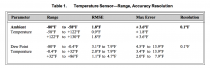
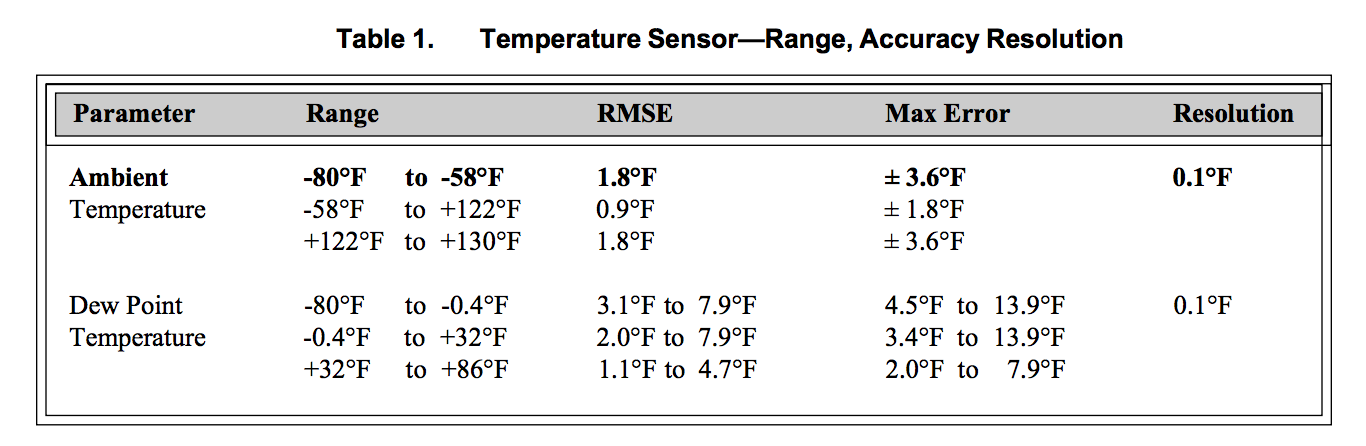
A similar attempt was made to disallow the -50F reading in Maine that winter, but pressure from the TV mets in Maine forced the NWS to accept as a new state record.
By Rick Moran
A new paper analyzing government temperature data says the Global Average Surface Temperature (GAST) data published by NASA and NOAA are “not a valid representation of reality.” In fact, the three respected scientists who published the paper hint strongly that the data may have been fudged.
Here are the the money grafs from the paper:
In this research report, the most important surface data adjustment issues are identified and past changes in the previously reported historical data are quantified. It was found that each new version of GAST has nearly always exhibited a steeper warming linear trend over its entire history. And, it was nearly always accomplished by systematically removing the previously existing cyclical temperature pattern. This was true for all three entities providing GAST data measurement, NOAA, NASA and Hadley CRU.
As a result, this research sought to validate the current estimates of GAST using the best available relevant data. This included the best documented and understood data sets from the U.S. and elsewhere as well as global data from satellites that provide far more extensive global coverage and are not contaminated by bad siting and urbanization impacts. Satellite data integrity also benefits from having cross checks with Balloon data.
The conclusive findings of this research are that the three GAST data sets are not a valid representation of reality. In fact, the magnitude of their historical data adjustments, that removed their cyclical temperature patterns, are totally inconsistent with published and credible U.S. and other temperature data. Thus, it is impossible to conclude from the three published GAST data sets that recent years have been the warmest ever - despite current claims of record setting warming.
Finally, since GAST data set validity is a necessary condition for EPA’s GHG/CO2 Endangerment Finding, it too is invalidated by these research findings. (Full Abstract Report)
Using the government’s own data. the researchers showed that government agencies were able to “prove” that the Earth is warming simply by leaving out vital information.
While the notion that some “adjustments” to historical data might need to be made is not challenged, logically it would be expected that such historical temperature data adjustments would sometimes raise these temperatures, and sometimes lower them. This situation would mean that the impact of such adjustments on the temperature trend line slope is uncertain. However, each new version of GAST has nearly always exhibited a steeper warming linear trend over its entire history.
The scientists are not arguing that adjustments to temperature data are not necessary. Over the 160 years or so of recorded temps, the weather stations where the data is gathered sometimes move, or a city grows up around them, or there is a change in sea levels where the temps are recorded. All of these factors and more would make the data useless without “adjustments.”
The professors argue - and skeptics have been saying this for years - that it is just too convenient for these “adjustments” to almost always show an increase in temperature over the unadjusted data. This is statistically impossible and leads to the inescapable conclusion that the books are being cooked.
What makes this paper a little different from other skeptical scientific literature on global warming is the lineup of respected scientists and experts who agree with its conclusions. Here are a few of them with their credentials:
Dr. Alan Carlin, Retired Senior Analyst and manager, US Environmental Protection Agency, Washington, DC.; Author, Environmentalism Gone Mad, Stairway Press, 2015; Ph.D., Economics, Massachusetts Institute of Technology, Cambridge, MA; BS, Physics, California Institute of Technology, Pasadena, CA.
Dr. Harold H. Doiron, Retired VP-Engineering Analysis and Test Division, InDyne, Inc.; Ex-NASA JSC, Aerospace Consultant; B.S. Physics, University of Louisiana - Lafayette; M.S., Ph.D., Mechanical Engineering, University of Houston.
Dr. Theodore R. Eck, Ph.D., Economics, Michigan State University; M.A, Economics, University of Michigan; Fulbright Professor of International Economics; Former Chief Economist of Amoco Corp. and Exxon Venezuela; Advisory Board of the Gas Technology Institute and Energy Intelligence Group.
Dr. Richard A. Keen, Instructor Emeritus of Atmospheric and Oceanic Sciences, University of Colorado; Ph.D., Geography/Climatology, University of Colorado; M.S., Astro-Geophysics, University of Colorado; B.A., Astronomy, Northwestern University.
Dr. Anthony R. Lupo, IPCC Expert Reviewer; Professor, Atmospheric Science, University of Missouri; Ph.D.,; Atmospheric Science, Purdue University; M.S., Atmospheric Science, Purdue University
This paper won’t dissuade the global warming hysterics. But in those places where the truth actually matters, it will stimulate debate and discussion. That’s what science should be all about.
Alan Carlin | July 5, 2017
A new report finds that the three Global Average Surface Temperatures (GAST) data sets used by climate alarmists are not a valid representation of reality, including their repeated claims of highest recorded average temperatures. Authored by Drs. James P. Wallace III, Joseph S. D’Aleo, and Craig D. Idso, the new extensively peer reviewed research report examines whether the GAST used by the UN IPCC and the USEPA are sufficiently credible to be used for policy purposes.
In fact, the report says, “the magnitude of their historical data adjustments, that removed their cyclical temperature patterns, are totally inconsistent with published and credible U.S. and other temperature data. Thus, it is impossible to conclude from the three published GAST data sets that recent years have been the warmest ever despite current claims of record setting warming.”
The report concludes that “since the GAST data set validity is a necessary condition for EPA’s GHG/CO2 Endangerment Finding, it too is invalidated by these research findings.” The Endangerment Finding is the basis for all EPA regulations intended to reduce emissions of CO2, so the report’s conclusions imply that all these regulations (such as the Clean Power Plan) should also be invalidated.
The new report shows that each new version of GAST has nearly always exhibited a steeper warming linear trend over its entire history. And it has nearly always been accomplished by systematically removing the previously existing cyclical temperature pattern. This was true for all three organizations providing GAST data measurements, NOAA, NASA and Hadley CRU.
Need for the Study
The need for this study arose because most of the adjustments made by NOAA, GISS, and Hadley CRU in recent decades have resulted in GAST that make the alleged effects of increasing atmospheric CO2 on GAST more credible. These “one-sided” adjustments have been identified by many climate skeptics as likely to be unjustified since routine adjustments are normally “two-sided” as corrections are made to solve various problems. And the keepers of the data bases are all strong supporters of climate alarmism, which might have supplied a motive for such “one-sided” adjustments that favor their policy views.
Previous skeptic analyses of GAST have primarily discussed the justification for individual adjustments to GAST made by government agencies in the course of their record maintenance responsibilities. This study instead asks whether the sum effect of all the adjustments represent credible temperature series that are useful for policy purposes or not.
Earlier Report Also Invalidates EPA Endangerment Finding
Two of the same authors have recently issued another report which finds that the Greenhouse Gas Endangerment Finding (EF) is also invalidated by the finding that each of the three lines of evidence used by EPA to justify the EF are also invalid based on new-to-climate research statistical relationships found using satellite and balloon temperature data. The earlier report is able to explain global temperatures using only natural factors and without any effects of human-caused emissions.
So there are now two unrelated extensively peer reviewed reports that reach the same conclusion through new and entirely different approaches: The USEPA’s three lines of evidence as well as the UNIPCC reports supporting climate alarmism are invalid. The authors believe it is time for the EPA to reevaluate the EF and withdraw it. This would invalidate all EPA regulations based on the EF.
The formal press release prepared by the authors is as follows:
PRESS RELEASE
On the Validity of NOAA, NASA and Hadley CRU Global Average Surface Temperature Data & The Validity of EPA’s CO2 Endangerment Finding
Abridged Research Report June 2017
Just released: A peer reviewed Climate Science Research Report has proven that it is all but certain that EPA’s basic claim that CO2 is a pollutant is totally false. All research was done pro bono.
The objective of this research was to test the hypothesis that Global Average Surface Temperature (GAST) data are sufficiently credible estimates of global average temperatures such that they can be relied upon for climate modeling and policy analysis purposes. The relevance of this research is that the validity of EPA’s CO2 Endangerment Finding requires GAST data to be a valid representation of reality.
In this research report past changes in the previously reported historical data are quantified. It was found that each new version of GAST has nearly always exhibited a steeper warming linear trend over its entire history. And, it was nearly always accomplished by each entity systematically removing the previously existing cyclical temperature pattern. This was true for all three entities providing GAST data measurement, NOAA, NASA and Hadley CRU.
As a result, this research sought to validate the current estimates of GAST using the best available relevant data. The conclusive findings were that the three GAST data sets are not a valid representation of reality. In fact, the magnitude of their historical data adjustments which removed their cyclical temperature patterns are totally inconsistent with published and credible U.S. and other temperature data.
Thus, despite current claims of record setting warming, it is impossible to conclude from the NOAA, NASA and Hadley CRU GAST data sets that recent years have been the warmest ever.
Finally, since GAST data set validity is a necessary condition for EPA’s CO2Endangerment Finding, it too is invalidated by these research findings. This means that EPA’s 2009 claim that CO2 is a pollutant has been decisively invalidated by this research.
See video post from WeatherBELL this Sunday showing summer heat has been declining for decades!!
Paul Dreissen
Replacing fossil fuels with renewable energy would inflict major land, wildlife, resource damage
Demands that the world replace fossil fuels with wind, solar and biofuel energy - to prevent supposed catastrophes caused by manmade global warming and climate change - ignore three fundamental flaws.
1) In the Real World outside the realm of computer models, the unprecedented warming and disasters are simply not happening: not with temperatures, rising seas, extreme weather or other alleged problems.
2) The process of convicting oil, gas, coal and carbon dioxide emissions of climate cataclysms has been unscientific and disingenuous. It ignores fluctuations in solar energy, cosmic rays, oceanic currents and multiple other powerful natural forces that have controlled Earth’s climate since the dawn of time, dwarfing any role played by CO2. It ignores the enormous benefits of carbon-based energy that created and still powers the modern world, and continues to lift billions out of poverty, disease and early death.
It assigns only costs to carbon dioxide emissions, and ignores how rising atmospheric levels of this plant-fertilizing molecule are reducing deserts and improving forests, grasslands, drought resistance, crop yields and human nutrition. It also ignores the huge costs inflicted by anti-carbon restrictions that drive up energy prices, kill jobs, and fall hardest on poor, minority and blue-collar families in industrialized nations - and perpetuate poverty, misery, disease, malnutrition and early death in developing countries.
3) Renewable energy proponents pay little or no attention to the land and raw material requirements, and associated environmental impacts, of wind, solar and biofuel programs on scales required to meet mankind’s current and growing energy needs, especially as poor countries improve their living standards.
We properly insist on multiple detailed studies of every oil, gas, coal, pipeline, refinery, power plant and other fossil fuel project. Until recently, however, even the most absurd catastrophic climate change claims behind renewable energy programs, mandates and subsidies could not be questioned.
Just as bad, climate campaigners, government agencies and courts have never examined the land use, raw material, energy, water, wildlife, human health and other impacts of supposed wind, solar, biofuel and battery alternatives to fossil fuels - or of the transmission lines and other systems needed to carry electricity and liquid and gaseous renewable fuels thousands of miles to cities, towns and farms.
It is essential that we conduct rigorous studies now, before pushing further ahead. The Environmental Protection Agency, Department of Energy and Interior Department should do so immediately. States, other nations, private sector companies, think tanks and NGOs can and should do their own analyses. The studies can blithely assume these expensive, intermittent, weather-dependent alternatives can actually replace fossil fuels. But they need to assess the environmental impacts of doing so.
Renewable energy companies, industries and advocates are notorious for hiding, minimizing, obfuscating or misrepresenting their environmental and human health impacts. They demand and receive exemptions from health and endangered species laws that apply to other industries. They make promises they cannot keep about being able to safely replace fossil fuels that now provide over 80% of US and global energy.
A few articles have noted some of the serious environmental, toxic/radioactive waste, human health and child labor issues inherent in mining rare earth and cobalt/lithium deposits. However, we now need quantitative studies - detailed, rigorous, honest, transparent, cradle-to-grave, peer-reviewed analyses.
The back-of-the-envelope calculations that follow provide a template. I cannot vouch for any of them. But our governments need to conduct full-blown studies forthwith - before they commit us to spending tens of trillions of dollars on renewable energy schemes, mandates and subsidies that could blanket continents with wind turbines, solar panels, biofuel crops and battery arrays; destroy habitats and wildlife; kill jobs, impoverish families and bankrupt economies; impair our livelihoods, living standards and liberties; and put our lives under the control of unelected, unaccountable state, federal and international rulers - without having a clue whether these supposed alternatives are remotely economical or sustainable.
Ethanol derived from corn grown on 40,000,000 acres now provides the equivalent of 10% of US gasoline - and requires billions of gallons of water, and enormous quantities of fertilizer and energy. What would it take to replace 100% of US gasoline? To replace the entire world’s motor fuels?
Solar panels on Nevada’s Nellis Air Force Base generate 15 megawatts of electricity perhaps 30% of the year from 140 acres. Arizona’s Palo Verde nuclear power plant generates 900 times more electricity, from less land, some 95% of the year. Generating Palo Verde’s output via Nellis technology would require land area ten times larger than Washington, DC - and would still provide electricity unpredictably only 30% of the time. Now run those solar numbers for the 3.5 billion megawatt-hours generated nationwide in 2016.
Modern coal or gas-fired power plants use less than 300 acres to generate 600 megawatts 95% of the time. Indiana’s 600 MW Fowler Ridge wind farm covers 50,000 acres and generates electricity about 30% of the year. Calculate the turbine and acreage requirements for 3.5 billion MWH of wind electricity.
Delving more deeply, generating 20% of US electricity with wind power would require up to 185,000 1.5 MW turbines, 19,000 miles of new transmission lines, 18 million acres, and 245 million tons of concrete, steel, copper, fiberglass and rare earths - plus fossil-fuel back-up generators for the 75-80% of the year that winds nationwide are barely blowing and the turbines are not producing electricity.
Energy analyst David Wells has calculated that replacing 160,000 teraWatt-hours of total global energy consumption with wind would require 183,400,000 turbines needing roughly: 461,000,000,000 tons of steel for the towers; 460,00,000,000 tons of steel and concrete for the foundations; 59,000,000,000 tons of copper, steel and alloys for the turbines; 738,000,000 tons of neodymium for turbine magnets; 14,700,000,000 tons of steel and complex composite materials for the nacelles; 11,000,000,000 tons of complex petroleum-based composites for the rotors; and massive quantities of other raw materials - all of which must be mined, processed, manufactured into finished products and shipped around the world.
Assuming 25 acres per turbine, the turbines would require 4,585,000,000 acres (1,855,500,000 hectares) - 1.3 times the land area of North America! Wells adds: Shipping just the iron ore to build the turbines would require nearly 3 million voyages in huge ships that would consume 13 billion tons of bunker fuel (heavy oil) in the process. And converting that ore to iron and steel would require 473 billion tons of coking coal, demanding another 1.2 million sea voyages, consuming another 6 billion tons of bunker fuel.
For sustainability disciples: Does Earth have enough of these raw materials for this transformation?
It gets worse. These numbers do not include the ultra-long transmission lines required to carry electricity from windy locations to distant cities. Moreover, Irina Slav notes, wind turbines, solar panels and solar thermal installations cannot produce high enough heat to melt silica, iron or other metals, and certainly cannot generate the required power on a reliable enough basis to operate smelters and factories.
Wind turbines (and solar panels) last just 20 years or so (less in salt water environments) while coal, gas and nuclear power plants last 35-50 years and require far less land and raw materials. That means we would have tear down, haul away and replace far more “renewable” generators twice as often; dispose of or recycle their component parts (and toxic or radioactive wastes); and mine, process and ship more ores.
Finally, their intermittent electricity output means they couldn’t guarantee you could boil an egg, run an assembly line, surf the internet or complete a heart transplant when you need to. So we store their output in massive battery arrays, you say. OK. Let’s calculate the land, energy and raw materials for that. While we’re at it, let’s add in the requirements for building and recharging 100% electric vehicle fleets.
Then there are the bird and bat deaths, wildlife losses from destroying habitats, and human health impacts from wind turbine noise and flicker. These also need to be examined - fully and honestly - along with the effects of skyrocketing renewable energy prices on every aspect of this transition and our lives.
But for honest, evenhanded EPA and other scientists, modelers and regulators previously engaged in alarmist, biased climate chaos studies, these analyses will provide some job security. Let’s get started.
Paul Driessen is senior policy analyst for the Committee For A Constructive Tomorrow (www.CFACT.org) and author of Eco-Imperialism: Green power - Black death.
By Bob Livingston
Man-caused global cooling / global warming / climate change is not science. It’s a faith-based quasi-religion/money laundering scheme of hokum, balderdash and outright lies.
Look no further for evidence of this than the hyperbolic overreaction to Donald Trump’s announcement that the U.S. would not abide by the Paris accords. Only those whose messiah had been slain or who had had their money bags ripped from their hands would overreact to such extremes.
In the wake of Trump’s announcement, headlines screamed that by pulling out of the accord Trump was ushering in the end of the world. But even James Hansen, the so-called father of global awareness of climate change and former NASA scientist, called the Paris accord “a fraud, a fake… absolute bulls**t” in the wake of its signing in 2012.
Of course, the proponents of the theory of man-caused climate change have been predicting this doom and gloom for dozens of years, led, of course, by the globalist anti-American United Nations. In 1989, a U.N. environmental official posited that governments had a 10-year window of opportunity to solve the greenhouse effect before it goes beyond human control. At that point global temperatures would rise 1 to 7 degrees and polar ice cap melts would raise sea levels three feet, displacing millions of people and flooding arable land, he claimed.
This was just one of dozens of dire predictions made by climate alarmists and their collectivist central planning advocates over the last several decades.
It’s now 28 years later - and four days since President Donald Trump announced that the U.S. was pulling out of the Paris Climate accord - and, despite the caterwauling of the climatephobes, the streets have not become rivers, tornadoes and hurricanes are not obliterating large swaths of the country, the south is not blanketed in feet of snow, nor is a blazing sun turning the U.S. into another Sahara. Just like none of the predictions of catastrophe have happened since scientists in search of largess from the public trough began in the early 1900s promoting their theories of climactic eschatology.
Climate alarmism is home to the Marxists of old who lost their cause when the Soviet Union fell and they needed a new vehicle to promote their utopian central planning ideology. But it’s also a cause embraced by the banisters, Wall Street types and multi-national corporations that stand to profit immensely off the money-laundering schemes involved in it.
The Paris accord in and of itself was based on false science: that CO2 emissions are causing temperatures to rise - the temperatures are not, and there is no evidence that the emissions do so - that there is some magical ideal global temperature that needs to be maintained and we know what that temperature is, and that by reducing said CO2 emissions the atmospheric levels of CO2 will drop and temperatures will stabilize.
And the Paris accord was not a treaty. President Barack Obama admitted as much by refusing to bring it to the Senate for ratification. So the U.S. was not bound to it. Nor, apparently are other signatories. Germany, for instance, saw its total energy production rise by 1.6 percent in 2016 over 2015 and was likely to miss its Paris accord pledge of cutting CO2 emissions 40 percent by 2020 compared to 1990 levels.
The accord is a feckless central planning scheme that sought to expropriate the wealth of Americans and redistribute it around the globe for the banksters and crony green energy companies. The plan would have destroyed American sovereignty, rendering it subservient to Third World backwaters looking for handouts. It would have cost hundreds of thousands of American jobs, put a further damper on American manufacturing and, according to The Heritage Foundation, destroyed $2.5 trillion in gross domestic product by 2035. And it would have empowered American alphabet soup federal agencies to impose ever tighter restrictions on energy use by Americans as it met the ever changing reduction guidelines, escalating American energy costs.
It has already cost America $1 billion, which Obama contributed to a green energy slush fund called the Green Climate Fund without congressional authorization.
The Paris accord was not a “lawful” agreement, much less a treaty, despite the word changers’ and propagnadist’s use of the that word. Outside of Obama’s inner circle, the Green mafia, the banksters and cronies, and ignorant leftists, no widespread American support was evident - certainly there was no support for ratification by the Senate.
The new French President Emmanuel Macron snooted that the “treaty” was non-negotiable. That’s good news. There won’t be a temptation for some subsequent collectivist-minded U.S. president to sell America down the river again, as Obama did.
Macron also invited Americans to come to France to help “make our planet great again. Evidently, Macron thinks that France, by virtue of its participation in the treaty, will be immune from the hyped effects of America’s pullout. Either that or he’s admitting it’s all just a hoax.
No, Trump did not cause the end of world with his decision to remove America from the Paris hoax. He saved America, her jobs and her energy sector. But he did destroy one of the biggest anti-liberty scams in world history.
by John Siciliano
President Trump’s budget gets away from the “crazy stuff” former President Barack Obama prioritized to fight climate change, such as climate change musicals, Office of Management and Budget Director Mick Mulvaney said Tuesday.

“We are simply trying to get things back in order to where we can look at the folks that pay taxes and say look, we want to do some climate science but we aren’t going to do some of the crazy stuff that the previous administration did,” he said at a briefing to release Trump’s proposed budget for fiscal 2018.
The Environmental Protection Agency budget zeroes out a program for reporting on greenhouse gas emissions that many scientists blame for causing the Earth’s climate to warm. The EPA budget also slashes the air and radiation office, responsible under the Obama administration for climate regulations, by nearly 70 percent.
Mulvaney said the budget doesn’t “get rid of it [climate funding],” entirely. “Do we target it? Sure. Are a lot of the EPA reductions aimed at reducing the focus on climate science? Yes. Does it mean we are anti-science? Absolutely not.”
When asked by a reporter if the budget targets climate change programs as wasteful spending, Mulvaney replied: “You tell me. I think the National Science Foundation used your taxpayer money last year to fund a climate change musical.”
He asked the reporter, “Do you think that is a waste of your money?” The reporter didn’t respond immediately. “I’ll take that as a yes.”
The reporter then responded, asking what about the climate science funding?
“What I think you saw happen during the previous administration is the pendulum swing too far to one side, where we were spending too much of your money on climate change. And not very efficiently,” Mulvaney said.
Anthony Watts
Remember the much ballyhooed paper that made the cover of Nature, Steig et al, “Warming of the Antarctic ice-sheet surface since the 1957 International Geophysical Year”, Nature, Jan 22, 2009 that included some conspicuously errant Mannian math from the master of making trends out of noisy data himself? Well, that just went south, literally.
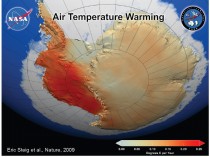
And it just isn’t because the Steig et al. paper was wrong, as proven by three climate skeptics that submitted their own rebuttal, no, it’s because mother nature herself reversed the trend in actual temperature data in the Antarctic peninsula, and that one place where it was warming, was smeared over the entire continent by Mannian math to make it appear the whole of the Antarctic was warming.
The peninsula was the only bit of the Antarctic that suited the Warmists. They gleefully reported glacial breakups there, quite ignoring that the Antarctic as a whole was certainly not warming and was in fact tending to cool. The study below however shows that the warmer period on the peninsula was an atypical blip that has now reversed.
Highlights
We examine climate variability since the 1950s in the Antarctic Peninsula region.
This region is often cited among those with the fastest warming rates on Earth.
A re-assessment of climate data shows a cooling trend initiated around 1998/1999.
This recent cooling has already impacted the cryosphere in the northern AP.
Observed changes on glacial mass balances, snow cover and permafrost state
Recent regional climate cooling on the Antarctic Peninsula and associated impacts on the cryosphere
M. Oliva et al.
Abstract
The Antarctic Peninsula (AP) is often described as a region with one of the largest warming trends on Earth since the 1950s, based on the temperature trend of 0.54C/decade during 1951-2011 recorded at Faraday/Vernadsky station. Accordingly, most works describing the evolution of the natural systems in the AP region cite this extreme trend as the underlying cause of their observed changes. However, a recent analysis (Turner et al., 2016) has shown that the regionally stacked temperature record for the last three decades has shifted from a warming trend of 0.32 C/decade during 1979-1997 to a cooling trend of -0.47 C/decade during 1999-2014. While that study focuses on the period 1979-2014, averaging the data over the entire AP region, we here update and re-assess the spatially-distributed temperature trends and inter-decadal variability from 1950 to 2015, using data from ten stations distributed across the AP region. We show that Faraday/Vernadsky warming trend is an extreme case, circa twice those of the long-term records from other parts of the northern AP. Our results also indicate that the cooling initiated in 1998/1999 has been most significant in the N and NE of the AP and the South Shetland Islands (> 0.5C between the two last decades), modest in the Orkney Islands, and absent in the SW of the AP. This recent cooling has already impacted the cryosphere in the northern AP, including slow-down of glacier recession, a shift to surface mass gains of the peripheral glacier and a thinning of the active layer of permafrost in northern AP islands.
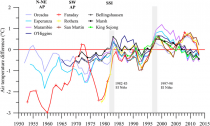
Fig. 4. Temporal evolution of the difference between the MAATs and the 1966-2015 average temperature for each station (3-year moving averages).

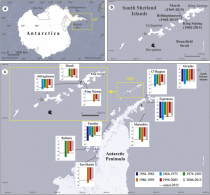
Fig. 1. Location of the AP within the Antarctic continent. b. Detail of the South Shetland Islands and its stations. c. Distribution of the stations on the Peninsula and neighbouring islands, with inter-decadal MAAT variations since 1956 across the AP region.
Science of The Total Environment. Volume 580, 15 February 2017, Pages 210-223
h/t to “Greenie Watch”