




By James Taylor
Climate activists and the United Nations are suffering a major black eye this week as protests and riots resulting from high energy prices have erupted in Santiago, Chile.
Chile, which will host a major U.N. climate conference in December (NOW CANCELLED), earned praise from climate activists for recently imposing a carbon dioxide tax on conventional energy sources and switching the Santiago Metro system to renewable power. Now, the people of Chile are rising up and firing a shot across the bow of other nations considering similar energy taxes and expensive renewable energy programs.
On Oct. 25, protestors took to the streets throughout Santiago in response to Metro fare hikes. The protests soon spread to other cities and led to rioting and at least five reported deaths. The Chilean government and the legacy media blamed the fare hikes on rising oil prices. But that isn’t true.
Oil prices aren’t rising. Global oil prices are currently 25 percent lower than they were a year ago and 37 percent lower than they were five years ago.
In Chile, gasoline prices reflect the lower oil prices. Chilean gasoline prices were $1.12 per liter in August (the most recent month for which data are available), compared to $1.28 a year ago. Five years ago, gasoline sold at $1.50.
Santiago Metro fares are rising, amid falling oil and gasoline prices, because government officials in 2018 traded out most of the Metro’s energy sources to wind and solar power from conventional sources. The Chilean government also hit the portion of conventional power that remains with new carbon dioxide taxes.
As a result, Chileans are now burdened by higher Metro fares reflecting unnecessary energy price increases. As Chileans protest, climate activists and their media allies want people to believe oil is to blame, rather than government climate programs that raise energy prices and impoverish people.
Unlike speculative climate change woes that never seem to materialize, carbon dioxide taxes and renewable energy mandates immediately and measurably raise living costs and reduce living standards. In the United States, people may have some concern about climate change, but polling shows most Americans aren’t willing to pay $2 per month to reduce carbon dioxide emissions.
In Chile, where per-capita income is merely one-quarter of U.S. per-capita income, people are understandably even less willing to pay for carbon dioxide reduction. Moreover, Chile’s per-capita income is higher than that of most other Latin American countries, so people in other Latin American countries would be even more likely to rise up and protest economically destructive climate change programs like the ones imposed in Chile.
For United Nations officials planning the 25th Conference of the Parties (COP25) climate conference, scheduled for the first two weeks of December in Santiago, the protests are especially embarrassing. Last year’s U.N. conference took place in Poland, where government officials and the prominent Solidarity labor union have criticized costly U.N. climate programs. Solidarity even held a press conference at the U.N. event and issued a joint statement criticizing U.N. climate activism.
The December U.N. conference was originally scheduled for Brazil, but the Brazilian government strongly criticized U.N. climate activism and told the United Nations it no longer desired to serve as host.
The Chilean government offered to host in Brazil’s place, touting its carbon dioxide taxes, renewable-powered metro, and other activist climate programs. Yet, the world is seeing the Chilean population rioting in the streets as a result of those taxes and climate programs. This is the third major black eye for the U.N. Conference of the Parties in less than a year.
The Chilean protests, like the Yellow Vest protests that erupted in France a year ago, highlight how out of touch the international climate class is with the people they seek to govern and control. Faced with a choice between suffering certain lower living standards today or dealing with speculative climate change in the distant future, people wisely choose the latter.
That will continue to be the case until predicted climate harms actually materialize and negatively affect people, or until wind and solar power can economically compete with conventional energy. So far, neither has been the case.
James Taylor (JTaylor@heartland.org) is the director of the Arthur B. Robinson Center on Climate and Environmental Policy at The Heartland Institute.
By Steve Goreham—April 9, 2019
Buffalo News (11/16/19) reports: “Ever notice how many of the wind turbines on the old Bethlehem Steel property along Lake Erie don’t rotate, even on windy days? Now we know why. The company that manufactured parts for the turbines went bankrupt, and the owner of the turbines in Lackawanna and Hamburg can’t get replacement parts. Now the company that owns them, Erie Wind, a subsidiary of TerraForm Power, plans to spend $21.46 million to fix them - with bigger blades designed to be safer for birds. The original investment in the turbines was $65 million to $70 million. “They have replaced these windmills two-and-a-half times over, and they’re still not functioning” said Sean Doyle, executive director of the Hamburg Industrial Development Agency. The turbines were built in two phases, and they were hailed as the first urban wind farm in the country, a symbol of the future of renewable energy and a model for repurposing brownfields.”
----------
By Steve Goreham
“Connecticut, Maine, Massachusetts, New Hampshire, New York, Rhode Island, and Vermont now pursue decarbonization targets to reduce emissions 75-85 percent by 2050. These states’ “strategic electrification” policy calls for eliminating natural gas and propane from home and water heating applications by substituting electric appliances and heat pumps that can use wind and solar systems.”
“Because of insufficient gas pipeline capacity, New England now faces critical shortages. In January, utility Con Edison announced a moratorium on new natural gas customers in Westchester County, New York. That same month, Holyoke Gas & Electric of Massachusetts also announced that it can no longer accept new natural gas service requests due to a lack of supply.”
Global usage of natural gas continues to grow rapidly. Methane and propane are essential low-cost, non-polluting fuels for heating, cooking, industrial use, and generation of electrical power. But states in New England, New York, and some nations seek to curtail the use of natural gas.
From 1965 to 2017, world natural gas consumption increased almost six-fold, from 631 billion cubic meters to 3.7 trillion cubic meters per year. Gas use in North America doubled, increased in Europe by a factor of 14, and skyrocketed in Asia Pacific by a factor of more than 100. Gas became the primary fuel for heating and cooking in developed nations and a major fuel for industry and electricity generation across the world.
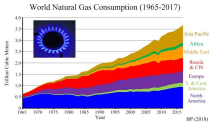
Figure 1. World Natural Gas Consumption
In 2017, natural gas delivered 23 percent of the world’s energy, up from about 15 percent in 1965. Today gas provides nine times as much global energy as wind and solar combined.
Natural gas, or methane, is a clean-burning fuel, free of nitrous oxides, sulfur dioxide, soot, and other pollutants. Water vapor is the largest waste product from methane combustion. But New England states have decided to curtail the use of gas to reduce greenhouse gas emissions.
Connecticut, Maine, Massachusetts, New Hampshire, New York, Rhode Island, and Vermont now pursue decarbonization targets to reduce emissions 75-85 percent by 2050. These states’ “strategic electrification” policy calls for eliminating natural gas and propane from home and water heating applications by substituting electric appliances and heat pumps that can use wind and solar systems.
A 2015 survey by the US Department of Energy found that 58 million US residences use natural gas as the primary heating fuel. An additional 11 million homes use propane, fuel oil, or kerosene. Natural gas and other hydrocarbon fuels heat about 58 percent of US homes. Gas use is even higher in New England, with hydrocarbons the primary fuel for over 80 percent of one to four family homes.
Elimination of natural gas and propane for heating will be costly for New England residents. A 2017 study by the New York State Energy Research and Development Authority found that only four percent of the state’s heating, ventilation, and air conditioning load could cost-effectively switch to heat pumps.
To force a transition away from natural gas, New England policymakers have blocked construction of new gas pipelines. The Constitution Pipeline, a project to bring gas from the shale fields in Pennsylvania to the pipeline network in Schoharie County, NY, is one of many examples. This pipeline continues to be stalled after receiving a construction permit from the Federal Energy Regulatory Commission in 2014.
In opposing the Constitution Pipeline, Governor Andrew Cuomo’s office stated, “...we will not relent in our fight to protect our environment and ensure a cleaner, healthier future...New York is stepping up for the future of our planet, our economy, and our children.”
Because of insufficient gas pipeline capacity, New England now faces critical shortages. In January, utility Con Edison announced a moratorium on new natural gas customers in Westchester County, New York. That same month, Holyoke Gas & Electric of Massachusetts also announced that it can no longer accept new natural gas service requests due to a lack of supply.
New England residents pay high prices for heating and electricity, particularly in winter months. Shortages during weeks of severe cold push residential gas prices up by as much as 400 percent. Power plants are forced to use expensive oil fuel, with gas reserved for home heating. Oil provided almost one-quarter of New England’s electricity during the severe cold at the end of December, 2017.
New England policies contrast sharply with those of most of the country. US natural gas main and service distribution pipelines grew 80 percent from 1984 to 2016 and continue to expand in most states.
In an extreme case, in 2017 the government of Netherlands called for elimination of all natural gas usage by 2050. Despite the fact that 90 percent of Dutch homes are heated by natural gas, the government proposed that 170,000 gas lines would be disconnected every year, to be replaced by geothermal and heat pump systems. Last year Amsterdam announced a phase-out of natural gas in favor of more “sustainable” sources of energy.
In contrast to efforts to curtail gas use in New England and Netherlands, global shipments of liquefied natural gas (LNG) are exploding to help satisfy growing demand. World LNG trade increased 12 percent in 2017, 10 percent last year, and is projected to increase by another 11 percent in 2019.

There is no evidence that restrictions on New England usage will have a measurable effect on world demand for natural gas, or the slightest effect on global temperatures. But misguided government energy policies will raise prices for New England residents.
Japan and South Korea remain the world’s largest importers of liquefied natural gas, with LNG demand growing fastest in China, South Korea, and Pakistan. LNG supply growth is dominated by shipments from Australia and the fracking fields of the United States.
Steve Goreham is a popular speaker on the environment, business, and public policy. He is author of the influential primer, Outside the Green Box: Rethinking Sustainable Development, and other books on energy and the environment.
By Dr. Jeffrey Foss
More honesty and less hubris, more evidence and less dogmatism, would do a world of good
Dr. Jeffrey Foss
“What can I do to correct these crazy, super wrong errors?” Willie Soon asked plaintively in a recent e-chat. “What errors, Willie?” I asked.
“Errors in Total Solar Irradiance,” he replied. “The Intergovernmental Panel on Climate Change keeps using the wrong numbers! It’s making me feel sick to keep seeing this error. I keep telling them - but they keep ignoring their mistake.”
Astrophysicist Dr. Willie Soon really does get sick when he sees scientists veering off their mission: to discover the truth. I’ve seen his face flush with shock and shame for science when scientists cherry-pick data. It ruins his appetite - a real downer for someone who loves his food as much as Willie does.
You have got to love a guy like that, if you love science - and I do. I’m a philosopher of science, not a scientist, but my love for science runs deep - as does my faith. So I cannot help but admire Willie and his good old-fashioned passion for science.
Willie Soon may one day be a household name. More and more he appears at the pointy end of scientific criticism of Climate Apocalypse. In two recent lawsuits against Big Oil, one by New York City and the other by San Francisco and Oakland, Dr. Soon is named as the “paid agent” of “climate change denialism.” As the man who - Gasp! - singlehandedly convinced Big Oil to continue business as usual.
Can you even imagine that? I can’t: Big Oil couldn’t turn off its taps in big cities even if it wanted to.
Putting such silly lawsuits aside, it is a big honor, historically speaking, for Dr. Soon to be the face of scientific rebuttal of Climate Apocalypse, since feeding the developed world’s apocalypse addiction is the main tool of a powerful global political agenda.
The IPCC - along with the United Nations and many environmentalist organizations, politicians, bureaucrats and their followers - desperately want to halt and even roll back development in the industrialized world, and keep Africa and other poor countries permanently undeveloped, while China races ahead. They want Willie silenced. We the people need to make sure he is heard.
Dr. Soon never sought the job of defending us against the slick, computer model-driven, anti-fossil fuel certainties of Climate Apocalypse. Willie just happened to choose solar science as a career and, like many solar scientists, after nearly three decades of scientific research in his case, came to believe that changes in the sun’s brightness, sunspots and energy output, changes in the orbital position of the Earth relative to the sun, and other powerful natural forces drive climate change. In brief, our sun controls our climate.
Even the IPCC initially indicated agreement with him, citing his work approvingly in its second (1996) and third (2001) Assessment Reports. That later changed, significantly. Sure, everyone agrees that the sun caused the waxing and waning of the ice ages, just as solar scientists say. However, the sun had to be played down if carbon dioxide (CO2) was to be played up - an abuse of science that makes Willie sick.
Unfortunately for the IPCC, solar scientists think solar changes also explain Earth’s most recent warming period which, they point out, began way back in the 1830s - long before we burned enough fossil fuels to make any difference. They also observed the shrinking of the Martian ice-caps in the 1990s, and their return in the last few years - in perfect time with the waning and waxing of Arctic ice caps here on Earth.
Only the sun - not the CO2 from our fires - could cause that Earth-Mars synchronicity. And surely it is no mere coincidence that a grand maximum in solar brightness (Total Solar Irradiance or TSI) took place in the 1990s as both planets’ ice caps shrank, or that the sun cooled (TSI decreased) as both planets’ ice caps grew once again. All that brings us back to Dr. Soon’s disagreements with the IPCC.
The IPCC now insists that solar variability is so tiny that they can just ignore it, and proclaim CO2 emissions as the driving force behind climate change. But solar researchers long ago discovered unexpected variability in the sun’s brightness - variability that is confirmed in other stars of the sun’s type. Why does the IPCC ignore these facts? Why does it insist on spoiling Willie’s appetite?
It sure looks like the IPCC is hiding the best findings of solar science so that it can trumpet the decreases in planetary warming (the so-called “greenhouse effect") that they embed in the “scenarios” (as they call them) emanating from their computer models. Ignoring the increase in solar brightness over the 80s and 90s, they instead enthusiastically blame the warmth of the 1990s on human production of CO2.
In just such ways they sell us their Climate Apocalypse - along with the roll-back of human energy use, comfort, living standards and progress: sacrifices that the great green gods of Gaia demand of us if we are to avoid existential cataclysms. Thankfully, virgins are still safe - for now.
Surely Willie and solar scientists are right about the primacy of the sun. Why? Because the observable real world is the final test of science. And the data - actual evidence - shows that global temperatures follow changes in solar brightness on all time-scales, from decades to millions of years. On the other hand, CO2 and temperature have generally gone their own separate ways on these time scales.
Global temperatures stopped going up in the first two decades of this century, even though CO2 has steadily risen. The IPCC blames this global warming “hiatus” on “natural climate variability,” meaning something random, something not included in their models, something the IPCC didn’t see coming.
This confirms the fact that their models do not add up to a real theory of climate. Otherwise the theory would be falsified by their incorrect predictions. They predicted a continuous increase in temperature, locked to a continuous increase in CO2. But instead, temperature has remained steady over the last two decades, while CO2 climbed even faster than before.
IPCC modelers still insist that the models are nevertheless correct, somehow - that the world would be even colder now if it weren’t for this pesky hiatus in CO2-driven warming. Of course, they have to say that - even though they previously insisted the Earth would not be as cool as it is right now.
Still, their politically correct commands stridently persist: stay colder in winter, stay hotter in summer, take cold showers, drive less, make fewer trips, fly less, don’t eat foods that aren’t “local,” bury your loved ones in cardboard boxes, turn off the lights. Their list of diktats is big and continuously growing.
Unlike the IPCC, Willie and I cannot simply ignore the fact that there were multiple ice ages millions of years ago, when CO2 levels were four times higher than now. And even when CO2 and temperature do trend in tandem, as in the famous gigantic graph in Al Gore’s movie, the CO2 rises followed temperature increases by a few centuries. That means rising CO2 could not possibly have caused the temperature increases - an inconvenient truth that Gore doesn’t care about and studiously ignores.
Unfortunately, through their powerful political and media cadres, the IPCC has created a highly effective propaganda and war-on-fossil-fuels vehicle, to herd public opinion - and marginalize or silence any scientist who dares to disagree with it. For better or worse, richer or poorer, my dear, passionate Dr. Soon is one scientist who is always ready to stand in the path of that tank and face it down: anytime, anywhere.
I’m frightened by the dangers to Willie, his family and his career, due to his daily battles with the Climate Apocalypse industry. I can’t get it out of my mind that the university office building of climatologist John Christy - who shares Willie’s skepticism of Climate Apocalypse - was shot full of bullet holes last year. But let’s not let a spattering of gunfire spoil a friendly scientific debate. Right?
Willie’s courage makes me proud to know him, and to be an aficionado of science like he is. When it comes to the long game, my money is on Dr. Willie Soon. We the people hunger for truth, as does science itself. And that hunger will inevitably eclipse our romantic dalliance with the Climate Apocalypse.
Dr. Jeffrey Foss is a philosopher of science and Professor Emeritus at the University of Victoria, Victoria, British Columbia, Canada
------------
Current Solar Cycle The 3rd Quietest In More Than 250 Years Of Observation
By P Gosselin on 26. December 2018
The sun in November 2018
By Frank Bosse and Prof. Fritz Vahrenholt
(Translated by P Gosselin)
Our sun was also very much less active in November than normal, comparing all solar cycles 1-23 up to month no. 120 since since the beginning of the systematic survey in 1755, the first year of solar cycle 1.The latest observed SSN (sunspot number) was a meager 5.9 for the monthly average.
On 16 days the sun was completely “spotless”. The maximum number over the days of November was 15, which does not mean that there were 15 spots - no, the number indicates that 5 spots were observed in a maximum of 1 spot group. So there was very low spot activity, only 20% of the average value.
Fig. 1: The current solar cycle 24 (red) compared to a mean cycle calculated as the average of cycles 1-23 (blue) and cycle 5 (black), which for years was quite similar and observed around 1800.
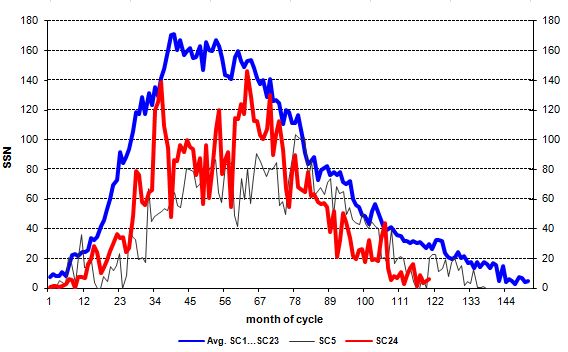
Fig.1 clearly shows that we had probably already arrived at the solar minimum at the beginning of 2018 (month 110 in the diagram). Will there be another “flare up” like in SC 5? The probability is rather low.
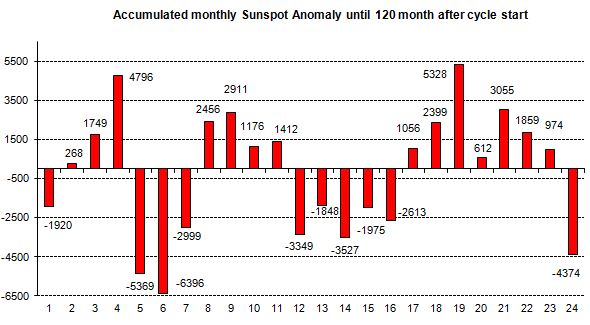
A comparison of all the observed solar cycles so far, 120 months into the cycle:
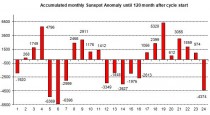
Fig. 2: The summary (between the observed SSN numbers and the respective mean value (blue in Fig.1) for all cycles up to the current cycle month 120 of SC 24.
The measurements of Cycle 24 are well recorded. It is very likely that we will stay in the minimum for another year with very little activity. This can also be seen in the solar polar fields, which stagnate at their maximum value. To illustrate this, we have graphically processed them as mean values from the solar northern and southern hemispheres. We always looked at the same time period, between the zero point (it is the respective spot maximum) and 2110 days afterwards, that is the last measuring point of the SC24 on November 27, 2018:
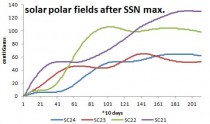
Fig. 3: The temporal development ( of the polar solar fields of the sun since 1980. The strength in the spot minimum, at the end of the respective graph when the fields become stationary and hardly change, is a good indicator for the activity of the subsequent cycle.
Figure 3 shows very clearly how hesitantly the increase in the current cycle occurred. The three predecessor cycles showed a much faster development after the zero crossing. Later, SC 24 then settled on a slightly higher value than SC 23. This could mean that SC 25 could become slightly stronger from 2020. But one should not expect too much accuracy from the method. It is clear that SC 25 will by far not become as strong as SC23 and 22, i.e. sub-normally active, see Fig. 2.
We’ll keep you up to date!
Also see new papers???” that support the solar changes and likely cooling.
David Wojick
Let the fight begin
In March the Heartland Institute fired a big broadside right into the teaching of climate change alarmism in America’s schools. They began sending Why Scientists Disagree About Global Warming directly to many of the Nation’s science teachers. Of course the alarmists went nuts, especially Sen. Sheldon “jail the skeptics” Whitehouse, who denounced Heartland’s bold move in a series of letters to various education groups.
My group is now taking the next skeptical step. We are crowd funding the Climate Change Debate Education (CCDE) project. While Heartland’s effort explains skepticism to teachers, our goal is to explain it to the students. You can make donations here.
Our project will establish a website portal that collects and distributes materials to teach about the climate debate. Once established and given sufficient funding we will also produce new teaching materials. The long term goal is to build a collection that systematically addresses all of the important climate science issues at the appropriate grade levels. Our target audience is not just teachers, but parents, friends of students and the students themselves.
There are presently a lot of alarmist websites offering one-sided classroom materials teaching the false dogma of dangerous human induced climate change. That this alarmism is highly debatable is nowhere to be seen on these websites. So we want to counter these alarmist websites with one that teaches about the real debate, between alarmism and realistic skepticism.
Both the Federal government and many advocacy groups maintain websites that distribute alarmist climate teaching materials. These materials teach that dangerous human induced climate change is settled science, which is far from true.
For example, the CLEAN website is funded jointly by NOAA, NSF and DOE. CLEAN stands for Climate Literacy and Energy Awareness Network. In fact “climate literacy” is code for the false belief that humans are causing dangerous climate change. CLEAN says it has over 600 free, ready to use resources suitable for use in secondary and higher education classrooms. They also boast that they are the core of the “Teaching Climate” part of the federal Climate.gov website. This is Government bias targeting children.
All of CLEAN’s teaching materials are biased and based on this false premise. The reality is that dangerous human influence on climate is completely unproven and the subject of intense scientific debate. That only the scary side is being presented as settled science is a severe lack of balance.
Creating balance in climate science education
The first step toward creating balance in climate education is to provide teaching materials that properly present the scientific debate as it actually is. We propose a phased approach to this effort. First an implementation phase then, if funding is available, a production phase. Here the goal is to recruit and guide volunteers who will produce highly targeted teaching materials. In particular, there is a need for simple, yet well designed, lesson plans that teach a specific scientific issue to a specific grade level.
These lesson plans need to be tailored to the state standards, which typically dictate what topics are taught in which grades. There are numerous specific scientific issues that need to be taught at different grade levels. Each potential lesson needs to be simple and compact, designed to fit into the mandated curriculum. Moreover, each lesson must stand alone, because teaching time is limited.
Getting around the gatekeepers
We will also develop short, handout types of materials as a way to get around what we call the gatekeepers. Gatekeepers are doctrinaire people who make it hard to get balance into the classroom. It may be the principal, the teacher’s supervisor or even the teacher.
Our handouts will be something that a parent or student can bring to class. It is normal for students to bring supplementary materials to class, especially when the topic is controversial. In the case of climate change, surveys have also shown that parents often become involved. As with the lesson plans, these handouts will be highly focused, nonpolitical, and tailored to a specific grade level. Since they will be online they can easily be emailed as well. Thus the gatekeepers cannot prevent their distribution.
Target audiences
There are three distinct target audiences - teachers, parents and students. Teachers need lesson plans, which are relatively specialized documents. Students need materials written at their grade level. Parents need non-technical information that they can explain to their children or use to confront a gatekeeper. Of course teachers and non-parents can use this information as well. The website will be organized in such a way that each group can find what they need.
It is important to keep in mind that many K-12 science teachers do not have science degrees, nor do most parents. K-12 is not the place to go into the technical details of climate science. Simplicity is the key.
Replacing Clean Power Plan with less harmful ACE rule does not fix fraudulent CO2 science
Paul Driessen
As the Punic Wars dragged on, Cato the Elder reportedly concluded every speech to the Roman Senate by proclaiming “Carthago delenda est” - “Carthage must be destroyed.”
Ample evidence suggests that the Obama era Environmental Protection Agency’s “Endangerment Finding” was devised in violation of basic scientific and transparency principles that ignored or excluded extensive evidence that contradicted its preordained outcome. The EF was then used to justify anti-fossil fuel rules that seriously harmed the energy security, jobs, health and welfare of millions of Americans.
The Finding must be reexamined. If these contentions are validated, it must be reversed and demolished.
In its 2007 Massachusetts v. EPA decision, the U.S. Supreme Court ruled that EPA must determine whether emissions of carbon dioxide and certain other atmospheric gases “cause or contribute” to “air pollution” that may be “reasonably anticipated to endanger public health or welfare.” If the agency found the answer was yes, then it had to regulate those emissions. The Bush EPA failed to take action.
However, candidate and President Obama had promised that he would eliminate coal-based electricity generation and “fundamentally transform” America. It was thus a foregone conclusion that his EPA would quickly find a dire threat existed. On December 7, 2009, EPA issued its Endangerment Finding (EF): that carbon dioxide (CO2) and five other “greenhouse gases” (GHGs) were pollutants that did indeed “threaten the public health and welfare of current and future generations” of Americans.
The Obama EPA then promulgated its “Clean Power Plan,” which shut down numerous coal mines and coal-fired power plants, eliminated thousands of jobs and severely impacted factories, families and communities across the United States. The CPP also spurred the shift to unreliable wind and solar power.
However, any CPP climate change, health and welfare benefits are at best undetectable, in part because the rest of the world - from China, India, Indonesia and Southeast Asia to Australia, Germany and Poland - continue to build thousands of coal-fired power plants and put millions of vehicles on the road.
Recognizing this, President Trump pulled the USA out of the Paris climate treaty. His EPA has proposed to replace the Obama Clean Power Plan with an “Affordable Clean Energy” (ACE) plan that lets states take the lead in devising GHG emission reduction programs that best serve their individual energy needs.
These are important steps. But they are not enough, because they perpetuate the false claim that plant-fertilizing carbon dioxide is a “dangerous pollutant.” Even worse, leaving the EF in place would enable any future anti-fossil fuel administration to impose new economy-strangling, welfare-degrading rules.
Worst of all, leaving the Finding unchallenged and ignoring the way it was concocted and implemented would sanctify some of the most fraudulent and dictatorial Deep State bureaucratic actions in history.
In devising its EF, the Obama EPA did no new research and made no effort to examine the full range of studies and evidence readily available on natural versus manmade climate change. It just cherry-picked Intergovernmental Panel on Climate Change (IPCC) reports; deliberately excluded studies that contradicted its predetermined finding; and relied on temperature and extreme weather predictions by computer models.
The IPCC itself had long ago ended any pretense of trying to understand the interplay of natural and human influences on Earth’s climate. Instead, for political reasons, it had decided to focus on human fossil fuel use and GHG emissions as the only important factors influencing modern climate change. Its reports reflect that approach - and ignore the growing and readily available body of contrary studies and evidence, such as volumes of studies summarized by the Nongovernmental International Panel on Climate Change.
The Obama EPA team even removed one of its most senior experts, who had prepared a contrarian report. “Your comments do not help the legal or policy case for this decision,” his supervisor told him. EPA consulted with alarmist scientists and environmentalist groups, but ignored moderates and IPCC critics.
The computerized climate models relied on by EPA are programmed to reflect the assumption that rising atmospheric CO2 levels are the primary factor determining climate and extreme weather. However, the average prediction by 102 models is now a full 1 degree F above what satellites are actually measuring.
In fact, even as atmospheric carbon dioxide levels climbed well above the supposed 350 ppm “tipping point” (they reached 405 ppm in 2017), except for noticeable short-term temperature spikes during El Nino ocean warming events, there has been virtually no planetary warming since 1998 or at least 2002.
Moreover, Harvey finally ended a record 12-year absence of Category 3-5 hurricanes making US landfall. Tornados are no more frequent than in the 1950s. Droughts differ little from historic trends and cycles. Seas are rising at just seven inches per century, and Antarctic and Arctic ice are largely within “normal” or “cyclical” levels for the past several centuries. Indeed, reports of vanishing Arctic ice go back nearly a century and low ice levels were documented by Francis McClintock and other explorers long before that.
In many cases, older temperature records were adjusted downward, modern records got bumped upward a bit, and government-paid scientists relied on measurements recorded near (and contaminated by) airport jet exhausts, blacktop parking lots, and urban areas warmed by cars, heating and AC vents.
Humans might well be “contributing” to temperature, climate and weather events, at least locally. But there is no real-world evidence that “greenhouse gases” have replaced natural forces or are causing unprecedented climate chaos or extreme weather; no evidence that those emissions are “endangering public health and welfare” or that humans can control Earth’s perpetually fickle climate by controlling emissions.
Far from being a “pollutant,” carbon dioxide is the miracle molecule without which most life on Earth would cease to exist. The more CO2 in the air, the faster and better crop, forest and grassland plants grow, and the more they are able to withstand droughts, diseases, and damage from insects and viruses.
In fact, a slightly warmer planet with more atmospheric CO2 would be tremendously beneficial for plants, wildlife and humanity. A colder planet with less carbon dioxide would greatly reduce arable land extent, growing seasons, wildlife habitats, crop production and our ability to feed humanity.
Equally important, over 80% of US energy still comes from fossil fuels - and the countless benefits of those abundant, reliable, affordable fuels (and their CO2 output) exceed the EPA’s alleged “social costs of carbon” and “human health and welfare impacts” by at least 50 to 1, and perhaps as much as 500 to 1.
On a closely related matter, contrary to the “97% consensus” myth, scientific debate continues unabated over recent and future global warming, cooling, storms, droughts, sea levels and other “adverse effects” from oil, natural gas and coal use. Computer models and alarmist climate specialists say the threats are serious. Real-world observations and moderate to skeptical climate experts vigorously disagree.
The Obama EPA’s Endangerment Finding ignored all of this. It likewise dismissed the extravagant raw material requirements of expensive wind, solar and biofuel “alternatives” and their adverse impacts on wildlife and wildlife habitats. That makes the 2009 process even more suspect and fraudulent.
There is no demonstrable, much less dire or unprecedented, danger to American health and welfare from continued CO2 emissions. The danger is from anti-fossil fuel policies justified by the EF and IPCC.
Simply put, in concocting its Endangerment Finding, the Obama EPA violated the cost-benefit analysis policies and basic standards for honest, open, informed, replicable science. With so much of America’s energy, economy, environment, health and welfare at stake, this cannot be allowed to continue.
The Trump Administration must disavow the “CO2 drives climate change” tautology and stop viewing the Endangerment Finding as “established” law and policy. It is no more established or acceptable than were the Supreme Court’s reprehensible 1857 Dred Scott and 1896 Plessy v. Ferguson decisions.
It is time to reexamine the Endangerment Finding, give it the intense Red Team scrutiny it deserves, and relegate it to the dustbin of history. The Endangerment Finding delenda est.
Paul Driessen is senior policy analyst for the Committee For A Constructive Tomorrow and author of books and articles on energy, climate change, economic development and human rights.
Falmouth Massachusetts Is Ground Zero For Poorly Placed Wind Turbines In USA. Politicians Put The Cart Before The Horse Ignored The Public
Falmouth Massachusetts USA July 10, 2018
Massachusetts and Rhode Island have the fourth and fifth highest electric rates in the United States and it’s only to get more expensive.
The average homeowner in either state can walk out their front door and see the electric wires and transformers are the same ones placed in the 1940s and 1950s. During the Winter months, thousands of residents lose power for weeks and during the summer power usage is causing ongoing power outages. The electric company is maintaining an aged system.
During the Summer, the additional household load can create a major strain on transmission lines. The local electric company suppliers say their equipment is reliable and resilient but tell that to the residents sitting in the dark with no air conditioning or power in the winter.
Soon we will all be asked to cut back on our electrical usage as we are every Summer. With the heat and humidity on the way, more and more communities have experienced Summer power outages. So how reliable and resilient is the current system?
Massachusetts and Rhode Island have a long twenty-year history of promoting renewable energy. Technologies include megawatt land and ocean-based wind turbines and massive megawatt solar fields The legislatures have passed legislation to force electric companies into business with private renewable energy companies. The only problem has been politicians put the cart before the horse. The electric grid or what is called the infrastructure is old and antiquated leaving customers to pray the wind doesn’t go over 50 miles per hour or the temperature doesn’t rise above 90 degrees.
Today homeowners are surrounded by loud land based commercial megawatt wind turbines, solar panels and massive battery backup systems and now plans for massive ocean wind turbine farms but the power outages to the residential homes are getting worse as the electric infrastructure ages in the neighborhoods.
Let’s look at Falmouth, Massachusetts where residents on Cape Cod pay some of the highest electric rates in the country. The town purchased at a cost of millions two commercial megawatt wind turbines in which the local zoning board and Massachusetts Superior Court determined they are a nuisance and shut them down. Select Board Chairwoman Susan Moran said the legal expenses are $800,000.00 after an eight-year legal battle between the town and residents. The electric grid is still old and the bills are expensive. You wonder how many Falmouth residents remember how long and how many times their power went out last winter?
Next, last week on Block Island, the Town of New Shoreham, Rhode Island had power outages to local residents and businesses. The antiquated electric grid on the Island can’t handle the influx of Summer residents. Block Island, Rhode Island has 5 ocean commercial wind turbines equal to 30 megawatts, back up diesel generators and in 2017 took a major step forward as National Grid placed a 20-mile ocean electric cable between the mainland ( Narragansett) and Block Island. How much longer before the residents and businesses on the Island figure out their politicians have put the cart before the horse? The power still goes out! During the ocean wind turbine installations their town diesel generators caught fire.
The Block Island off-shore wind turbines constitute an epi-phenomenon on an already decrepit power grid that has difficulty serving the increased needs of many second home summer residents that swell the island’s population. (You can look into how many that is, but when they suddenly turn on their air conditioning systems, as well as try to use supplied electricity to do all the things that a modern society does, the power will fail.)
Adding wind turbines into the “energy mix” didn’t help prevent the power outages. They guaranteed that they would happen.
Finally, Puerto Rico is a Caribbean island and unincorporated U.S. territory. In 2016 the Island had almost 200 megawatts of wind turbine power and 125 megawatts of Solar power. Hurricane Maria in one storm took out hundreds of millions of dollars of renewable energy.
Prior to Hurricane Maria Puerto Rico’s power authority was $9 billion in debt. Puerto Rico prior to the storm in 2016 was suffering power outages at rates four to five times higher than average U.S. customers. The power grid was ignored as millions were spent on renewable energy projects wasted by one storm. A year after the hurricane there are still power outages!
It’s time for our politicians to stop spending our tax dollars on renewable energy projects and start upgrading the electric infrastructure to residential homes before we’re all siting in the dark.
It’s time for the media to stop reporting by omission and report the entire story that includes Jill and Joe electric ratepayers whose electric bills are a second mortgage on our homes.
As the Wall Street Journal’s Holman Jenkins noted in November 2015:
By the count of researcher Marcia Wyatt in a widely circulated presentation, the U.S. government’s published temperature data for the years 1880 to 2010 has been tinkered with 16 times in the past three years.
Paul Driessen
Climate alarmism dominated the Obama era and run-up to Paris. But it’s at least as bizarre, dogmatic and intolerant now that: President Trump pulled the United States out of the all pain/no gain Paris climate pact; the US EPA is reversing anti-fossil fuel programs rooted in doom-and-gloom climatology; America is producing and exporting more oil, gas and coal; developing nations are burning vastly more of these fuels; Poland is openly challenging EU climate diktats; and German, British Australian and other politicians are voicing increasing concerns about job-killing, eco-unfriendly “green” energy.
With trillions of dollars in research money, power, prestige, renewable energy subsidies, wealth redistribution schemes, and dreams of international governance on the line, the $1.5-trillion-per-year Climate Industrial Complex is not taking the situation lightly. Climate fear-mongering is in full swing. Tried-and-true scare stories still dominate the daily news, often with new wrinkles tied to current events.
The Winter Olympics were going to take “a huge hit from our warming planet,” the pressure group Protect Our Winters warned us (yes, it’s an actual organization). Of course, that was before fiendishly frigid conditions repeatedly postponed events and drove spectators from PyeongChang slopes.
But of course, bitter cold is “exactly what we should expect’ from the global warming “crisis,” said Climategeddon expert Al Gore, who got a C and D in the only two science courses he took in college. It’s reminiscent of dire predictions that the Arctic would be ice-free by 2010 (or 2015 or 2025), and “children just aren’t going to know what snow is” (until record cold and snow battered the UK a couple years later).
We’re likewise propagandized constantly with deliberate falsehoods about “carbon pollution.” We burn carbon, in the form of hydrocarbons and coal. In the process, we emit carbon dioxide which is not a pollutant. It is the miracle plant food that makes life on Earth possible.
Other standard scares ignore the innumerable, monumental benefits of carbon-based fuels - and blame these fuels and CO2 emissions for planetary warming (and cooling), rising seas, forest fires, and every major problem from malaria to rainstorms, droughts, hurricanes and tornadoes.
A newly discovered danger, say a couple researchers, endangers green sea turtles. Planetary warming is causing up to 99% of turtle eggs to hatch as females. It won’t be long, perhaps just decades, until “there will not be enough males: to propagate the species. Some “30 years of knowledge” support this thesis. That would take us all the way back to 1988, a decade before the 18-year global warming “hiatus” that was interrupted by the 2015-16 El Nino; a half-century since the Dust Bowl and record high planetary temperatures of the 1930s; 40 years after scientists were convinced Earth was about to enter a new little ice age; and some 750 years after the 300-year-long Medieval Warm Period. One has to wonder how sea turtles managed to survive such previous warm spells - and cold periods like the four-century-long Little Ice Age, since cold weather apparently churns out only male sea turtles.
Not to be outdone, Hillary Clinton asserted that women “will bear the brunt of looking for food, looking for firewood, looking for the place to migrate to when all the grass is finally gone, as the desertification moves south” because of climate change. Wrong. Entire families will continue to bear these burdens because of anti-energy policies imposed in the name of sustainability and climate change prevention.
(For more fearsome forecasts, see The Warmlist, a no longer complete, but still entertaining compendium of some 800 horrors supposedly caused by “dangerous manmade global warming and climate change.") The constant consternation strikes many as ridiculous. But others have become true believers - and have committed to not having children, not taking showers, de-carbonizing, de-industrializing and de-growing developed countries, shutting off oil pipelines, and other futile actions that bring no earthly benefits.
Our planet has certainly been warming. Thank goodness for that, because the extra warmth lifted habitats and humanity out of the Little Ice Age and its chilly, stormy weather, greatly reduced arable land, short growing seasons and CO2-starved crops. Powerful, uncontrollable natural forces drove that temperature rise. Earth may now face dangerous Mann-made global warming and climate cataclysms concocted by computer models - but no “unprecedented” or “existential” human-caused dangers in the real world.
Question or challenge climate crisis orthodoxy, however, and you will be vilified and face RICO prosecutions, bogus slander and SLAPP lawsuits, censure or expulsion from your university, attacks for sponsoring museum exhibits, or even “four hots and a cot” in a jail or a faraway gulag.
Thankfully, there are excellent antidotes: books by climatologists Roy Spencer, Patrick Michaels, Jennifer Marohasy, Tim Ball, political observer Marc Steyn and others; and websites like ClimateDepot.com, WattsUpWithThat.com, DrRoySpencer.com and Global Warming Policy Foundation.org, for example.
For a concise, yet comprehensive, and eminently readable lay guide to real climate science, geologist Gregory Wrightstone’s Inconvenient Facts: The science that Al Gore doesn’t want you to know may meet your needs. Its 123 pages are organized into two sections and 30 easily understood chapters, written in plain English and complimented by over 100 colorful charts, graphs, tables and illustrations, covering all the common climate issues, fears and myths. The book is capped off by a handy list of 60 inconvenient facts that eviscerate alarmist dogma, and15
pages of references. As Lord Christopher Monckton’s says in his foreword, Wrightstone has succeeded “splendidly” in reliably distinguishing myths from realities in the climate debate.
The opening section devotes 54 pages to explaining greenhouse and climate basics, showing how carbon dioxide is huge in planetary life but minuscule on the climate front, skewering the myth of a 400 ppm CO2 “tipping point,” analyzing climate models versus real world measurements of global temperature, and showing why and how water vapor plays such a vital and dominant role in weather and climate.
Carbon dioxide, he notes, is essential plant food that makes forests, grasslands and crops grow faster and better, with less water, and thus able to feed more people from less land. Figure I-15 summarizes data from 3,586 experiments on 549 plant species and depicts how crop yields would increase and generate trillions of dollars in overall monetary benefits, if CO2 levels rose by 300 ppm. His analysis of the “hockey stick,” computer models and temperature predictions is equally illuminating. Part II of Wrightstone’s book examines the many assertions and myths of a coming climate apocalypse, and demonstrates why they fail to meet basic standards of scientific evidence and integrity. The opening chapter demolishes the phony 97% “consensus” of scientists who supposedly agree that humans are now the primary cause of extreme weather and climate change, ushering in a catastrophic future. Subsequent chapters address famines, forest fires, tornadoes, hurricanes, melting ice packs, rising seas, polar bear populations, and other staples of climate alarmism.
“Ocean acidification,” he points out, is a term deliberately chosen to alarm people about an imaginary problem. Being honest, and saying seas might become very slightly less alkaline (have slightly lower pH levels) from more atmospheric and oceanic CO2 in the coming centuries, wouldn’t suffice. Worse, an oft cited study ignored a full century of readily available data, and instead used computer models to fill in the contrived “gaps” on pH levels. As Wrightstone suggests, many people would call it Climate pHraud.
The bottom line? Scientists still do not understand the complexities of climate and weather. They still cannot separate human influences from the effects of powerful natural forces that have brought often profound climate changes throughout history. There is no evidence of a coming climate cataclysm. Spending trillions of dollars - and condemning billions of people to expensive, insufficient, unreliable, land and raw material gobbling wind, solar and biofuel energy - is not just unnecessary. It is immoral.
Paul Driessen is senior policy analyst for the Committee For A Constructive Tomorrow (www.CFACT.org) and author of books and articles on energy and environmental policy.
By Valerie Richardson, The Washington Times - Tuesday, December 19, 2017
Climate change has been blamed for causing higher temperatures, drought, wildfires and hurricanes - and now it’s being credited with generating record snow.
A study released Tuesday in the journal Scientific Reports found that snowfall on the highest peak in the Alaska Range has more than doubled since the start of the Industrial Revolution in the mid-19th century, which researchers attribute to climate change.
How? The study linked the heavy snow accumulation to “warmer waters thousands of miles away in the tropical Pacific and Indian oceans,” driven by rising greenhouse gas emissions, according to the Dartmouth College press release.
“We were shocked when we first saw how much snowfall has increased,” said Erich Osterberg, an assistant professor of earth sciences who led the investigation with researchers from Dartmouth, the University of Maine and the University of New Hampshire.
“We had to check and double-check our results to make sure of the findings,” Mr. Osterberg said. “Dramatic increases in temperature and air pollution in modern times have been well established in science, but now we’re also seeing dramatic increases in regional precipitation with climate change.”
The paper, which analyzed “two ice cores collected at 13,000 feet from Mount Hunter in Denali National Park” demonstrated that the modern snowfall is “unprecedented for at least the past 1,200 years and far exceeds normal variability.”
Lead author Dominic Winski, a Dartmouth research assistant, said it was “now glaringly clear from our ice core record that modern snowfall rates in Alaska are much higher than natural rates before the Industrial Revolution.”
“This increase in precipitation is also apparent in weather station data from the past 50 years, but ice cores show the scale of the change well above natural conditions,” Mr. Winski said.
Less convinced were climate skeptics, who have long taken issue with the climate change movement for chalking up any number of weather patterns and natural disasters to global warming.
Meteorologist Ryan Maue, chief operations officer at Weather.us, made the point that Alaska presumably would have experienced significant natural variability during that time frame and beyond.
“Is the null hypothesis that climate remained static in Alaska since year 1600?” he said on Twitter. “The Pacific Ocean surely has variability on decadal/centennial/millennial time scales that would affect mountain snow.”
The “global warming causes heavy snow” thesis isn’t new. During a 2011 cold snap, former Vice President Al Gore said that “scientists have been warning for at least two decades that global warming could make snowstorms more severe” by sending more moisture into the air.
Others have claimed the opposite. In 2000, University of East Anglia senior research scientist David Viner concluded that winter snowfalls would become “a very rare and exciting event,” thanks to global warming.
Quipped Climate Depot’s Marc Morano, “Why not? Less snow used to ‘prove’ global warming. Snow used to be ‘a thing of the past’ according to climate activists. Now more snow ‘proves’ global warming. No matter the weather, they can claim it is consistent with global warming theory.”
“Man-made global warming has become unfalsifiable,” said Mr. Morano, author of “The Politically Incorrect Guide to Climate Change,” slated for release Feb. 26 by Regnery.
The latest study, “Industrial-Age Doubling of Snow Accumulation in the Alaska Range Linked to Tropical Ocean Warming,” found that winter snowfall has risen by 117 percent in south-central Alaska and that summer snows increased by 49 percent in less than 200 years.
The paper cited scientific models predicting increases in global precipitation per degree of warming of as much as 2 percent but concluded that such an explanation still didn’t explain the heavy Denali snow.
“The research suggests that warming tropical oceans have caused a strengthening of the Aleutian Low pressure system with its northward flow of warm, moist air, driving most of the snowfall increases,” said the release. “Previous research has linked the warming tropical ocean temperatures to higher greenhouse gas concentrations.”
Mr. Osterberg said scientists continue to discover that “climate change is full of surprises.”
“We need to understand these changes better to help communities prepare for what will come with even more carbon dioxide pollution in the air,” he said.
CO2 is not pollution!!!